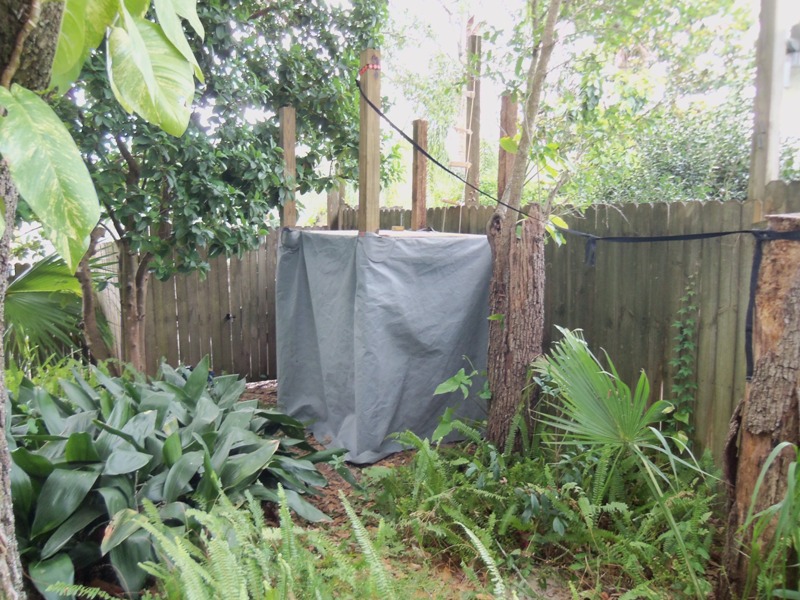
Congratulations to my brother and sister-in-law, who not only managed to get a 25-hour anniversary, but have much of the state honoring them with romantic candlelight.

'Tis better to light a single candle than to curse the darkness.  A kerosene heater helps, too.

Posted by sursumcorda on Sunday, November 6, 2011 at 3:05 pm | Edit
Permalink | Read 2574 times | Comments (1)
Category Everyday Life: [first] [previous] [next] [newest]

I'd heard of FlyLady before, with her system for helping those of us who were born creative—i.e. distractible and disorganized.  But I was quickly turned off by her system.  Perhaps it was her annoying perkiness, which slaps you in the face, even in the design and colors of her website.  More likely she lost me at Beginner Baby Step #2, which requires us to put on shoes before we even begin the day.  I don't wear shoes any more than is absolutely necessary, and we have a shoes-off-at-the-door policy in our house. (Not for guests, so don't let that stop you from visiting.)  On the other hand, perhaps the requirement to wear shoes until the work is done would do wonders for my productivity, who knows?  Anyway, I filed FlyLady under "Somewhat Interesting, Maybe, Someday" and there she has remained.

But Janet has been wiser and stayed with the program long enough to find some great wheat in the chaff.  For example, the famous "Swish & Swipe" (which I mis-typed as "Swiss & Swipe" the first time) for the bathrooms.  Janet taught it to me when she was here.  I adapted it to my own use, and I LOVE IT.


Here's how I do Swish & Swipe each morning.  It's supposed to take two minutes; I'm not quite that fast, but it's not much more. (More)

Posted by sursumcorda on Sunday, November 6, 2011 at 6:08 am | Edit
Permalink | Read 3937 times | Comments (5)
Category Everyday Life: [first] [previous] [next] [newest]


alt

— 1

One thing I learned from our stay at a Waldorf Astoria:  There's a limit to how much luxury I can appreciate.  I've become leery of cheap motels (especially along the notorious I-95 corridor) with their reputation as the lodging of choice for bedbugs and manufacturers of crack cocaine, but to stay at a Hampton Inn (Hilton's low-rent district) or Fairfield Inn (Marriot's) is all the luxury I want.  For me, the higher-end hotels add little.  In fact, they take away:  The big guys charge (a lot) for amenities that matter to me, whereas the price of a room at their poorer relations includes unlimited tea, cocoa, and coffee (and sometimes cookies!) in the lobby, a breakfast buffet, and in-room Internet.  It seems the more you pay for your room, the more they expect you to pay in miscellaneous charges. Mind you, the higher-end hotels are nice, just not worth the extra cost.

2

One notable difference between the Waldorf and a Hampton Inn that did matter to me:  Instead of a USA Today at the door in the morning, we received the Sunday New York Times.  Now there's a newspaper that still carries content!  About a month's worth of reading, I'd say.  Part of that content is the Sunday Times crossword puzzle, which has always intimidated me as the epitome of difficulty.  But no more.  It was no harder than the three-star (highest difficulty) puzzles in my World of Puzzles magazine.  And, alas, no more free of pop culture clues.  Reference an obscure vocabulary word or something in Shakespeare I don't know, and I'll happily look it up and thank you for the lesson—but spare me current movie and popular song trivia, please.

— 3 —

Gee, thanks, bank.  Here's the good news from one of our credit card companies:

We are always looking for new ways to meet your borrowing needs on your terms.  Effective January 15, 2012, you may receive new promotional offers that include an increased Minimum Payment Due, which can help you pay the promotional balance down faster.

Silly me, I thought you could always pay your balance down faster by remitting more than the minimum payment due.

George Orwell would be proud.

4

Babies are born geniuses, as Buckminster Fuller and observant parents could tell you.  Scientists are finally catching up.  Here's Looking at You, Kid is a not-to-be-missed article on the research of Richard Aslin, professor of Brain and Cognitive Sciences at the University of Rochester.  Advanced technology has enabled his team to back mothers' intuition with reproducible data.

[B]abies just months old have mental capacities formerly believed to be the domain of children much older.  “We knew babies could learn—I mean, obviously they can learn. Your grandmother knows that,” Aslin says. “It’s the rapidity, the ease, with which they learn things that I think has just been startling.”

The key is measuring and interpreting babies' eye-gaze patterns.  For example, the idea of object permanence—that something continues to exist even when it is hidden—had been thought to develop by nine or ten months, because that's when a child will reach out and reveal a covered object.  It turns out that children as young as two months, who don't have the physical ability to remove a cover, already understand the concept.

A baby's language-learning capacity is particularly dramatic (emphasis mine):

[A recent study] conducted on infants, showing them multiple objects and giving them the name of the object in a sentence, demonstrated that they could pick out the object and learn its name by six months of age rather than the expected 17 months. While other such studies conducted elsewhere have given babies the words in isolation rather than in the context of sentences, ... the complexity of conditions in [this] experiment may account for the babies’ performance—the more complicated task of picking the word out of the sentence may actually have been easier for them because that’s the way they hear language every day.

[In another study, researchers] brought babies to the lab, where the children encountered a simple nonsense language the researchers had created to ensure they wouldn’t bring any prior knowledge to bear on the experiment.  “We wanted to find out what they could learn in the lab, not what they’d already learned in the environment,” Aslin says. The children listened to the language, “and then we tested them to see whether or not they’d learned the underlying structure of this little language.” They had.

“They learned the language in just a couple of minutes—and just by listening. Nobody was telling them what to listen to. They were only eight months old.”

When you consider that only 50 - 60 years ago scientists were asserting that newborns are blind and deaf, it's a good thing that mothers have been in charge of their babies all along.

5

The Stradivarius of Windchimes.  A scene from our recent trip to the gift shop at Bok Tower Gardens:

"Come listen to these beautiful windchimes!  Aren't they wonderful?  Just don't look at the price; leave it to me to desire the most expensive chimes on display."

"But you hate windchimes."

"Are you crazy?  I love windchimes!  I have since childhood."

"But I disinctly remember you saying how much you dislike them."

"Hrumph.  Must have been one of your other girlfriends."

After this exchange with my husband, we determined that perhaps he was remembering a conversation with his sister, or our friend who is also named Linda, or our neighbor.  I sure hope it wasn't our neighbor, because someday there will be windchimes gracing our back porch.  I gravitate to any windchime display I see, listening and pondering, though I haven't yet gone so far as to make a decision.  Maybe now that we have that little misunderstanding cleared up....

The chimes that so captured my heart are made by Music of the Spheres in Austin, Texas.  Choose "Chime Tunings" from their main menu, and you can hear recordings of their chimes in various tunings (Pentatonic, Quartal, Chinese, Mongolian. Westminster, Hawaiian, Japanese, Balinese, Whole Tone, Aquarian, Gypsy) and sizes (Soprano, Mezzo-Soprano, Alto, Tenor, Bass, and more).  Here's a link to the Japanese mezzo-soprano.  And the Gypsy soprano.  I can't stop myself:  The Whole-Tone tenor.

The price?  There's more than one reason they're called the Stradivarius of Windchimes:  from $90 for a Soprano (any tuning) to $2950 (plus shipping) for the 200-pound Basso Profundo.

— 6 —

Educators, please don't miss this post on innovation from the Occasional CEO.

Children in America used to want to become cowboys and Indians, doctors and firemen, astronauts and acrobats.  Now they want to become entrepreneurs and innovators.  They are told they must change the world, often before they enter it.

But 90% of the population should not become innovators.

It’s not because they can’t do it well, though that’s possible too.  It’s just that innovation can cause great damage to the things we love.  To the guy making the fries at McDonalds or the pumpkin spice latte at Starbucks: Don’t innovate.  To the person building the next lot of iPhones from which I’ll be purchasing one: Please don’t innovate.  To my tax accountant: Do Not innovate.  The mechanic fixing my car.  The pilot flying my plane.  To the fine people at Apple: For goodness sake, stop sending me updates and new operating systems.  I hate em.  Just when I get everything the way I like, you innovate me into something that costs me two hours at the Apple Bar.  Where, incidentally,  I want zero innovation from your hip kids in blue shirts.  Just follow the FAQs and fix my iPad.

When we complain that schools are not teaching our kids to innovate, I say: Bravo!  People who can innovate will always find ways to innovate, while most of the rest of us need a serious tutorial in how to follow directions.  Show up on time. Do our jobs. That’s not something that comes naturally for many human beings.

There’s nothing less intelligent or inferior about people who practice consistency.  Consistency takes extraordinary talent, just like innovation. ... We have made innovation glamorous and consistency somehow mundane and less worthwhile. That’s our fault, not the fault of talented people whose consistency, attention to order, willingness to show up all the time and insistence on a little good ol' tradition improves our lives.

Here endeth the lesson; the following is my editorial comment:

Children do not need to be taught to be innovators and inventors.  They need to be taught the facts and skills that will become the tools with which they can innovate, practice consistency, or both.  Then they need freedom and time and opportunities to learn to use those tools effectively.

— 7 —

Those of you who enjoyed the TED talk by Temple Grandin, or the movie about her life, or any of her books, will probably like this TED lecture on the importance of perception, by Daniel Tammet, a high-functioning, synaesthetic, autistic savant who is also an artist and a writer.

Our personal perceptions ... are at the heart of how we acquire knowledge.  Aesthetic judgements, rather than abstract reasoning, guide and shape the process by which we all come to know what we know.


For more Quick Takes, visit Conversion Diary!

Posted by sursumcorda on Friday, November 4, 2011 at 6:14 am | Edit
Permalink | Read 2606 times | Comments (7)
Category Random Musings: [first] [previous] [next] [newest]

We went to Naples a couple of weekends ago.

No, not that Naples, although there are some superficial similarities, such as a location on the southwest coast of similarly-shaped peninsulas, a warm climate, and inhabitants who speak both English and a Romance language.

alt

We were nearing the expiration of the hotel voucher we'd earned by listening to a timeshare presentation in Hawaii, and chose to use it at the Naples Grande Beach Resort, a Waldorf Astoria hotel in Naples, Florida.  You see, it was a $200 voucher, but good only for the hotel room, and only for one night.  Hence the pricy hotel.

It’s a four-hour trip—about like driving from Florence if you’re thinking of the other peninsula—and we made it longer by stopping in Lake Wales for several hours.  That’s where the lovely Bok Tower Gardens are.  (As usual, click on a picture for a larger image.)

alt    alt

One of my favorite places in the Gardens is the Window on the Pond, where we can observe the wildlife from inside a duck blind style shelter. Corn kernels are scattered on some large tree stumps to encourage the birds to come close. But as with any bird feeder....


The next day we headed for nearby Marco Island, where we enjoyed a walk at Tigertail Beach Park.  Much of the flora was identified, but not this gorgeous purple grass:

alt

These Aqua-Cycles, suitable for sand and water exploration, were available for rent.  We did not try them out, but immediately thought, “Wouldn’t that be fun at the Maggie P!”

alt

But lest any nephews or grandchildren (or uncles) get too excited, when we later investigated we learned that it would take over $3000 to make that dream come true!  Not this Christmas, folks.

After an ice cream treat at the beach café, we turned our GPS toward home and drew the curtain on a much-needed weekend of R&R. 

Posted by sursumcorda on Tuesday, November 1, 2011 at 9:30 pm | Edit
Permalink | Read 5189 times | Comments (0)
Category Travels: [first] [previous] [next] [newest]

Bah, humbug.  We live in very safe, sidewalked neighborhood of over 900 homes, and to our door tonight came one, count 'em, ONE boy who might have been in middle school, a handful of high school students, and two ADULTS begging for candy!  One had a pacifier-sucking toddler in a stroller, presumably as her excuse for trick-or-treating, though in this case I have to hope she was planning to eat the candy herself.  Nothing interesting in the way of costumes.

Maybe next year we'll save on candy and just keep the lights off.  We have more leftover candy than our grandkids could (read, "would be allowed to") eat in a year.  It's not your grandmother's Hallowe'en anymore.

On a cheerier note, in a neighborhood nearby the child-like inhabitants had a glorious time celebrating the day, which is the real reason for this post.  Enjoy!  (H/T a WWMB friend.)

Posted by sursumcorda on Monday, October 31, 2011 at 9:25 pm | Edit
Permalink | Read 2588 times | Comments (3)
Category Just for Fun: [first] [previous] [next] [newest]

What was Hallowe’en like when you were a little girl, Grandma?  alt

No one has as yet asked me that question, but if things run true to form for most Americans, someone will, someday, after I am past being able to respond.  So I will answer it now.

My Hallowe’en formative years were in the 1950s and early 60s, in a small village in upstate New York.  Contrary to what we’d like to believe, it was not an idyllic and crime-free time.  One of my first (and worst) Hallowe’en memories was of the teenaged thugs who thundered onto our porch, grabbed our carefully-carved jack-o-lanterns, and smashed them to bits.  I lived a sheltered life:  this was my first view of senseless, wanton destruction; my first encounter with people who get pleasure from breaking the hearts of little children.  Our tiny village did not escape teen gangs and vandalism, which seemed to be more widespread, if much less dangerous, in those days.   At least they attacked property, not people.

That was the only scary thing about our Hallowe’ens.

The most important difference between Hallowe’en then and now is that the occasion was first, last, and always for children.   A few adults dressed in costume for the neighborhood parade and party, but the purpose of the event was to entertain the children.  The only excuse for anyone over 12 going out trick-or-treating was to escort the younger ones—every once in a while a compassionate homeowner would give us a piece of candy, too.  Now, when high schoolers come to my door, I give them candy if they’ve made any attempt at a costume, but I pity them, that at their age they are begging door-to-door for candy instead of helping younger children to have a good time.

On the other hand, teenaged trick-or-treaters is a clear improvement over teenaged vandals.

The Hallowe’en season began several weeks in advance of October 31.  No, not because Hallowe’en stores began popping up all over town, and shelves everywhere sprouted candy in yellow and orange.  Because of the costumes.  Store-bought costumes were largely unavailable, and anyway, who would have wanted one?  Hallowe’en was an occasion for great creativity.  Merely deciding what to be could take a month.  (Decisiveness, I’ll admit, was never my strong suit).  Those who come to our door today are mostly beings—a cat, a princess, a Star Wars character—but we favored things:  one might be a rocket ship, a pencil, or the whole Mad Hatter’s Tea Party (no relation to the present-day Tea Party, as mad—in either sense—as they may be).  The challenge was to create a costume from whatever we could scrounge around the house without actually having to spend money.  No problem—we had not yet forgotten what any five-year-old knows:  the cardboard box is the most universally useful of all materials. (More)

Posted by sursumcorda on Sunday, October 30, 2011 at 6:16 am | Edit
Permalink | Read 3313 times | Comments (12)
Category Genealogy: [first] [previous] [next] [newest] Children & Family Issues: [first] [previous] [next] [newest] Random Musings: [first] [previous] [next] [newest] Everyday Life: [first] [previous] [next] [newest]


I love this Feudal Effort strip!  (Click on the image for a larger version.)  It describes exactly the attitude I have when watching quasi-historical movies.  Not to mention movies based on books.   ("Would it have hurt them to actually read the book?")

alt

I do cut Shakespeare some slack, however.  He didn't have the same access to sources as we do, and anyway, he certainly didn't have time to spare.  It just might have killed him to do basic fact-checking.

Speaking of historical interest, Duncan I was my 28th great-grandfather.  :)

Posted by sursumcorda on Saturday, October 29, 2011 at 8:07 am | Edit
Permalink | Read 2677 times | Comments (0)
Category Just for Fun: [first] [previous] [next] [newest]

So.  I just spent all afternoon creating a Hallowe'en post.  A perfectly adequate Hallowe'en post.

On the way to the grocery store, I realized that it needs to be completely re-written.  And I'm going to do it.

If Thomas Mann was correct in saying that a writer is a person for whom writing is more difficult than it is for other people, maybe I really am on my way to becoming one.

Posted by sursumcorda on Friday, October 28, 2011 at 5:47 pm | Edit
Permalink | Read 2461 times | Comments (0)
Category Everyday Life: [first] [previous] [next] [newest]


alt

— 1

alt 

Porter planted a wildflower garden in our front yard.  The excuse was to cover a patch where the grass, and even the green weeds, had long since stopped growing.  We think it is a definite improvement over boring grass! (Click on the image to enlarge it.)

2

alt

Now that my daughter's birthday has come and gone, I can reveal the exciting news:  Speculoos à Tartiner, a.k.a. Biscoff Spread, is now available at Publix!!! And at a couple of other local stores as well.  This pleasant development came only just in time:  Our supply, generously imported for my birthday—from France via Switzerland—was running dangerously low.  Oddly enough, it's in the peanut butter section; perhaps not so oddly, as that's where they keep the Nutella, too.

If you've never experienced a Biscoff cookie, you're missing one of life's higher pleasures.  (For a long time I thought they were limited to flights on Delta Airlines, but the grocery store now sells the cookies, too.)  Speculoos à Tartiner is even better.  Making a spread out of cookies was a brilliant idea.  Think of the possibilities:  Oreo, chocolate chip, Girl Scout Thin Mint....

— 3 —

alt   alt

Seeds are amazing. When we feed our worms, it's generally with food that has been chopped rather vigorously, as that makes it more digestible for them, and hence they convert garbage to fertilizer at a faster rate.  Nonetheless, after one butternut squash meal last year, I noticed a large number of sprouts that grew vigorously in the worm bin, despite maceration and a total lack of sunlight.  Such persistence deserves some reward, so I rescued a few of the seedlings and planted them in our garden.

The plants appeared to thrive, putting forth healthy leaves and a multitude of blossoms.  However, perhaps due to it being the wrong season for growing most vegetables in Florida (too hot), or our persistent nematode problem, or a lack of water when we were on vacation—for whatever reason, the fruit that set would grow for a little while, then drop off.  The three squash you see here were the entire crop.  Even the largest is much smaller than those you see in the grocery store.

When cut open, the smallest was revealed to be too dry for use, but I cleaned and cooked the other two.  What a surprise!  The largest was very good, and the middle-sized (which was actually quite small) was the most wonderful butternut squash either of us had ever tasted.

My view of zucchini completely changed once I realized it was better to pick them small than large, and now the grocery stores have also realized that bigger isn't better.  But I can't buy butternut squash this size to determine if that's what made our squash taste so good.  Perhaps we'll have to try growing our own again, in a different season.

4

Picking squash before it is fully grown may be a good idea, but the same is not true of plucking human babies prematurely from the womb.  The steady rise in mothers and doctors who believe otherwise has prompted the March of Dimes to campaign against elective Caesarians and labor inductions before the 39th week of gestation.

Studies have shown that as many as 36 percent of elective deliveries now occur before 39 weeks, and many of these early deliveries are contributing to an unacceptable number of premature births and avoidable, costly complications. ... This is not to suggest that women should panic if labor begins earlier on its own. “It’s a whole different story when a woman goes into labor early than when labor is induced" ... [T]he textbook definition of “term pregnancy” as one that lasts from 37 to 41 weeks “is arbitrary—it has no biological basis. If a woman’s water hasn’t broken, if labor hasn’t begun on its own, if there are no medical or obstetrical problems, there’s no reason for a woman to be delivered before 39 weeks.” ... The recommendation applies not just to women whose labor is induced, but also to those having a scheduled Caesarean delivery. Too often, women are mistaken about when they got pregnant, which can throw off the calculation of their due date. Even when a “dating” ultrasound is done during the first trimester of pregnancy, there can be as much as a two-week margin of error.

Why on earth would someone without medical complications want to deliver a baby prematurely?  (Besides the obvious discomforts of late pregnancy, that is?)

Well-educated women may be more inclined to want to schedule birth at a convenient time for themselves and other family members. Doctors, too, may suggest an elective delivery so that birth occurs at a time that best suits their schedules, including office hours and vacation times. Sometimes doctors, fearing a malpractice suit if something should go wrong if a pregnancy proceeds to term, choose to deliver babies early when they are alive and well.

The March of Dimes wants to make the "well-educated" mothers more educated about the dangers of induction and elective Caesareans, confident that no mother will deliberately choose convenience over the long-term health of her child.  Sounds good to me.  Maybe they should enlist the help of midwives, who have been preaching against such practices for a long time.

5

Do you have trouble falling asleep?  Perhaps you should ditch the Ambien and reach for an ice pack.  Researchers from the University of Pittsburgh designed special "cooling caps" and studied the sleep patterns of volunteers.  Why?  Insomnia is associated with increased metabolism in the frontal cortex, and cooling decreases the metabolism.

Patients with insomnia who were treated at maximum cooling intensity for the whole night took about 13 minutes to fall asleep and slept 89% of the time that they were in bed, the researchers said.  That's similar to the sleep enjoyed by healthy study subjects who didn't have insomnia (who took 16 minutes to fall asleep and also slept 89% of the time).

Maybe it's just a placebo effect for me, but an ice pack really does help me fall asleep when my brain won't get out of high gear.

— 6 —

Speaking of drugs, it turns out that cannabis can induce symptoms of schizophrenia in healthy people.  Healthy rats, too:

[T]he drug completely disrupted coordinated brain waves, which are essential for memory and decision-making, in the area across the hippocampus and prefrontal cortex. ... The resulting brain activity was uncoordinated and inaccurate ... The rats exposed to the cannabis-like drug were left unable to make accurate decisions....

Having grown up in the infamous 1960's, let me just say that this explains a lot about modern American society.  :)

— 7 —

Here's a 7.5-minute video about a mood-enhancer with positive effects on your brain.  It makes you happier, it makes others happier, it makes them think more positively about you, it has no calories, and it's absolutely free.  You could try to listen to Ron Gutman's TED talk without smiling, but I wouldn't recommend it.  It may be the healthiest thing you do all day.


For more Quick Takes, visit Conversion Diary!

Posted by sursumcorda on Friday, October 28, 2011 at 6:02 am | Edit
Permalink | Read 3370 times | Comments (4)
Category Random Musings: [first] [previous] [next] [newest]

This was just posted on Free-Range Kids, and deserves to go viral.  So I'm doing my part.  The author, Darreby Ambler, is a writer and mother of three from Bath, Maine.

These were the travel rules we used with our kids when they were smaller.  They are now 15, 19, and 21, and travel independently and joyfully around the world. (You can tell from the rules that it wasn’t always this way!  Hang in there, parents!)

Ambler Family Travel Rules and Responsibilities
  • It’s good to talk to strangers.  The outside world is full of them.  The place you don’t have to deal with them is at home, which is where people who can’t cope with strangers will stay next time.
  • Each traveler is responsible for finding things to be excited about, and sharing that enthusiasm.
  • If the enthusiasm of others embarrasses you, pretend otherwise.  Being cool is dull, except in a sports car.
  • Unusual foods are part of the point.
  • Staying home is usually more comfortable than traveling, but traveling is more interesting.  Prioritize well.
  • Travel disruptions are normal and a good way to show your readiness for more challenging adventures.
  • Remember that your dislikes do not make interesting conversation.
  • Wash your hands.  You have no immunity to foreign germs.  Throwing up is not interesting.
  • You have travel in your future that you can not even imagine.  Adhering to these guidelines makes you eligible for such travel.
Posted by sursumcorda on Tuesday, October 25, 2011 at 1:25 pm | Edit
Permalink | Read 2760 times | Comments (4)
Category Travels: [first] [previous] [next] [newest] Children & Family Issues: [first] [previous] [next] [newest]

What's the point of having a camera that takes videos if you can't share them?  Hence my venture into the world of YouTube as something more than a bystander.  If this one works, you can expect more from time to time.  This is Joseph, two months ago, playing on our brachiation ladder.

Posted by sursumcorda on Sunday, October 23, 2011 at 9:47 pm | Edit
Permalink | Read 2609 times | Comments (2)
Category Everyday Life: [first] [previous] [next] [newest]


alt

— 1

This. Is. Not. Good.  It's only my third Quick Takes Friday, and I had not written word one before today.

It's Google's fault.  Picasa made me do it.

2

I had experimented with Google's Picasa back in its early days, and still had a version of Picasa 2 on my machine.  I never used it, except occasionally for the image viewer, because I hated the way it took over my machine, and consumed so much space on my hard drive with its thumbnail images.  But a friend recently raved about Picasa 3's face recognition ability, and as I was (am) in the middle of working with a large batch of photos, and had been recently blessed with a new 500 Gb drive, I decided to try it out.

WOW.

True, the &*^%$ program still takes over the machine.  The first thing Picasa did was spend several hours examining and cataloging all my images, and then at least as long analyzing them for faces.  As far as I can tell, there is no way to stop the process other than shutting down the program.  Even now, if Picasa is running, even minimized, it will occasionally take up so much of the CPU that it looks as if the machine has crashed.  (Mostly, if I'm patient, it will eventually come back.)

But oh, the face recognition is incredible!  You train Picasa by identifying "unknown" faces, and it catches on very quickly.  Soon it begins offering you suggestions for the identification, and after a while makes its own decisions, asking only that you confirm or correct them.  It's really, really good.  Occasionally it mistakes one of my daughters for the other, but mostly it's spot on.  It is eerily able to extrapolate from a childhood picture to the same person as an adult, and vice versa.  It recognizes family relationships:  if it makes mistakes in the identification of a child, the suggestion is almost always the mother, father, sibling, or sometimes a cousin.  This is what makes Picasa addictive, resulting in the problem noted in QT#1.  You'd think the process of adding, correcting, and confirming identifications would be tedious, but it was difficult to pause, even for meals and sleep.  I was constantly calling to my husband in the next office, "Come here!  You have to see this.  You won't believe it!"

I'm finding that it's not quite as impressive now that it's store of possibilities is much larger, but it's still incredible.  And hopefully will be incredibly useful.  Note that this is not an overall endorsement of Picasa.  I haven't used it enough to make a judgement of the software as a whole.  But if the police have resources like this, it's no wonder the can identify criminals from security camera photos.

3

Do you ever get stuck on a project and can't get back into gear because it keeps growing and growing and you can't deal with the new stuff because the old stuff hasn't been dealt with and it keeps preying on your mind but you can't make yourself get back to it because it's all so overwhelming?  That's the situation my photo collection was in.  Never mind all the physical prints from years back that I still have to identify and label; I'm talking about our digital photos since early 2009, when thousands of pictures from our daughter's wedding caused my system to overload and crash.  Not the computer; me.

I'd already learned the lesson about how much can be accomplished if you tackle a project in small, but regular, sessions.  ("How to you eat an elephant?  One bite at a time.)  But I couldn't get started.  This week I finally learned another important lesson: Sometimes a mighty effort can break a log jam.  I decided to spend four, concentrated hours working on the wedding photos, and made arrangements to have as few interruptions as possible.

As usual, things take much longer than expected, even with relatively few interruptions:  In four hours I didn't even finish preparing and organizing the photos, much less do any sorting, analyzing, culling, or labelling.  But it was enough to break the mental block, and I'm back on track to finish in, maybe, 2020 or so.

4

Speaking of overload—at the risk of being a bit incestuous by referencing a post at Conversion Diary, which hosts 7QTF, Jen's post on how she deals with feeling overwhelmed rang so many bells with me I thought I must be caught in a clock tower at noon.

I have a personality type that leads me to feel overwhelmed a lot. I’m ambitious but lazy; I have a latent perfectionist streak that comes out at unexpected times; I’m an Olympian procrastinator; and I’m so non-confrontational that I often find myself saying “Yes, I’d love to help with that” when what I should be saying is, “I CANNOT EVEN FIND TIME TO BRUSH MY HAIR RIGHT NOW, LET ALONE SIGN UP FOR ONE MORE FREAKING THING.”

To her excellent four-step survival plan—Get your physical environment in order, Get some sleep, Pray — preferably outside of the house, and Talk through it—I would add one more:  Exercise.  Because exercise takes extra time, it tends to go out the window when I'm feeling pressed.  I can whittle a two-hour shopping trip down to 30 minutes if I drive instead of walking.  When deadlines loom, even a half-hour run seems too time-consuming.  But just as with prayer, sleep, and order, it seems that the busier I am, the more important physical activity becomes.

5

I haven't had time to play with it much (see QT#2), but I've discovered AreYouInMyPhoto.com, a site for identifying old (and not-so-old) photographs and the people in them.  If enough folks get involved, this could become a great resource for genealogists and others with mystery photos.  I'm hoping it will also save old pictures from being tossed simply because no one knows who might appreciate them.

6

Another genealogical resource that can be fun for almost everyone is FindAGrave.com.  Thousands of volunteers have scoured cemeteries and uploaded gravestone information, sometimes with photographs.  Do you wonder where suffragist Susan B. Anthony is buried?  If, like me, you went to the University of Rochester, you know her grave is in nearby Mt. Hope Cemetery.  But ordinary mortals can find out the same information through Find A Grave.  Would you like a photograph of your great-grandfather's gravestone but can't manage a trip to Nebraska?  Check it out; someone may have done the work for you already.  Find A Grave is always growing, and I have often hit a brick wall in my research only to come back three months later and find exactly what I needed.

7

Thirty-two years ago, as I write this, I was within seven minutes of the culmination of a 20-hour ordeal.  Only a saint can see the glory to come while yet in the midst of suffering, but it's a lesson first-time mothers never forget.  Happy birthday, Dearest Daughter!


For more Quick Takes, visit Conversion Diary!

Posted by sursumcorda on Friday, October 21, 2011 at 12:00 pm | Edit
Permalink | Read 2349 times | Comments (0)
Category Random Musings: [first] [previous] [next] [newest]

Modesty:  propriety in dress, speech, or conduct (Merriam-Webster)

It’s an old-fashioned word, uncommon in our hyper-sexualized, push-the-envelope, anything-goes culture.  It even has negative connotations, as when it is associated with oppression of women in Islamic countries, or with certain Christian circles in which women, even young girls at play, wear only long dresses.

But it’s a good word, and a good concept.  We’re not meant to share all that we are with all-and-sundry.   Merriam-Webster’s other definition, freedom from conceit or vanity, gives a hint as to one of its benefits:  modesty focuses our attention away from ourselves.

Perhaps because of the extremes, discussions and practices of modesty almost always focus on matters of dress and behavior:  physical modesty.   To our great loss, we have largely ignored what I will call soul modesty.  What is blogging but baring our souls to anyone with an Internet connection?  What is Reality TV but a striptease in which hope of financial gain entices the few to allow their emotions, weaknesses, and character flaws to be exposed to the ogling many?  How can the reporter’s demand that a grieving mother tell the world how she feels about her child’s murder be considered anything other than verbal rape?

Lest you think this is not a problem if one stays out of the public eye, how much do you know about what happens in your children’s schools, Sunday school classes, day care, and other activities?  As a school volunteer as well as a parent, I came to realize that our young children are frequently subjected to emotional intrusion that, were it physical, would have a teacher out on the street in a heartbeat.  We take great care to teach our children about private parts of their bodies, and how to recognize and report “uncomfortable touches,” but don’t give them the tools to detect and deflect uncomfortable questions or manipulative exercises.

What puzzles me the most is that I find as little respect for soul modesty among those who prize physical modesty as I do in the general community.  It is particularly prevalent in churches, where community, fellowship, and bonding are often forced, rather than being allowed to grow organically from shared life and work.  I had one friend from a former church—a dear, self-sacrificing lady—who not only shared the most intimate details of her own life but pressed others to reveal themselves similarly—all the while thinking she was “just being friendly.”  It was uncomfortable enough talking with her, but downright scary to see her apply the same approach to children.   More than that, she saw it as her duty to be intrusive in this way, and was hurt when others were not similarly “friendly” to her.  And she was hardly unique.  It must be difficult for churches to discern how to be inquisitive enough to appear friendly to some people while not driving others away.

I’ve been to more than one church gathering where crowd dynamics and peer pressure have induced people to make revelations that I’m certain they regretted the morning after, if not immediately.  I mean, what sadist dreamt up the idea of asking, “What was your most embarrassing moment?” as an icebreaker?  To this day I’m embarrassed for some of the things others confessed.  There’s a reason confessional booths are small.

Although they may differ on the particulars, most people will agree that when it comes to physical modesty, relationship and circumstance should guide our behavior.  That slinky nightgown is appropriate to wear for my husband, but not for my neighbor.  Family members may see us in our underwear, but that’s not how we dress for grocery shopping.  Doctors have privileges with our bodies that almost no one else does.

It’s time we took as much care for our souls. 

Posted by sursumcorda on Tuesday, October 18, 2011 at 11:25 am | Edit
Permalink | Read 2928 times | Comments (5)
Category Children & Family Issues: [first] [previous] [next] [newest] Random Musings: [first] [previous] [next] [newest]


alt

— 1

Many people have, at one time or another, described their jobs as "shovelling manure."  Last week, this was literally true for me.  A local mushroom farm sells their leftover compost by the truckload for a you-can't-afford-to-pass-this-up price.  Our neighbor has a pickup truck.  Hence the need for an extra shower that day.

2

Changing lives one soda bottle at a time:  Filipino entrepreneur Illac Diaz brings light to darkened homes.

3

altMy afflication has a name:  earworm.  According to this WebMD articleThey bore into your head. They won't let go. There's no known cure. Earworms can attack almost anyone at almost any time.  More prosaically, it's "stuck song syndrome," a song or song fragment that takes over your brain and will not go away.

On Sunday, our otherwise wonderful pastor, in an otherwise wonderful sermon, reiterated his determination to have us sing simple "praise choruses" at all our services, even the most traditional, so that they will stick in our heads and we'll have them handy in times of need.  I've complained about this before, because what is apparently comfort to him is torture to me.

Stuck song syndrome annoyed, frustrated, and irritated women significantly more than men. And earworm attacks were more frequent—and lasted longer—for musicians and music lovers. Slightly neurotic people also seemed to suffer more.

Well, there you have it.  Female, music lover, and slightly neurotic.  My own perfect storm.

4

With a hat tip to Liz,  I pass on this Salon article by Kate Fridkis, A Home-Schooler Goes to College.  I read the article, and thought it well-written and an accurate description of some of the shocks that await an unschooled child who goes off to college.  I thought it might be an encouragement to homeschoolers, and help others understand them a little better.  But after reading the comments below the article, I'm no longer sure.  It's almost always a mistake for me to read the comments to major blogs or newspaper articles:  they generally make it very difficult for me to remain in my little bubble of isolated naïveté, where people actually care about listening to and trying to understand those who are different from themselves.

5

Our grandchildren are growing so fast.  Joy (seven months) has progressed to crawling, sitting, creeping, and now pulling herself up since we saw her in August.  Joseph (15 months) clearly shows that he understands much, and is beginning to communicate, in three languages.  The older children also seem to have changed significantly in the two months since we were last together.  How miserable it must have been to be a long-distance grandparent in the days before blog posts, Skype, videos, and digital cameras!  I suck in newly-uploaded media like a camel at an oasis.

6

Tomato with a capital T and that rhymes with P and that stands for....  Here's good news for gardeners with young boys.

A team of Finnish researchers found that sprinkling tomatoes with human urine mixed with wood ash was the ultimate eco-friendly fertiliser.  It worked just as well with cucumber, corn, cabbage and other crops.  The mixture produced bumper harvests when compared to untreated plants. ... The university study ... found using nitrogen-rich urine does not carry any risk of disease.

Hmmm.  Two young grandsons whose home is heated by a wood fire.  And I thought their record-breaking harvest this year was due to their new watering schedule.

7

We had a taste of autumn a week ago, but after a weekend that would have inspired the original Noah—nearly doubling the rainfall record set in 1954—summer is back.  The foretaste is a promise of more pleasant days to come, however.  October is a lovely month in so many places!


For more Quick Takes, visit Conversion Diary!

Posted by sursumcorda on Friday, October 14, 2011 at 6:48 am | Edit
Permalink | Read 3302 times | Comments (5)
Category Random Musings: [first] [previous] [next] [newest]

alt alt alt

Eight Rick Brant Science-Adventure Stories:  The Rocket's Shadow,  Sea Gold, The Caves of Fear, The Electronic Mind Reader, The Scarlet Lake Mystery, The Pirates of Shan, The Flaming Mountain, and The Flying Stingaree by John Blaine (Grosset and Dunlap, New York, 1947-1963)

The Mystery of the Timber Giant (A Tom Quest Adventure) by Fran Striker (McLoughlin Bros./Clover Books, New York, 1955)

Tom Swift and The Visitor from Planet X (The New Tom Swift Jr. Adventures) by Victor Appleton II (Grosset and Dunlap, New York, 1961)


The uncovering of a box that had been mostly ignored since our move (yes, that was eight and a half years ago) transported me back to early childhood, on the wings of these books that simply had to be read to help make the agonizing decision:  keep? give away? ebay?  (Note I said "help."  The decision has still not yet been made.)

As a child, I never cared for Nancy Drew or the Hardy Boys; I was hooked on a less popular series:  Rick Brant's Science/Electronic Adventures.  And do you know?  I still am.  There are plenty of times when I look back on things I liked/believed/wrote/said/did and am flooded with embarrassment rather than nostalgia.  But even though the science in the Rick Brant books is dated—they were written between 1947 and 1968—the value of the stories is undiminished.  The science, although somewhat futuristic, was believable then, and so the human elements still are.  There is just one aspect that I find embarrassing now, as I did 50 years ago:  the female characters, specifically the teenage girls.  No wonder I almost always identified with the boys in my childhood books.  Looking back, I can see that the girls are more intelligent and less flighty than in many books of that time, but still!

I'd like to be able to finish reading the Rick Brant series, and hope efforts to republish them will be successful.  But, unlike the Nancy Drew and Hardy Boys books, these are rarely carried by libraries.  Looking back, I'm frustrated with myself for not having bought all the books, or at least made stronger requests for them at Christmas time.  It's hard to believe today how unusual it was to buy books back then.  We read an awful lot, fetching armloads of books regularly from the library, but buying books was an unusual expense.  It was not until after I graduated from college that I broke away from that attitude.  (And then with a vengeance; our house has more books than square feet of living space.)

Reading The Mystery of the Timber Giant was the final installment on a very old debt.  The book was the thoughtful gift of a friend, and I'm sure I received it with due thanksgiving at the time.  But I never read it.  I was a picky child when it came to books, and back then was especially suspicious of anything recommended to me by someone else.  (I drove my mother crazy; thank you, Heather and Janet, for being more reasonable.)  But I kept the book, out of some weird sense of duty.  I dragged it, and an accompanying portion of guilt, through five moves, still unread!  But now, the debt is paid at last.  And guess what?  I enjoyed the book.  Smile  Perhaps if I had known as a child that Fran Striker had also created The Lone Ranger, I would not have been so hesitant to open the book.  I'm not likely to seek out more of the series at this point, but it was an interesting story.

The Visitor from Planet X was my first encounter with Tom Swift, Jr., as this book was from Porter's childhood, not mine.  Whether or not I would have liked it as a child, I can't say for sure, but I think not.  I liked science fiction (and still do), but unlike in the Rick Brant stories, the science here is too unbelievable to be enjoyable.  Even fantasy worlds must be credible in their own way, and having your hero avert world-destroying disasters with inventions he thinks up in an hour and builds in a day is further than my credulity will stretch.

Reading all these books within a short span of time, what struck me the strangest was how much all the characters, villain and hero, relied on fist-fights to settle their difficulties.  There's not all that much violence otherwise, but that was an era when playground scuffles were not uncommon and boys could exchange black eyes one day and be best friends the next.  It's not something you see much in children's literature today.

Posted by sursumcorda on Tuesday, October 11, 2011 at 8:22 pm | Edit
Permalink | Read 3196 times | Comments (5)
Category Reviews: [first] [previous] [next] [newest]
Go to page:
«Previous   1 2 3 ... 144 145 146 147 148 149 150 151 152 153 154 ... 240 241 242  Next»