
I hope you all had a very merry Christmas. Ours began with a live cello carol concert and included the opportunity to serve Christmas dinner at the community kitchen where my nephew volunteers. Although the church was packed, there were actually more hands than work to do, so after a while Porter and I found ourselves part of the entertainment: singing Christmas carols for an appreciative audience. That was great fun, though pehaps a litte too much of a workout for my throat. Now we're enjoying the peace and rest of a Christmas evening at home.
But on to the business at hand.
I may have to amend this if I finish another book before the end of the year, but since I made my 52-book goal and have lots of other things going on this week, I'm going to go ahead and publish my 2014 reading list post now.
It's amazing that I can read at a pace of a book a week and still make so little progress on the shelves and shelves of unread books lining our walls. Some are gifts, some are books I bought because they looked promising, and most are from the many boxes of books I brought here when my father moved out of his large home into a small apartment. All of the books are ones I want to read, eventually. But a book a week is only 52 books read in a year, and what with all the new (to me) interesting books that come to my attention, plus books that are so good I want to reread them on a regular basis, the "unread" stack is growing rather than diminishing. Yet I keep on keeping on.
One particular feature of 2014 was the beginning of my determination to read all of the books written by Scottish author George MacDonald, in chronological order of their publication. This is an ongoing project, as there are nearly 50 books on that list. I didn't make this decision until April, which resulted in my reading a one of the books twice—once early in the year, and once when it came up in its chronological ranking. I have no problem with that.
I own beautiful hardcover copies of all these books, a wonderful gift from my father, collected over many years. I would prefer to be reading them book-in-hand, with my family all reading around me, enjoying a toasty fire in the fireplace or cool back-porch breezes. But in reality, this year I have read most of the MacDonald books on my Kindle (or the Kindle app on my phone), in spare minutes snatched here and there from a busy life, or in the few minutes between crawling into bed and falling asleep. George MacDonald's books are public domain and thus free on the Kindle, and are very good material with which to end the day on an uplifting note. This also liberates other time for reading books that I only have in physical form.
Here's the list from 2014, sorted alphabetically. A chronological listing, with rankings, warnings, and review links, is here. I enjoyed most of the books, and regret none. Titles in bold I found particularly worthwhile.
- 2BR02B by Kurt Vonnegut
- Adela Cathcart by George MacDonald
- Alec Forbes of Howglen by George MacDonald
- Annals of a Quiet Neighborhood by George MacDonald
- At the Back of the North Wind by George MacDonald (read twice)
- The Blue Ghost Mystery: A Rick Brant Science-Adventure Story #15 by John Blaine
- The Brainy Bunch by Kip and Mona Lisa Harding
- The Caves of Fear: A Rick Brant Science-Adventure Story #8 by John Blaine
- David Elginbrod by George MacDonald
- The Egyptian Cat Mystery: A Rick Brant Science-Adventure Story #16 by John Blaine
- The Flaming Mountain: A Rick Brant Science-Adventure Story #17 by John Blaine
- The Flying Stingaree: A Rick Brant Science-Adventure Story #18 by John Blaine
- The Golden Skull: A Rick Brant Science-Adventure Story #10 by John Blaine
- Guild Court by George MacDonald
- Handel's Messiah: Comfort for God's People by Calvin R. Stapert, audio book read by James Adams
- Half the Church by Carolyn Custis James
- The Hobbit by J.R.R. Tolkien
- The Jungle by Upton Sinclair
- Life of Fred: Australia by Stanley F. Schmidt
- Life of Fred: Cats by Stanley F. Schmidt
- Life of Fred: Dogs by Stanley F. Schmidt
- Life of Fred: Edgewood by Stanley F. Schmidt
- Life of Fred: Farming by Stanley F. Schmidt (all the Life of Fred books are worthwhile, but I particularly enjoyed Edgewood and Farming)
- The Life of Our Lord by Charles Dickens
- The Locust Effect by Gary A. Huagen and Victor Boutros
- Melancholy Elephants by Spider Robingson
- The Miracles of Our Lord by George MacDonald
- The Mysterious Affair at Styles by Agatha Christie
- Not Exactly Normal by Devin Brown
- The Peculiar by Stefan Bachmann
- Phantastes by George MacDonald
- The Pirates of Shan: A Rick Brant Science-Adventure Story #14 by John Blaine
- The Portent and Other Stories by George MacDonald
- The Princess and Curdie by George MacDonald
- The Princess and the Goblin by George MacDonald
- Ranald Bannerman's Boyhood by George MacDonald
- Robert Falconer by George MacDonald
- The Scarlet Lake Mystery: A Rick Brant Science-Adventure Story #13 by John Blaine
- The Seaboard Parish by George MacDonald
- The Secret Adversary by Agatha Christie
- The Shadow Lamp by Stephen R. Lawhead
- The Silent Swan by Lex Keating
- Smuggler's Reef: A Rick Brant Science-Adventure Story #7 by John Blaine
- Something Other than God by Jennifer Fulwiler
- Sometimes God Has a Kid's Face by Sister Mary Rose McGeady
- Station X: Decoding Nazi Secrets by Michael Smith
- Unbroken by Laura Hillenbrand
- Unspoken Sermons Volume I by George MacDonald
- The Vicar's Daughter by George MacDonald
- The Wailing Octopus: A Rick Brant Science-Adventure Story #11 by John Blaine
- Wool Omnibus by Hugh Howey (Wool 1 - Wool 5)
- Your Life Calling by Jane Pauley
Onward to next year!
Permalink | Comments
Category Education Everyday Life
Not to mention a great lesson about cotton, and a potential field trip for some New Hampshire homeschoolers we know! Check out the Occasional CEO's article this morning.
I'm not a big fan of going to the dentist, but yesterday's visit paid an unexpected benefit: the hygienist, a former neighbor of ours, shared this video with me.
Heather, this is especially for you, but I think Janet will appreciate it as well, despite her memories being less happy than yours. I enjoyed it a lot despite my own mixed feelings. There are plenty of good memories for Porter as well. :)
This video is just the trailer for a documentary project promoting music education, Marching Beyond Halftime. As such, it has relevance to many outside of our immediate family. Enjoy!
Permalink | Comments
Category Education Children & Family Issues Everyday Life
I haven't written much on the Common Core school standards mess (just this), but since Florida give us the opportunity to take sample tests, I couldn't resist checking out what was expected of third graders in mathematics. I was a math major in college and usually enjoy taking standardized tests, so it should have been a piece of cookie, as we say in our family in honor of one of Heather's college math instructors, who was, Ziva-like, idiom-challenged in English.
I'm strongly in favor of holding students, teachers, and schools accountable for what is learned in school. What's more, I have always had little sympathy for those who whine about the standardized testing that comes with a welcome concern for such accountability. For endless years schools have failed to work with parents, to open their doors and records to parents, and to provide parents any reasonable assurance that the massive amount of their children's time spent at school is not being wasted. They brought it all on themselves with their high-handed, "we know best, you just have to trust us" attitude.
And to those who complain that too much time is being wasted in school with teaching to and practicing for the tests, I always say the fault is not in the test, but in teaching to it and practicing for it. Any generalized testing system worth its salt should be able to count on the fact that test results are a representative sample of a student's knowledge; teaching to the sample undermines its reliability.
All that said, this is a test that requires practice, and specific, test-related teaching. First, doing math by mouse clicks instead of paper and pencil is a non-trivial exercise. In this I was aided by my hours of Khan Academy math work. But certainly students need time and practice to learn the specific testing interface.
Second, and most important, even with a bachelor's degree in math I found questions that made me stare blankly at the screen. I don't just mean i didn't know the answer: I hadn't a clue how to begin answering the question.
I'd like to tell you how I did on the test, but when I finished I was presented with this annoying screen (for all images, click to enlarge):

Now that's just lazy website design. Being lazy myself, and fully confident of most of my answers, I didn't bother to confirm them. However, I did pull up the answers to the two questions I couldn't figure out for love nor money. Here are the problems, for your own amusement, edification, or frustration. (Scroll down after the second problem to see the answers.)

If I wanted to graph the data, I would simply set Blue to 3, Green to 6, Brown to 12, and Hazel to 9. But what does "Use a scale of 3" mean? That on the Number of Students axis, the number 1 actually represents 3 students? If so, I need to make the Eye Color bars 1, 2, 4, and 3, which is not only ridiculous but can't be done: the bar heights snap to multiples of three. Does it mean that I should scale each entry up by a factor of 3? No, because then I'd need one entry to be 36, which is beyond the range of the graph.

Okay, this seems reasonable at first, with the little trick thrown in that one X on the graph means 2 students. I'm glad to see that third graders are expected to notice such subleties. So I plot "Two students like camping" with a single X. But wait a minute. "At least 5 students like playing basketball." What am I supposed to do with that? I can plot 2 1/2 X's, but there's no obvious way to indicate that the number might or might not be higher than 5. And what about "Twice as many students like hiking more than playing basketball"? Who cares if they like hiking better than basketball? Maybe they like camping better than either one. And twice as many as what? Even if you rewrite it as "twice as many students like hiking best as like playing basketball best," you're still left with the problem of how to graph "at least."
Scroll down for the answers:

It seems that all they mean by "use a scale of 3" is that the vertical axis labels should be multiples of three, which is totally unnecessary, and thus confusing, since the axis is already labelled.

Except for the poor wording, this turns out to be a good puzzle, and I like to think that if I hadn't been rushing through the test—because I was in a hurry, and it was for third graders, after all!—I would have caught it. Assuming that "twice as many students like hiking best as like playing basketball best" was meant, embedded within the graphing question is a simple algebra problem: if B = the number of students who prefer basketball, then the number of students who prefer hiking is 2B, and thus 3B + 2 = 32, or B = 10 and 2B = 20. But for third grade?
My limited experience more than once made me question the language abilities of whoever wrote the questions, but I have to say that a problem of this complexity on a third grade test is impressive. It's not a hard problem, but it requires realizing that it is not a simple graphing question. That's a subtlety I'm not accustomed to on standardized tests at this grade level, and might be indicative of an exam that actually measures students at the higher levels of skill and knowledge, instead of levelling them all out at "99%." Unless, of course, you teach to the specific questions.
I came out of the exercise with no strong feelings one way or the other about the new Common Core approach to math. All in all, it's very like the Khan Academy approach, so there's plenty of practice available for those who want it. But I'm not sure what I think of the Khan approach. It's not unreasonable to demonstrate multiplication of multidigit numbers via diagrams like the one below, but is it useful as a primary teaching method? Does it really increase mathematical insight? That's more than I know. But I'm pretty sure that taking someone who already knows how to multiply and making him spend much time on this kind of exercise is less helpful than educators would like to think. Especially if it's just to pass a test.

Permalink | Comments
Category Education Children & Family Issues
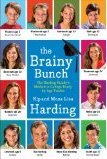 The Brainy Bunch by Kip and Mona Lisa Harding (Gallery Books, 2014)
Facebook, like smartphones, can enslave or empower. Or both at once. At the moment I'm feeling grateful to Facebook, and the friend who posted a link that eventually led me to this Today Show feature about the Harding family and their book.
As most of you know, education has long been my passion, particularly the education of young children, and most especially my belief that most children can learn and do so very much more than we give them the opportunity to achieve. It will thus come as no surprise that when I heard of a family where seven (so far!) of the children had gone to to college by the time they were twelve years old, I immediately ordered the book from our library, and finished reading it the day after I picked it up. If read with an open mind, this is a book that can blow away a number of stereotypes and presuppositions, and not just about education.
Although a large number of homeschoolers are Christians, including many who have spectacular records both academically and socially, as the movement has grown there have slso been examples of less-than-stellar achievement, especially in academics. It is unfortunate that when many people think of "Christian homeschoolers," it is the latter example that comes to mind. The Harding family is a stunning counterexample, especially since The Brainy Bunch bristles with buzzwords that set off alarm bells: Mary Pride, A Full Quiver, Josh Harris, early marriage, Michael and Debi Pearl (at least they label the Pearls' book "a bit legalistic"), creationism, the Duggar Family, and others that might send some running for the hills. But hang on—they also mention John Taylor Gatto, Raymond and Dorothy Moore, unschooling, and the Colfaxes, quite on the opposite end of the spectrum (inexplicably leaving out John Holt, however). Mona Lisa and Kip sound like people after my own heart, able to take the best from many sources and leave aside what doesn't work for them. In any case, the family deals a clean blow to many prejudices, including that of the college student who once told them, "Children in big families have low IQs."
The Hardings insist, however, that their IQs are strictly average; their children are not geniuses. This bothered me at first, as it seemed almost a reverse boast, as if there were something wrong with being smart. But I think I know why they make this point, and it's important. There are a surprising number of people who have gone to college at an extremely young age (here's a list of the ten youngest), but they are generally prodigies with super-high IQs and extraordinary skills. This does nothing to encourage most families to believe that early college entrance is possible for their children. Or desirable. Despite its title, The Brainy Bunch shows that this higher-level work is well within the grasp of the average student, and why this is a good idea.
Some might even say the Hardings started out as a below-average family, or at least one with several strikes against it when it came to predicting their children's academic success. Kip and Mona Lisa were high school sweethearts who married in their teens. After high school, he went into the military and she started having babies. Lots of babies. Their life was not easy, requiring many moves, and times of great financial hardship. And yet here they are, with their children not only college graduates but successful at a young age in many fields: engineering, architecture, medicine, music, and more.
So how do they do it? The book may seem short on specific practical advice, because it's a lifestyle, not a curriculum. Here, however, is a brief timeline of their approach:
- Around age four we start to teach reading.
- By age six we start teaching borrowing, multiplying, writing short essays, and encouraging independent reading.
- By age eight we start algebra, reading real chapter books, and having the children do more writing on their own.
- By age ten they are figuring out what they really believe and why. They continue along in math as they add in reviewing for the SAT/ACT.
- Somewhere around age eleven, they have mastered the five-paragraph essay and can produce a decent research paper.
- By age twelve (sometimes sooner) they have finished lots of high school-level books on many general subjects to fill in their transcripts. With that and enough emotional intelligence, they should be ready for a college class or two.
Sixty-three sticky notes festoon the book, marking places I thought I might quote in this review, but I'll content myself with a few observations. Okay, several observations.
- I've read the complaint that the book is not well written. I see the point, but I've read a lot of popular books that are much worse, trust me. I would say it's not so much that it's poorly written as that the writing reminds me of blog-writing. It's not polished. But it's not bad; rather it's like the difference between folk music and a Bach fugue. Read it for what it is, and enjoy it.
- Most people's first reaction to this idea is, "Why not let your kids be kids?" It's a legitimate question, but as the Hardings point out, in many ways their children are allowed to be kids longer than most, since they are immersed in a loving family and don't have to face the pressures to "grow up" prematurely that are present in school.
- They make sure their children learn about creationism, but also about evolution. They encourage independent thinking.
- They are careful that their children read good books, and partake of quality television. They realize that the Internet can be a dangerous place, but liken it to a hot stove: it's a powerful tool that must be used wisely. ("The Internet wants to reveal all of Victoria's Secrets to your child. Teach them the real secret to success in life is to overcome temptation.") Once a child can use the Internet, the sky's the limit for learning, and parents can respond to questions with, "Go look it up and share with us what you learn."
- The book never mentions Project-Based Homeschooling, but there is a similarity in their methods. With the Hardings, however, it appears to be much less organized and purposeful.
- Conversations, especially at the dinner table, play a key role in the children's general education, and in sparking their interests. It reminds me of Richard Feynman's early education, given informally by his father in the form of questions and discussions on frequent, casual occasions. It also reminds me of a family we know; although they were never homeschoolers, they were always challenging their children with questions, and encouraging the children to do the same to their parents. Written like that it sounds unpleasant, but I observed it, and it was delightful, not at all like a test or a drill session.
- The Hardings were good at finding "back doors" when faced with locked front doors. When they lived in California, their children could obtain high school diplomas by taking a comprehensive test. They were nowhere near the age minimum to take the test, but there was a loophole: high school sophomores could take the test no matter what their age. Since the children were homeschooled and doing work on that level, the parents had no trouble classifying them as sophomores. That didn't work in Alabama, but they discovered that community college transfer credit made up for the lack of a diploma. They used lesser schools as stepping stones. Why not? At that age, they had plenty of time.
- The idea of sending a child to college at middle school age doesn't seem to jibe with their emphasis on family togetherness, but again this is the advantage of not aiming for the perfect college. The young students went to school close to home, in most cases living at home, and at first accompanied by one of their parents. When family needs forced them to be in different states, the children stayed with siblings or other relatives. As I recall, one child stayed in a dorm—at a somewhat older age—but the parents still managed to have plenty of contact and presence.
- Reading the descriptions of their efforts to keep their college kids close to family at all times rang a bell with me, and that's when it struck me: Mona Lisa Harding is a Hispanic mother. This would not have meant anything to me had our own children not attended a high school with a significant Hispanic population. Two characteristics marked Hispanic families, as far as I could tell: the importance of the Quinceañera celebration, and very tight parental reins kept on the girls, such as mothers accompanying their children on band trips, and a girl staying in the mother's hotel room rather than with the other students. Suddenly I recognized the Hardings' practices as typically cultural on the one hand, and extremely liberal on the other.
- They never say it in so many words, but I think the Hardings would agree with the idea that the middle and high school years are usually the most wasted time in a child's life. At that age they can and should be doing college-level work. Not MIT-level, but a lot more than is generally offered in middle school and high school. So they considered what it takes to get into college, and geared the children's early education to meet those requirements. The kids take none of the usual standardized tests, but begin preparing for the ACT and SAT instead. As soon as possible they begin taking classes for which they can get college credit.
- High priority is given to character education; there's no point in being academically advanced if your character development and social awareness are lacking.
- Since much emphasis is placed on the children's following their own interests, a big question is, How do you (or they) know what that is? By doing a lot of listening, and working together, for one thing. It's also important to note that the kids aren't deciding at age six what they want to do with the rest of their lives. Interests are never set in stone, but are allowed to change, going one way, then another. As long as learning is happening, the parents are happy.
- There's a lot of flexibility in the Hardings' program ("We follow more of a checklist than a timed schedule"), but here's a sample day:
- Get dressed
- Eat breakfast
- Chores
- Bible study
- ACT review (a section a day)
- Writing
- Lunch
- Reading (history and science)
- Math (if not covered in the ACT review)
- Spanish
- Violin or piano (they alternate)
- 2:30, ready or not, PLAY OUTSIDE!
- no homework "allowed" in the evenings—just reading for fun.
One of the reasons I read The Brainy Bunch was to know whether or not to recommend it to our children. I would say, most definitely. Would I buy the book? Not if I could get it out of the library. It's definitely worth reading, but I'd read it once before committing shelf space to it. Then I'd wait for the paperback to come out rather than paying over $16 for the hardcover. (Hint: it's available Interlibrary Loan in New Hampshire.) If I couldn't borrow it? It's under $10 for the Kindle version; I'd go for that.
Permalink | Comments
Category Reviews Education Children & Family Issues
For some time we double-dipped in choir, singing for two different churches. We've only been back a couple of times to visit what I might call the secondary church, but we seem to be perpetually on their mailing list. Recently I received an e-mail promoting their Youth Choir, which included the following paragraph (emphasis mine).
Elligibility for the Youth Choir is not based on age or grade in school. We welcome participants who are confident readers (grade two-level minimum) and who have the support of their families in making a commitment to attend rehearsals regularly and to be faithful in singing at the 9:00 am service on the third Sunday of each month (September through June). The Youth Choir also leads the singing at the 5:00 pm service on Christmas Eve.
This may not seem radical, but it is. One of our frustrations in an otherwise positive experience with children's choirs is that choir placement was nearly universally made by age and/or grade, independent of musical or emotional maturity. One choir director told me frankly that she wouldn't have it any other way, because age/grade divisions are unarguable, and she did not want to be in the position of telling one family that their child was ready for a higher-level choir and another family that their child of the same age was not. Given that the director in question was a dedicated, self-sacrificing volunteer, I could hardly argue. But that didn't make the situation any less frustrating.
It's not just children's choirs that have this problem. Age discrimination is one of the few forms of prejudice still acceptable today. Grouping by age has never made sense to me—as if the most important factor that any group might have in common is the year of their birth.
Permalink | Comments
Category Education Children & Family Issues
There are a thousand things I could write about related to my trip to Switzerland, but time is short and people at least want to hear something, so to appease both them and L'il Writer Guy, I'll mention one thing that has struck me while observing Joseph's and Vivienne's speech patterns.
Joseph, who is less now than a month from his fourth birthday, was clearly delayed in his speech when I was last here, nine months ago. Maybe, as I wrote then, "different" is a better descriptor, but in any case he was not as verbal as the majority of children his age.
Today is a different story. Where he is in terms of "average" I don't know, but his speaking ability has clearly exploded, from understanding pronouns (saying "it is mine" rather than "it is Joseph's," for example) to being able to answer questions about the past and the future. It reminds me again of how tricky it is to decide when a problem is best solved by intervention (and the earlier, the better) and when it is best simply to let the child develop in his own way, at his own pace. We'd heard a variety of advice, from simple exercises to a radical diet; no doubt each would be appropriate for some situations, but in this case, trusting and waiting were the best medicine.
There's no doubt that Vivienne is developing differently. At 29 months she is nearly as verbally competent as Joseph. She has a good grasp of pronouns, speaks fluently, and works with determination and persistence to correct her own vocabulary, pronunciation, and grammar.
All this is hardly news; even within a single family, children develop differently. What makes it especially fascinating for me is that all this development is taking place in two (or more) different languages, and that, too, differs from one child to another. Joseph was slow to speak each language (though he clearly understood both English and Swiss German extremely well), but now is fluent in both and never mixes them up. He can translate from one to another (a very different skill from just speaking) and to some extent from French and High German as well. Vivienne, on the other hand, mixes the languages freely and with enthusiasm, chattering one moment in Swiss German and the next in English, pulling words from the other language as the spirit moves her, a happy experimenter.
I'm reminded of the two types of computer programmers I've observed: one who meticulously plans every detail, "measures twice, cuts once," and whose programs often work the first time; and the other, who works iteratively, putting forth one version after another and converging on the solution. Both approaches work, though each kind of programmer frustrates the other kind no end. Not that Vivienne and Joseph experience any of that sort of frustration in their speaking. But it's a good analogy of how it seems to be working for them.
Enough. It's past bedtime again—but L'il Writer Guy is happier.
Permalink | Comments
Category Education Children & Family Issues Everyday Life
I still have not read Anthony Esolen's Ten Ways to Destroy the Imagination of Your Child, recommended to me by a knowing friend, because (1) our library, which has otherwise been marvelously responsive to my suggestions for books to acquire, declined this one with the inexplicable excuse, "I'm sorry but this title does not fit our collection guidelines and we are unable to order it. It is a scholarly, university-level book."; and (2) while I expect I'll agree with much of what he says, I also suspect a sexist vein in his philosophy that would drive me nuts the way John Eldredge did. Someday, maybe.
In the meantime, Esolen continues to fascinate me. I can't personally say much about the new Common Core standards and all the kerfuffle they have generated, because I am blissfully beyond that stage of life in its practical application and therefore have not given the mess much attention. Nonetheless, I harbor an automatic suspicion of anything that moves educational decisions farther up the food chain, and so Esolen's How Common Core Devalues Great Literature sounds great to me.
The Common Corers get things exactly backwards. You do not read The Wind in the Willows so that you can gain some utilitarian skill for handling “text.” If anything, we want our children to gain a little bit of linguistic maturity so that they can read The Wind in the Willows. That is the aim. I want my college students to read Milton so that they can enter the world that Milton holds forth for us. I show them some of his techniques as an artist, since they’re mature enough to appreciate them, but not so that they can reduce the poem to an exercise in rhetoric. I show them those techniques so that they may understand and cherish the poem all the more. I want them to become “friends” with Don Quixote and Sancho Panza. I want them to climb with Dante and Virgil the glorious mountain of Purgatory. I want them to stand heart to heart with the Geats as they watch the flames devour the body of their deceased king Beowulf.
Those are the important things, the permanent things. If you are not reading The Wind in the Willows as Theodore and Edith Roosevelt and their children were reading it, then you should not read it at all. If you are turning Tom Sawyer into a linguistic exercise with a veneer of intellectual sophistication, then you should not read Tom Sawyer—in fact, you cannot have understood a blessed thing about Tom Sawyer. If you are reading The Jungle Book for any other reason than to enter the jungle with Mowgli, Bagheera, and Baloo, then you had best stay out of the world of art, keep to your little cubbyhole, cram yourself with pointless exercises preparatory for the SAT, a job at Microsoft, creature comforts, old age, and death.
Preach it, brother!
I'm always complaining that we—and by "we" I especially mean our schools—do not expect enough of our young people. This morning, however, while doing a Khan Academy mastery challenge, I ran into the following problem (click to enlarge):

Did you notice the grade level for this problem (in the black line, at the top)?
Fifty years makes no difference in the susceptibility to parody of elementary mathematics education in America.
Elementary school mathematics, 1964:
Elementary school mathematics, 2014:
My apologies: I can't get the embedding to work on this Stephen Colbert video, but you can click on the link above.
Permalink | Comments
Category Education Just for Fun
My go-to example of what young people can accomplish has always been David Farragut, midshipman in the U.S. Navy at age nine, given charge of a prize ship at 12, later the Navy's first admiral. But the Occasional CEO has provided some other examples for my list:
In 1792, the trading ship Benjamin departed Salem, Massachusetts, loaded with hops, saddlery, window glass, mahogany boards, tobacco and Madeira wine. The ship and crew would be gone for 19 months, traveling to the Cape of Good Hope and Il de France. All the while they bargained hard from port to port, flipping their freight several times “amid embargoes and revolutions,” naval historian Samuel Eliot Morison wrote, “slipping their cables at Capetown after dark in a gale of wind to escape a British frigate; drifting out of Bourbon with ebb tide to elude a French brig-o’-war.” In 1794, the Benjamin returned to Salem with a cargo that brought 500% profit to its owners.
The ship just happened to be captained by Nathaniel Silsbee, 19 years old when he took command. His first mate was 20 and his clerk 18.
I know we expect a different sort of education for our young people today, but surely we can do a better job of helping them get it more efficiently. No wonder today's teens are restive!
Permalink | Comments
Category Education Random Musings
Mallard Fillmore, from yesterday:

From what little I've read about the changes, there are some positive ones as well. Still, the move to make the test more aligned with what students are actually learning, and to what they will likely encounter in general life, is part of a disturbing trend. To my mind, the Scholastic Aptitude Test is only useful if it measures what is not taught in school, nor in "test-prep" courses. Otherwise, it's just another achievement test. A mastery of so-called arcane vocabulary is an indicator of the extent and quality of a student's outside reading. Success in the analogy section, which to my chagrin was dropped long ago, was an indicator of a certain kind of mental agility. A widely-read, mentally agile person is more likely to be successful in college, hence the putative value of the test.
Granted, an exam based so strongly on the English language puts foreign students, and those from difficult backgrounds, at a disadvantage, but that's only an argument for why the SAT should be but one part of many criteria for college acceptance, not for altering the test itself.
Except for a short lesson in proper test-taking strategies and the specific structure of the exam, I'm of the opinion that test-prep courses simply undermine the purpose of the test. Sorry for pulling the "old" card, but in my day we went into the SAT cold, knowing that the best preparation was years of good habits. In fact, we were told that it was impossible to study for such an exam! Easier all around....
It's still worrisome that our president does not consider directing the education of one's own children to be a fundamental human right, but today I'm offering thanks and respect for the Department of Homeland Security's decision to allow the Romeike family to stay in the U.S. "indefinitely." (Previous posts here and here.) That decision is not as satisfying for legal precedent as a positive court decision overturning the administration's efforts to deport the family—on the grounds that Germany's heavy-handed anti-homeschooling laws are not sufficient reason to grant asylum—but the Supreme Court refused to review the case. The TSA's decision, while still leaving the Romeikes in a somewhat tenuous position, at least also leaves them safe in their Tennessee home.
Permalink | Comments
Category Education Politics Children & Family Issues
My sister-in-law's "books read in 2013" post has me itching to work on my own, but re-entry chores after our vacation are taking priority (with difficulty). In the meantime, enjoy this post from the Occasional CEO.
In high school I studied the Civil War. A few weeks later, we tackled World War I. Those two wars seemed to me ages apart, in entirely different eons. In one, ancient soldiers rode horses and wore funny hats. In the other, ancient soldiers drove tanks and wore funny helmets. The distance in time between the two events was, to me, like that between the Punic and Vietnam Wars.
As I arise on this snowy morning in the new 2014, I am reminded that the death of the Archduke is only six months away and the guns of August eight. I realize too that I was in third grade when the Civil War ended. Said another way, my living memory has now spanned the period between the Civil War and WWI, and it turns out they were not fought in different eons at all but in a very short, very connected period. Brad Pitt was born the same year as Gettysburg. We saw Google launch when the USS Maine sunk in Havana and we declared war on Spain. Americans lost President Garfield to an assassin when Raiders of the Lost Ark premiered, and President McKinley when Apple introduced its first iPod.
Porter is always placing historical events in this kind of chronological context, which may explain why he has such a good sense of history.
There is a sense I now have of historical "connectedness" that I did not when I was young, or even when I was studying history in college. It is something, I suppose, that truly gifted historians can create in their writing. Sometimes it comes upon us abruptly ... as it did for me last year when I watched the video of a man who witnessed Lincoln's assassination at Ford's Theater appearing on TV's I've Got a Secret. More often than not, though, this sense of connectedness probably just comes with age.
That it comes with age makes sense—how can a ten-year-old really grasp a time span of more than a few years? Yet it seems worth the effort, given that apparently the graduates of 13 years or more of (mostly) compulsory education are even more ignorant of history than they are of geography. I'm not mocking the younger generations: almost all of my own historical and geographical knowledge was gained after I graduated from college.
(On the geography side, it didn't help that what I did learn in school went rapidly out of date. Once I could identify all the countries on a map of Africa. I can today—but few of them are the same countries. Learning must never cease, and knowledge always be refreshed.)
How to help young learners develop a sense of history? Timelines, certainly. I don't mean just memorizing dates, but a clear visual representation of the relationships between events. Perhaps something like Hillyer's Staircase of Time, or the huge timeline my sister-in-law created that took up most of their front hall. Not hidden away in a book, but a part of the home or school landscape that confronts us daily. Something frequently referenced, though, so it doesn't fade into the background.
It might be possible, also, to develop Porter's self-taught habit of translating bare historical dates into personal events, e.g. "When I was your age, we were fighting in Vietnam," or "Grandpa was born exactly 18 years after the Wright Brothers made their first flight at Kitty Hawk."
What other ideas can you think of? If you are one of those blessed with a sense of history, do you know how you developed it?
Aargh. I thought I could get a quick post by just putting up a link to someone else's. Apparently I'm incapable of not adding my own two cents. Especially since my refusal to set up a Google + profile keeps me from being able to comment on the Occasional CEO itself.
Back to post-vacation chores. (I did say it was "with difficulty.")
The process whereby a child learns to read continues to fascinate me. Three months ago, Noah, who had just turned seven, demonstrated great progress in learning to read. But he was not yet a reader. Back then, he did a good job of making his way through his simplified, beginning readers. But just now he read to me Curious George Gets a Medal, with its much more advanced vocabulary and structure, and he read fluently, nearly effortlessly, and with great expression.
Similarly, in the time between two years, four months and two years, seven months, Joy's language abilities have exploded. In that time she has made the transition from two-word phrases to full, mostly clear communication, including correct use of pronouns. Amazing.
There are advantages and disadvantages to large families, but surely one of the greatest is the example of older siblings. I'm certain Joy has no idea that her youth should hinder her keeping up with her big brothers and sister. Her size, maybe: Jonathan executed a neat vault over the porch railing, and Joy announced that she was not going to follow suit because she would get hurt. Quite fearless, as a rule, she knows the difference between courage and foolishness.
Quote of the Day, from Noah: "Grandma, I think you're old enough to wear tie shoes now." To which I responded, "I'm old enough now to choose to wear Velcro shoes because I like them better."
Bedtime. It's been a long but fun day.
Permalink | Comments
Category Education Children & Family Issues Everyday Life

