
When we moved to Florida more than 40 years ago, the heavenly smell from an orange juice factory frequenly wafted over our new house. As we drove around we frequently encountered citrus groves, and just outside of our neighborhood a farm stand sold Page oranges. Technically a Page orange is not an orange, but a cross between a clementine and a tangelo, thus 3/4 tangerine and 1/4 grapefruit. But these small, round orange-colored glories are by far my favorite citrus fruit, now nearly impossible to obtain. In the image below, the juice on the right is the best unpasteurized, non-adulterated, not-from-concentrate orange juice I could buy from the grocery store, and the juice on the left was squeezed from Page oranges.

Sadly, a series of devastating freezes in the mid-1980's drove the citrus industry out of Central Florida, as the owners of our local orchards were faced with the expense of replanting their entire crops—or selling out to developers who were eager to obtain the land on which their dead trees were sitting.
One of our first projects at our new house was to plant a Marsh white grapefruit tree. We nursed it through the freezing time, and for years it provided some of the best grapefruit I've ever eaten. After our local source of Page oranges disappeared, we doubled our "citrus grove" by adding a Page orange tree, and we enjoyed its fruit for many years.
The unusually cold weather of the 1980's moderated, sparing our trees, but the troubles of Florida's citrus industry were far from over. Production peaked in the 90's but the turn of the century brought one deadly attack after another: the Mediterranean fruit fly (Medfly), citrus canker, and several hurricanes that destroyed trees and spread disease and pests all over the state. The pressures of growth and development swallowed many struggling groves. And then in 2005 came citrus greening, a vicious bacterial infection spread by the invasive Asian citrus psyllid, which came to us from China through Mexico. That absolutely devastated Florida's groves, taking our own two trees with them.
The bridges don't fall down immediately. — Bret Weinstein
It's been 20 years since citrus greening came to our state, and the full effects accumulated slowly. Other than the deaths of our own trees, I didn't realize the extent of the damage until about a year ago when I picked up a carton of orange juice from the grocery store. Our favorite brand had long been Florida's Natural, which was reliably not from concentrate, guaranteed squeezed from Florida oranges. But that day I stood there in the middle of Publix, staring at a container of orange liquid that was neither natural nor from Florida: it was made from concentrate, and from Brazilian oranges. Keeping the Florida's Natural name took a lot of chutzpah.
For more of the story, including some out-of-the-box efforts being made to keep the industry alive while searching for a permanent solution, you can read the informative article from which I have pulled a few quotes (emphasis mine).
Florida harvested a record 244 million boxes of oranges during the 1997–1998 season. This year, the Department of Agriculture estimates that Florida will produce only 12.2 million boxes, a stunning 95 percent drop in a little less than 30 years.
Occasional freezes, catastrophic hurricanes, and an on-and-off, decades-long battle with the citrus canker disease proved to be frustrating setbacks for many orange growers, but the destruction of Florida’s citrus industry kicked into high gear in 2005.
The Asian citrus psyllid feeds on citrus tree leaves, causing the plant to contract a bacterial infection known as huanglongbing, commonly called citrus greening. The disease causes rapid root loss, slowly draining the life from healthy trees as they try to absorb and retain nutrients. There is no known cure.
Citrus greening has slashed total U.S. orange production by 80 percent and grapefruit production by 88 percent since 2000, according to a report from the American Farm Bureau Federation. California has now overtaken Florida to become the United States’ largest citrus producer, and nations such as Egypt and South Africa now export more oranges worldwide.
But Florida citrus farmers are not giving up.
The Kindle version of The Fall of Heaven: The Pahlavis and the Final Days of Imperial Iran is currently on sale a for $1.99. If you care to understand more about what is going on in the Middle East at the moment, this is excellent background and too good to pass up. It's also a page-turning story.
I wrote the following back in 2017, after my first reading of the book. Nine years later, I stand by my first impressions.
- The road to hell is paved with good intentions. Jimmy Carter is undoubtedly an amazing, wonderful person; as my husband is fond of saying, the best ex-president we've ever had. But in the very moments he was winning his Nobel Peace Prize by brokering the Egypt-Israel Peace Treaty at Camp David, he—or his administration—was consigning Iran to the hell that endures today. Thanks to a complete failure of American (and British) Intelligence and a massive disinformation campaign with just enough truth to keep it from being dismissed out of hand, President Carter was led to believe that the Shah of Iran was a monster; America's ambassador to the United Nations, Andrew Young, likened the Shah to Adolf Eichmann, and called Ruhollah Khomeini a saint. Perhaps the Iranian Revolution and its concomitant bloodbath would have happened without American incompetence, disingenuousness, and backstabbing, but that there is much innocent blood on the hands of our kindly, Peace Prize-winning President, I have no doubt.
- There's a reason spycraft is called intelligence. Lack of good information leads to stupid decisions.
- Bad advisers will bring down a good leader, be he President or Shah, and good advisers can't save him if he won't listen.
- The Bible is 100% correct when it likens people to sheep. Whether by politicians, agitators, con men, charismatic religious leaders (note: small "c"), pop stars, advertisers, or our own peers, we are pathetically easy to manipulate.
- When the Shah imposed Western Culture on his people, it came with Western decadence and Hollywood immorality thrown in. Even salt-of-the-earth, ordinary people can only take so much of having their lives, their values, and their family integrity threatened. "It does not do to leave a live dragon out of your calculations."
- The Shah's education programs sent students by droves to Europe and the United States for university educations. This was an unprecedented opportunity, but the timing could have been better. The 1960's and 70's were not sane years on college campuses, as I can personally testify. Instead of being grateful for their educations, the students came home radicalized against their government. In this case, "the Man," the enemy, was the Shah and all that he stood for. Anxious to identify with the masses and their deprivations, these sons and daughters of privilege exchanged one set of drag for another, donning austere Muslim garb as a way of distancing themselves from everything their parents held dear. Few had ever opened a Quran, and fewer still had an in-depth knowledge of Shia theology, but in their rebellious naïveté they rushed to embrace the latest opiate.
- "Suicide bomber" was not a household word 40 years ago, but the concept was there. "If you give the order we are prepared to attach bombs to ourselves and throw ourselves at the Shah's car to blow him up," one local merchant told the Ayatollah.
- People with greatly differing viewpoints can find much in The Fall of Heaven to support their own ideas and fears. Those who see sinister influences behind the senseless, deliberate destruction during natural disasters and protest demonstrations will find justification for their suspicions in the brutal, calculated provocations perpetrated by Iran's revolutionaries. Others will find striking parallels between the rise of Radical Islam in Iran and the rise of Donald Trump in the United States. Those who have no use for deeply-held religious beliefs will find confirmation of their own belief that the only acceptable religions are those that their followers don't take too seriously. Some will look at the Iranian Revolution and see a prime example of how conciliation and compromise with evil will only end in disaster.
- I've read the Qur'an and know more about Islam than many Americans (credit not my knowledge but general American ignorance), but in this book I discovered something that surprised me. Two practices that I assumed marked every serious Muslim are five-times-a-day prayer, and fasting during Ramadan. Yet the Shah, an obviously devout man who "ruled in the fear of God" and always carried a Qur'an with him, did neither. Is this a legitimate and common variation, or the Muslim equivalent of the Christian who displays a Bible prominently on his coffee table but rarely cracks it open and prefers to sleep in on Sundays? Clearly, I have more to learn.
- Many of Iran's problems in the years before the Revolution seem remarkably similar to those of someone who wins a million dollar lottery. Government largess fueled by massive oil revenues thrust people suddenly into a new and unfamiliar world of wealth, in the end leaving them, not grateful, but resentful when falling oil prices dried up the flow of money.
- I totally understand why one country would want to influence another country that it views as strategically important; that may even be considered its duty to its own citizens. But for goodness' sake, if you're going to interfere, wait until you have a good knowledge of the country, its history, its customs, and its people. Our ignorance of Iran in general and the political and social situation in particular was appalling. We bought the carefully-orchestrated public façade of Khomeini hook, line, and sinker; an English translation of his inflammatory writings and blueprint for the establishment of an Islamic republic in Iran came nine years too late, after it was all over. In our ignorance we conferred political legitimacy on the radical Khomeini while ignoring the true leaders of the majority of Iran's Shiite Muslims. The American ambassador and his counterpart from the United Kingdom, on whom the Shah relied heavily in the last days, confidently gave him ignorant and disastrous advice. Not to mention that it was our manipulation of the oil market (with the aid of Saudi Arabia) that brought on the fall in oil prices that precipitated Iran's economic crisis.
- The bumbling actions of the United States, however, look positively beatific compared with the works of men like Muammar Gaddafi of Libya, and Yasser Arafat and his Palestine Liberation Organization, who funded, trained, and armed the revolutionaries.
- The Fall of Heaven was recommended to me by two Iranian friends who personally suffered through, and escaped from, those terrible times.
The following excerpt from the Introduction to The Fall of Heaven matters much to me because at the time of the Revolution I had heard and absorbed the accusations against the Shah, and believed Khomeini was acting out of a legitimate complaint with regard to the immorality of some aspects of American culture. See the above comment about sheep....
The controversy and confusion that surrounded the Shah's human rights record overshadowed his many real accomplishments in the fields of women's rights, literacy, health care, education, and modernization. Help in sifting through the accusations and allegations came from a most unexpected quarter, however, when the Islamic Republic announced plans to identify and memorialize each victim of Pahlavi "oppression." But lead researcher Emad al-Din Baghi, a former seminary student, was shocked to discover that he could not match the victims' names to the official numbers: instead of 100,000 deaths Baghi could confirm only 3,164. Even that number was inflated because it included all 2,781 fatalities from the 1978-1979 revolution. The actual death toll was lowered to 383, of whom 197 were guerrilla fighters and terrorists killed in skirmishes with the security forces. That meant 183 political prisoners and dissidents were executed, committed suicide in detention, or died under torture. [No, I can't make those numbers add up right either, but it's close enough.] The number of political prisoners was also sharply reduced, from 100,000 to about 3,200. Baghi's revised numbers were troublesome for another reason: they matched the estimates already provided by the Shah to the International Committee of the Red Cross before the revolution. "The problem here was not only the realization that the Pahlavi state might have been telling the truth but the fact that the Islamic Republic had justified many of its excesses on the popular sacrifices already made," observed historian Ali Ansari. ... Baghi's report exposed Khomeini's hypocrisy and threatened to undermine the vey moral basis of the revolution. Similarly, the corruption charges against the Pahlavis collapsed when the Shah's fortune was revealed to be well under $100 million at the time of his departure [instead of the rumored $25-$50 billion], hardly insignificant but modest by the standards of other royal families and remarkably low by the estimates that appeared in the Western press.
Baghi's research was suppressed inside Iran but opened up new vistas of study for scholars elsewhere. As a former researcher at Human Rights Watch, the U.S. organization that monitors human rights around the world, I was curious to learn how the higher numbers became common currency in the first place. I interviewed Iranian revolutionaries and foreign correspondents whose reporting had helped cement the popular image of the Shah as a blood-soaked tyrant. I visited the Center for Documentation on the Revolution in Tehran, the state organization that compiles information on human rights during the Pahlavi era, and was assured by current and former staff that Baghi's reduced numbers were indeed credible. If anything, my own research suggested that Baghi's estimates might still be too high. For example, during the revolution the Shah was blamed for a cinema fire that killed 430 people in the southern city of Abadan; we now know that this heinous crime was carried out by a pro-Khomeini terror cell. Dozens of government officials and soldiers had been killed during the revolution, but their deaths were also attributed to the Shah and not to Khomeini. The lower numbers do not excuse or diminish the suffering of political prisoners jailed or tortured in Iran in the 1970s. They do, however, show the extent to which the historical record was manipulated by Khomeini and his partisans to criminalize the Shah and justify their own excesses and abuses.
Permalink | Read 567 times | Comments (0)
Category Reviews: [first] [previous] [next] [newest] Hurricanes and Such: [first] [previous] [newest] Politics: [first] [previous] [next] [newest] Glimpses of the Past: [first] [previous] [next] [newest]
You think Minnesota has problems? You should see what's going on here in Florida.
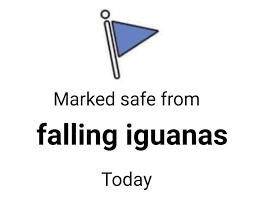
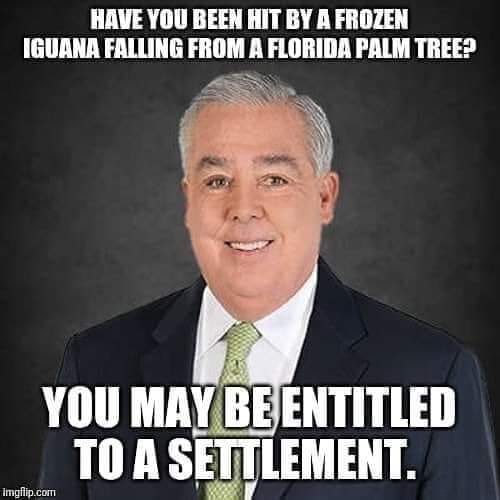
Back in 1992, Hurricane Andrew brought to Florida a massive wave of illegal immigrants. No, not people. Iguanas. The green iguana is an invasive species that has been devastating South Florida's flora and fauna ever since. Plus, what other state includes a "Falling Iguanas Warning" in its weather forecasts? In cold weather, the heavy, cold-blooded beasts go comatose and start falling out of trees, and woe to person, pet, or car standing in their way.
Sunday and Monday, the State has lifted their prohibition on transporting live iguanas, hoping people will join in a massive effort to round up the reptiles up for deportation while they are less capable of resisting.
Officials say the order allows people to remove green iguanas from private property with landowner permission, or from commission-managed lands in South and Southwest Florida, and deliver them directly to designated FWC offices.
Not that this is something you casually pick up off your neighbor's lawn and throw into the back of your pickup truck.
They said iguanas must be placed in a sealed, escape-proof cloth bag and then secured inside a locked container labeled “prohibited reptiles.” Bags must remain closed until transferred to FWC [Florida Fish and Wildlife Conservation Commission] staff. FWC also advises wearing protective gloves, long sleeves and pants when handling iguanas. Collected animals should be transported immediately to reduce the risk of escape.
Florida and Minnesota may be far apart both geographically and politically, but this weekend I believe the Sunshine State would be happy to join the North Star State in an anti-ICE protest. I can't remember when we had our last hard freeze. We did once go camping with the Indian Princesses when the temperatures hit the mid-20's—but I think that was some 30 years ago.
Permalink | Read 629 times | Comments (3)
Category Hurricanes and Such: [first] [previous] [next] [newest] Just for Fun: [first] [previous] [next] [newest]
In view of all the excitement over the weather these days, it seems appropriate to publish my father's story of one of my happiest childhood memories, which he called the Great Ice Storm of 1964. If you find yourself struggling under bitter cold, sheets of ice, and loss of power this weekend, I hope you will be able to turn the event into an adventure that your children will still remember with delight sixty years later.
The Great Ice Storm of 1964
by Warren Langdon
In December 1964, while we were living on Haviland Drive in Scotia, NY, an ice storm wreaked havoc throughout the area and left us with an adventure that I recorded in letters to my father and other family members. I recently found carbon copies of those letters and am rewriting them. It is my intent to copy the letters exactly as written except for misspellings and for words that are crossed out. Words that I have added I have put in italics, thus identifying the parts of the story that might suffer distortions caused by my faulty memory.
Part 1
December 9, 1964
Dear Dad,
What an adventure we have had this past weekend! It all started on Friday, the day that Lynn and Linda were supposed to go to the Girl Scout camp on Hidden Lake for the weekend and I was to stay home and baby-sit with the other three children. We all had great plans, but Friday morning brought freezing rain that had not let up by noon. At that time Lynn backed out of the trip, feeling that the weather was not proper for taking the girls out. Just before they were to leave at 3 o’clock the trip was canceled, and the freezing rain continued to fall.
I had been at work all day. The part of the Laboratory that I worked in was housed in a large multistory building that belonged to an entirely different part of the Company. Our offices were in a corner of an otherwise unoccupied first floor. I had not been outside all day and the first inkling I had that things were not normal came when all the lights went out at what I suppose must have been about 5 o’clock. The entrance to our office area was a fairly large room with desks for two secretaries and off this room was a moderately long hallway with offices on both sides. When the lights went out I was the only one in the area and I had to grope my way down the hall, through the entrance area and out to the out-of-doors. Of course it was dark at that time of day and since all electricity was off, there was essentially no light coming into the building. To make matters more interesting, as I was groping my way up the hall a fire engine with siren blaring drove up. (I found out later that some equipment that was running on the fourth floor was connected to sound an alarm in the fire station in the event that the power went off.) I went home and do not remember any difficulty getting there. The streets must have been well salted/sanded.
I arrived home about 6 o’clock to find a fire in each fireplace and candlelight removing the darkness from the house—the power had gone off at 1:50 in the afternoon and that is a time that is etched in my memory, for that is when the clock stopped, and that is what the clock read for better than three days—every time I looked at it.
When I got home Lynn had supper ready—baked beans cooked over the fire in the fireplace. They were burned a little, but they tasted good. All evening long we could hear trees snapping and branches falling as limbs bent and broke under the weight of the ice that was coating them. And in Scotia, every time a limb fell it took down a live power line. We could watch as the whole sky lit up brightly with the red, orange, and yellow light, and often the green that signified vaporized copper. The light was so bright and the sky so completely lit up that I thought it must have been the northern lights, even though they were in the east, but I have been assured several times since that it was all caused by high voltage power lines coming down. I never believed that it could be so bright from so great a distance, but I suspect that the low clouds did much to enhance the effect. But the fire department and the police in Scotia were very busy setting up barricades and otherwise coping with the problems of downed power lines. Our fire department got not one single call on Friday night—mostly, I think, because all the lines that went down in our district were dead when they went down.
Friday night Linda and Alan slept in sleeping bags in front of the fireplace while Nancy, David, Lynn, and I slept upstairs as usual. It was a little chilly upstairs but not bad. Linda watched the fire down stairs and put an occasional log on as she woke up during the night. We awoke Saturday morning to behold an awful mess outside. Almost every tree in our yard had been broken to some extent, although the two oaks in the back and the pines seemed unbroken. But the locusts and the wild black cherry trees were badly hit and they are now rather drastically thinned. The back yard is a mess, but our yard is not nearly as bad as some of the yards nearer Spring Road. But Scotia was far harder hit. Not only has the tree damage been worse, but almost every tree limb that fell took down a power or telephone line or blocked a street.
When the power went off Lynn was caught with a wash done but not dried, so one of the first chores on Saturday morning was to go into the village and see if there was a Laundromat open. At that time I did not realize just how badly the village had been hit since they had power when I came home from work on Friday. Linda and David went with me and we actually had very little trouble. The streets we traveled on were mostly clear and there was very little traffic out. There was enough power in the business district that a Laundromat was open and we dried the wash with no problems. We also went to a drug store that had some power. Their electricity came from two streets (they are located on a corner) and the part that came from Vley Road was on and the part that came from Fifth Street was off. We came home still not realizing just how many live wires were still coming down and how much damage had been done in some parts of the Village. The house of one of the men I worked with was without power for a full week. Things were bad enough that the sheriff’s cars were making the rounds of the Village with sound systems warning people to stay home unless it was absolutely necessary to go out. A state of emergency was declared, but I still do not know what that means. In spite of all the live wires that were falling, the only fatality so far as I know was the Mayor’s dog.
When we got home we made an effort to prop up the little wild plum tree in the front which was sagging badly and had one main branch broken, but beyond that there didn’t seem to be much to do and it didn’t make much sense to start cleaning up yet. We spent the day not accomplishing very much, but not having a hard time of it either. We had plenty of wood—in fact, on Friday, Linda and I had taken a couple of wheel barrow loads to a neighbor whose husband is a traveling auditor and was out of town.
Saturday night we cooked hamburgers over the charcoal grill, doing the cooking in the garage where the car lights helped us see what we were doing. Lynn used paper plates and paper cups as much as possible to cut down on the dish washing that was required since we were not in a position to heat much water. But cooking over the grill gave us a chance to have a good supply for the dishes. As far as I was concerned it was a privilege to wash the dishes as long as there was hot water to do it in. The water in the hot water tank was still rather warm and that, together with what we heated on the grill made dish washing easy.
Saturday night we moved Nancy’s crib down into the living room and we all slept downstairs. Nancy was in her crib; the other children were in sleeping bags in the living room; and Lynn was on a mattress in the living room while I was on the roll-a-way bed in the family room.
I suppose it was inevitable on such a weekend. About 3 a.m. the telephone rang (Don’t ask me how it was that no one had electricity and everyone had working telephones.) and I was told to report to 72 Spring Road as there was a fire there. (The fire station was without power too, so the siren did not blow. Don’t ask me why the power lines were down and the telephone lines were not.) I dressed and got there before the fire trucks did and actually had some trouble finding the place as no one was out to flag me down. I overshot and by the time I got back the fire engines were there. Then I could see considerable smoke coming out of the attic ventilator. It was a case of a fireplace in an interior wall and a hole in the mortar of the chimney. Either heat or sparks had set fire to the wall and it was a rather stubborn blaze. I tended the truck and ran the pump and never got inside, so I don’t know just how bad the damage was. I gather there was considerable damage to the wall but essentially none to the rest of the house. I gather the owners are back living in it now that the power is on.
I see that I am at about the limit of the paper that I can send to Ethiopia for one stamp so I will close and continue later except to say that we got our power back at 8:00 p.m. on Monday and are absolutely none the worse for wear. I’ll tell the rest of the story later.
Part 2
December 15, 1964
Dear Dad,
I left off last week’s narrative telling about the fire we went to at 3 a.m. Sunday morning during our week end without power. As I mentioned, I ran the pump and tended the truck, standing out in the wind and snow flurries and getting very, very cold. I kept thinking how nice it would be to go home after this was all over and have a good hot bath; then I would remember how impossible that was with no hot water, so I just shivered some more. We put the fire truck away by candlelight and returned at 11 o’clock to finish the job properly by daylight. I got home the first time about 6:30 a.m. which meant I no sooner gotten back into bed, after first building up the fires in the fireplaces, than the first of the children started waking up, and there was no more sleep for that night.
Sunday Lynn again went in to the village and did a laundry, primarily to make sure we had plenty of diapers. Both the Dietzes and the Campbells called to offer us any help that we might need. The Campbells were without power only about 28 hours and the Dietzes never did lose theirs. The only thing we thought we might want was a hot bath, but Sunday was a pleasant day and it seemed easier to stay home than to go out, so that is what we did. I did make a point of shaving in some rather lukewarm water but that is as far as we went toward cleaning up. A neighbor lent us his two-burner gasoline stove for our supper, so we had some hot gravy and a hot vegetable to go with some left over roast beef. We also cooked some baked potatoes in the fireplace and we dined like royalty. Of course I didn’t time the potatoes very well and they weren’t done until everything else was gone, but then, what better dessert is there than hot baked potatoes with butter? The gasoline stove got put to good use for heating water and it was a real pleasure to wash dishes under these circumstances.
Sunday night it got cold outdoors and was an official four degrees by Monday morning. Inside it was 44 degrees in our hall where the thermostat is and it was less than 34 degrees in the upstairs bathroom. (My recollection is that we had a Celsius thermometer hanging in the bathroom and it read barely one degree.) But in the family and living rooms it was warm enough that no one suffered. Monday there was no school and I decided not to go into work. Lynn packed up and went in to the Campbell’s in Scotia and they all had hot baths and a hot lunch while I watched the fires at home and took advantage of the deserted house to proof-read a rather lengthy report we were having to write. After lunch I abandoned the house for an hour or so and went also to the Campbell’s and had a hot bath. That was a feeling of real luxury! I think that the thing I missed most during the time the power was off was copious amounts of hot water. Lynn also used the visit to the Campbell’s to do another wash and to put some of our freezer foods in Mrs. Campbell’s freezer. Fortunately we had not had much perishable in our freezer when the power went off. There was bread which didn’t matter, some frozen vegetables and frozen strawberries that we could eat before they spoiled. But our really valuable frozen foods—the 12 quarts of blueberries—Lynn put in Mrs. Campbell’s freezer. Things were pretty well frozen on Monday morning, but were beginning to soften. The only thing we lost was about a gallon of ice cream.
As I returned from the Campbell’s I noticed the power company crew working on the broken line on Haviland Drive, and others were working on Spring Road, so it looked like we would have power by sometime Tuesday for sure. I returned to the Campbell’s for supper and a very pleasant dinner it was. Linda and Alan were invited to spend the night with the Campbell children, and they did—-not because of any hardship at home but because they enjoy playing with the children. The rest of us returned home for another night without heat and light, but sure it would be the last such night. And as we sat before the fire the lights suddenly went on. It was almost exactly 8:00 o’clock—-the power had been off just over 78 hours. So with the furnace running at last we knew that we could let the fireplace fires go out and we set about the business of finishing the defrosting of the freezer and the refrigerator, and giving both of them a good cleaning. And when we finished that job we probably got colder than at any time during the weekend. The fires had died considerably while we had been working, and the furnace had only barely begun to raise the temperature in the house. In fact, when I left for work on Tuesday morning the furnace had been running for eleven hours and the temperature was only up to 63 degrees. Monday night Nancy and David again slept before the living room fireplace, but Lynn and I slept upstairs where the electric blanket would nullify the effect of the cold bedroom. And so ended the big adventure. No one suffered and no one was unhappy. But poor Nancy—-in the years to come she will complain that she can’t remember a bit of it.
Editor's commentary:
- If, like me, you cringed when you read about using our hibachi-sized charcoal grill in the garage, know that (1) our garage was drafty, and (2) my father was not only an engineer but a fireman, and well aware of the dangers of burning charcoal in close spaces. I certainly don't recommend the practice these days, but he knew what he was doing and we were in no danger.
- In those days power lines and telephone lines were two different things, with the power wires being strung higher than the phone wires, and thus perhaps more vulnerable. "Landline" phones (there was no other kind) carried their own power, independent of the electrical service.
- His apparently incongruous concern over the cost of postage to Ethiopia was because that is where my father's sister and her family, to whom he sent copies of his letters, were living at the time.
- I am still puzzled by his description of the frozen food situation.
- Why, if it was 4 degrees outside, did they worry about frozen food? Why didn't they just put it outside? If they were worried about animals getting to it, then if my memory of the temperature of our garage was correct, that would have done just as well as a convenient, walk-in freezer.
- How on earth did we let a gallon of ice cream go to waste? Surely our family of six could have polished that off easily enough.
- Poor Nancy, indeed. The ice storm is one of my most cherished memories. What more could a child want? The family was together, school was closed, and we “camped out” at home. Toast never tasted so good as that which we grilled over the fire on our marshmallow sticks. I liked being responsible for keeping the family room fire going. Ordinary life was put on hold while we enjoyed working and playing together. (You can tell I was not the one responsible for making sure there were enough clean diapers.) The sun turned the ice-covered world into a crystal paradise, and the exploding transformers were as good a show as any fireworks display. While it is true that we always enjoyed being with the Campbells, the way I remember the night spent at their house was that I felt I was supposed to be grateful for heat and hot water and the chance to have a “normal” night, but I really resented missing the last few hours of an enormously pleasurable adventure. I suspect I didn’t communicate this to my parents at all at the time, but I’m surprised at how strong the memory of the disappointment is to this day.
Permalink | Read 619 times | Comments (5)
Category Hurricanes and Such: [first] [previous] [next] [newest] Everyday Life: [first] [previous] [next] [newest] Glimpses of the Past: [first] [previous] [next] [newest]
I don't usually pay attention when Hollywood celebrities preach about issues unrelated to their own professions, and at my age, I've finally learned to take even the confident pronouncements of experts with a grain of salt. But as an old Star Trek fan, when I heard that Mr. Spock (aka Leonard Nimoy) was narrating a special on the climate crisis, I had to watch. It's 22 minutes long and worth seeing in its entirety.
If you're not frightened or angry, you may at least be amused.
The year was 1978. We had recently graduated from college, gotten married, and begun our careers. The year before, we had moved into our first house; the following year we would welcome our firstborn child. Life was good.
Little did we know that doom was on our doorstep.
I hope you don't have to be on Facebook to see this very short clip of the challenge Jordan Peterson gave to ChatGPT.
I said, "Write me an essay that's a 13th rule for Beyond Order [one of Peterson's books], written in a style that combines the King James Bible with the Tao Te Ching." That's pretty difficult to pull off.... It wrote it in about three seconds, it's four pages long, and it isn't obvious to me ... that I would be able to tell that I didn't write it.
As the man said, "Hang onto your hats."
Permalink | Read 1526 times | Comments (0)
Category Hurricanes and Such: [first] [previous] [next] [newest] Random Musings: [first] [previous] [next] [newest]
I know nothing about any of the people or organizations involved in the following video, but the poem hit me hard when I discovered a few months ago. It expresses deeply one part of the groundswell that resulted in the election of President Trump, and seems particularly appropriate in light of President Biden's recent preemptive pardon of Dr. Anthony Fauci.
Permalink | Read 1091 times | Comments (0)
Category Hurricanes and Such: [first] [previous] [next] [newest] Health: [first] [previous] [next] [newest] Politics: [first] [previous] [next] [newest] Children & Family Issues: [first] [previous] [next] [newest] Here I Stand: [first] [previous] [next] [newest]
I know some mama bears who need to hear this message from yesterday. I don't want to send it to them individually, for a couple of reasons. One, even though I may be convinced that something about a video will resonate with a particular person, I could be wrong, and maybe even offend that person. I'd much rather make something available and let people decide for themselves. Secondly, even in a small audience like mine, I know there is someone who would benefit from it, though I have no idea who. Maybe some papa bears. Maybe some young people who are facing life with courage and joy yet are feeling old before their time. Who knows? So I put it out there. If you're not feeling overwhelmed and overstressed, feel free to skip this wisdom that is both Christian and Cherokee.
It is from the YouTube channel, Appalachia's Homestead with Patara. I've only been following it since Hurricane Helene, when I friend sent me a link to one of Patera's posts about the devastation there. News from Western North Carolina and East Tennessee was spotty at best, and those with already established communications channels (who weren't totally cut off) were a godsend. This quote is from her About section:
How a suburban family left it all behind in order to homeschool & homestead in Appalachia. Learn how to begin homesteading and to learn vital skills such as gardening, food preservation, animal husbandry, homeschooling, genealogy and more! We have chickens, turkeys, geese, quail, ducks, dairy cows, dairy goats, rabbits, 3 Great Pyrenees & the cutest farm cat around! Come along with us on our journey as we follow our Appalachian roots!
The video is 25 minutes long and does well at increased speed. I hope it is meaningful to some of you, but if not, that's okay, just move on.
Permalink | Read 1288 times | Comments (0)
Category Hurricanes and Such: [first] [previous] [next] [newest] Health: [first] [previous] [next] [newest] Children & Family Issues: [first] [previous] [next] [newest] YouTube Channel Discoveries: [first] [previous] [next] [newest] Here I Stand: [first] [previous] [next] [newest]
Consider this: The election of President Trump may be all that stands between us and nuclear war.
Does that sound crazy to you?
Okay, here's something crazier: President Biden just authorized the Ukraine to attack deep into Russian territory using American missiles.
This, like encouraging the Ukraine to join NATO, crosses another "red line" for Russia. From the BBC article linked above:
In September President Putin warned that if this were allowed to happen, Moscow would view it as the "direct participation" of Nato countries in the Ukraine war.
"This would mean that Nato countries… are fighting with Russia," he continued.
The following month, the Kremlin leader announced imminent changes to the Russian nuclear doctrine, the document setting out the preconditions under which Moscow might decide to use a nuclear weapon.
This was widely interpreted as another less-than-subtle hint to America and Europe not to allow Ukraine to strike Russian territory with long-range missiles.
This is 'way beyond "poking the bear."
It almost makes me believe those who say there are many in our government (with both D's and R's after their names) who want us to go to war with Russia. Who want us to go to war with Iran. Who are actively pushing us into these wars.
That is no garden-variety crazy. That is pathologically insane.
I've said from the beginning of the 2022 escalation of America's involvement in the fight between Russia and the Ukraine that we seem intent on leaving President Putin no way to save face, to back off without being utterly defeated, which strikes me as stupid on any number of fronts. Who in his right mind could possibly want to set off World War III? Seriously. Why do we continue to push Russia into an ever and ever tighter corner? Desperate people—and desperate countries—do desperate things. This is no situation of "we think maybe Iraq has weapons of mass destruction." We know Russia has them, and we should not be leaving nuclear, chemical, and/or biological warfare as their only options.
Even if we could keep a confrontation to conventional warfare, do you think the American military is adequately prepared for such a fight, likely on several fronts? I have no such confidence. Certainly the American public is not ready. Military standards, recruitment, and satisfaction in the ranks are all suffering. If FEMA couldn't find enough generators to help out Appalachia after Hurricane Helene because we gave them to the Ukraine, what about all our military equipment that went that direction? Sure, we can rebuild with newer and better equipment, but That. Takes. Time. Time we may not have. And money we certainly do not have.
Do you really want to bring back conscription? Maybe if you haven't lived through the Vietnam Era you can't understand the devastation that the draft brought to individuals, families, communities, and the entire country. If you think we are broken and divided and hurting now....
"Bodily autonomy" has proved to be a powerful rallying cry on both sides of the aisle, with Democrats using it primarily to mean the right to have an abortion, and Republicans using it primarily to mean the right to not have a COVID shot. Everyone agrees that the government's authority over our bodies and those of our minor children should be extremely limited. Everyone except those who favor conscription, that is.
Even that doesn't matter if the nukes start flying.
I'm praying that President Putin will remember that in a couple of months we'll have a new president, and be restrained in his response. New administrations can often be an excuse, welcomed on both sides, to break impasses—as when the hostages held by Iran for more than a year were finally released as soon as Ronald Reagan took office.
I suppose it's possible that this apparently unhinged action on the part of President Biden is actually a move calcuated to put incoming President Trump in a better negotiating position with the Russians. If so, I'd still call it more crazy than clever. But I'll be praying that it works.
Today, as I repeatedly refresh the map of Milton's predicted path, I've been thinking a lot about Orwell's Nineteen Eighty-Four.
My standard hurricane prayer is this: Please diminish, disorganize, and disperse this storm, and divert it to where it will do the least harm.
That's what I pray, and in my better moments that's what I mean.
In my not-so-good moments, however, I find my heart cheering whever the predicted path moves away from our home—which means it's moving toward someone else's.
All I can think of is, "Do it to Julia!"
Permalink | Read 934 times | Comments (0)
Category Hurricanes and Such: [first] [previous] [next] [newest]
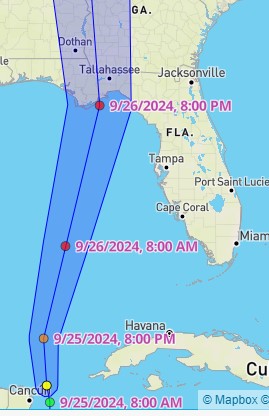
In case you are curious, here's the lastest predicted path (11 a.m.):
Permalink | Read 1116 times | Comments (0)
Category Hurricanes and Such: [first] [previous] [next] [newest]
The public schools around here have already decided to close for tomorrow, and I wonder why.
I take the possibility of a hurricane seriously and tend to err on the cautious side (no hurricane parties); what I question is the timing. So many times in my memory have schools been closed for days that turned out to be absolutely fine. With the weather—especially storms—you simply can't know so far in advance what is going to happen, so why make the decision so early?
I didn't grow up with hurricanes, but we had "snow days," and never knew till the same day whether we'd have school or not. Those are great memories: ears glued to the radio, listening to the list of schools that were closed. It was usually a long list, since most school districts were local and small, and my school district began with an "S" and thus came near the end. Oh, the cheers when they finally called our name (or groans, if they didn't)! My mother cheered as enthusiastically as we did—or so it seemed to me at the time.
The deciding point for closure was whether or not the roads could be plowed in time for the school buses to make their runs. (All but a small handful of us walked to my school, and they never worried about us, but they closed the whole district if the buses to other schools couldn't run. I was grateful for those rural schools.) The Superintendent of Schools would wake up early, assess the situation, and make the decision then.
I don't understand why Florida doesn't do the same.
On the other hand, at least when it turns out to be a false alarm, the kids here have a nice day off. But as I understand it, they must make up missed days later in the year, which we never did, and it sure seems unfair to shorten an expected vacation!
Permalink | Read 1167 times | Comments (3)
Category Hurricanes and Such: [first] [previous] [next] [newest]
The following is from CNN. If you want the information from a news outlet with a different political perspective, you can easily find it. It is essentially the same wherever I look, with varying degrees of concern being expressed but the same story.
Ukrainian President Volodymyr Zelensky told CNN that Ukraine’s request to use long-range missiles on targets inside Russia is part of his “victory plan,” that he is due to present to US officials next week.
Zelensky has been pushing Ukraine’s allies to ease restrictions on weapons and although there have been signs of the US shifting its stance he said they are yet to be given the go-ahead.
“We do have long-range weapons. But let’s just say not the amount we need.” Zelensky said Friday, adding that “neither the US nor the United Kingdom gave us permission to use these weapons on the territory of Russia.”
Speaking to journalists, Zelensky blamed the allies’ hesitation to authorize such use on escalations fears.
Escalation fears? And rightly so! Zelensky wants us to authorize the use of American missiles to strike deep into the sovereign nation of Russia, and he thinks we shouldn't be concerned about how Putin would react?
How would we react if Putin should supply Cubans with missiles and authorize them to use those missiles on the United States? Oh, wait—haven't we seen this already? And avoided World War III by the skin of our teeth and the courage of a Russian Naval officer?
We have been overtly and dramatically poking the Russian bear over the Ukraine for more than two years, including crossing Russia's "red line" by encouraging NATO membership for Ukraine. Actually, we've been messing with Ukraine's politics for a lot longer than that, though most Americans (including me) only became aware of it in early 2022.
Are we so divorced from the natural world that we have forgotten how unwise it is to tease a bear? Let not the one who encourages another to repeatedly provoke a bear think that he himself will escape when the bear turns wrathful.
It is the height of hubris to believe that America can flirt with World War III and remain unscathed. I acknowledge that sometimes a wise, bold, and decisive move made in the right way at the right time can bring about a strategic victory, but that opportunity has passed. It's only my opinion, but for what it's worth, I believe Russia and the Ukraine could have worked out a settlement early on if we had not been encouraging Zelensky and the Ukrainians to believe they could actually win all they want from this war. It's true that a much larger power can sometimes be defeated by persistence on the part of the smaller party and indecisiveness on the part of the more powerful one (e.g. Vietnam and Afghanistan), but the cost—in lives, land, infrastructure, and resources—is unspeakably great. A prolonged war only enriches the wrong pockets.
Consider:
- The United States military is not in a position to win a direct war with Russia, without resorting to terrible—and illegal—weaponry. I'm sorry to say that, and I mean no disrespect to our military personel—at least at the lower levels; I think less of the top brass and the politicians who are making our biggest decisions. But we are insufficient in hardware, personnel, and morale. Our only hope is that Russia is worse off, which it likely is at this point, but that makes it all the more likely that Putin will step out of the bounds of conventional warfare.
- That part about being insufficient in personnel? Perhaps only one who has lived through years of military conscription, as I have, can truly understand the horrors of a draft, the internal damage it causes a nation, and the blessings of an all-volunteer military. I don't see an out-and-out war being fought, let alone won, without a march larger military than we have, and that means conscription. Are we prepared to sacrifice our sons (and likely, this time, our daughters) in a fight that never should have been ours in the first place, if there is any reasonable way it can be avoided?
- We are pouring untold billions of dollars into Ukraine aid, of which over 100 billion directly aids the Ukrainian government. (See this article from the Council on Foreign Relations for details.) Leaving aside all issues of how much is lining corrupt pockets, and how much is sleight of hand in which the U.S. is getting rid of outdated equipment in hopes of being able to replace it with newer technology, that's still an incredible amount of money that we don't actually have. We are saddling our children and grandchildren with an enormous debt burden that makes their impossible college debts look like pocket change. (Side question: Does anyone even have pocket change anymore?)
- Ignoring the critical point that we are spending money that's not ours, and the fact that a massive influx of governmental money often does more harm than good—still, what progress might we have made if we had spend even a small fraction of that (albeit nonexistent) money on (for example) clearing our air and water of dangerous chemicals; supporting childhood cancer research (woefully underfunded compared with other cancers); strengthening our national security by encouraging small farms and businesses, protecting our farmlands and natural resources, building up and protecting our infrastructure, and bringing critical manufacturing back to the United States? (I'm all for international trade, but not at the expense of our independence.)
- By our actions, we have forced Russia to strengthen their ties significantly with countries that view us as a common adversary, China and Iran in particular. That's not good. I'll take a trade war over a war with bombs any day.
- By our heavy involvement in the Ukraine, we have set our relations with the Russian people back decades. They may be upset with Putin for continuing this war, but for certain they are upset with America for what our sanctions have done to them. And rightly so. We had been booked for a visit to Russia in the fall of 2020, and I expected to experience the warm welcome that our friends had enjoyed on their own visits to the country. Thanks to the worldwide, ill-advised panic over the covid virus, that trip was postponed—and later cancelled because of the war. Even if we avoid WWIII, I don't foresee living long enough for relations between Russia and the United States to heal sufficiently for tourist traffic to resume. My father enjoyed his trip to Russia in 1993, when he was my age, and perhaps my grandchildren will have a chance in their later years; I hold no such hope for myself.
- How is it that we care so much about the border between Russia and the Ukraine and so little about the borders of our own country? Our fentanyl and organized crime crises alone are orders of magnitude more important to the American people than which country rules the Donbas.
- I'm starting to believe that the events that mean so much to me, brought home forcefully during our recent trips to Berlin (the Fall of the Berlin Wall) and Gdansk, Poland (the Solidarity Movement), did not please everyone in our country. There appear to be those who very much miss the excitement (and profit) of the Cold War days.
This coming Thursday, President Zelensky will meet with President Biden to push for a green light to send our long-range missiles into Russia.
Regardless of whatever your political opinions may be, if you are a praying person, please pray for this meeting, and for his additional meetings with Kamala Harris and Donald Trump. I am more concerned about the possibility of unthinkable war than I have ever been—and I lived through the duck-and-cover days.
Don't be manipulated. Good advice, but very broad, and hard to follow. This post was inspired by what I have read about "bad actors"—AI bots or paid humans—attempting to sow discontent, anger, and hatred online. The Chinese and the Russians have both been accused of this, with what seems to be pretty convincing evidence, and I fear some of it is also homegrown.
My greatest concern is that Artificial Intelligence is rapidly advancing to the point where we can no longer trust our own eyes and ears, at least where online videos are concerned. It is possible to manipulate images and audio to make it appear that someone is saying something he or she never said. Think what political enemies could do with that! Everything from rigging elections to starting World War III. And you know those crazy spam blackmail threats that claim they recorded you doing "nasty things" in front of your computer? The ones you face with a grim smile and quickly delete because you know you never did whatever it is they claim? Imagine them including a video of you "actually" doing or saying what you did not? What if they show you a candidate for public office in that compromising position? Or your spouse, or your children. What about fake kidnappings? I could go on and on—my imagination is fertile and paranoid.
But that's not where I'm going in this post. AI's not quite there yet, and we have a clear and present danger in the here and now: Angry, profane, and hateful comments posted to articles, videos, and podcasts. Nasty online videos (especially the short form commonly seen on Tik-Tok and Facebook Reels) whose purpose (obvious or subtle) appears to be to stir up negative emotions. And that's just what I see every day; I know there's a lot more out there. It's hard not to have a visceral reaction that does no one any good, least of all ourselves.
And that, I'm afraid, is exactly the purpose of what is being posted. To make us angry; to make us suspicious of each other; to influence our reactions, our actions, our purchases, and our votes.
The best solution I've been able to come up with (and I have no idea how effective it might be, except with me) is this:
- Know your sources. Is this negativity coming from someone you actually know, in person, so that you are aware of the context? Is it from someone you know online only, but have had enough experience with over time to assess his general attitude, reliability, and track record? If not, keep your salt shaker near.
- When in doubt, if the content tempts you to react badly, assume the best: It's a bot or troll whose purpose is to make you angry; or a human tool too desperate for a job to consider its moral implications; or an ordinary human being who has been having a bad day/week/year (doesn't that happen to all of us?). In any case, make an effort not to fall into the trap.
- Avoid sources that usually make you react badly. Unfortunately, I don't think we can afford to avoid seeking information about what is happening in the world. One of the first rules of self-defense is to be aware of your surroundings. But we can be cautious. Even the sources I find most reliable can have nasty trolls in the comment section, so I mostly avoid reading the comments. I'm also trying to wean myself off of the Facebook Reels (mostly ported over from Tik-Tok or Instagram it seems). They can be fun, and funny, and sometimes usefully informative. But they are definitely addictive, and I've noticed that far too many of them are negative, even if humorous, leaving an aftertaste of fear, anger, disgust, and/or suspicion. Not good for the human psyche!
- Consider slowing down? I'm struggling with this one, because of the reality that so much of our information comes in video form these days. Unlike print, in which it is easy to skim for information, to skip over irrelevant sections, and to slow down and reread what is important, and which provides a much better information-to-time-spent ratio, the best one can do with video is to speed it up. I find that almost everything can be gleaned from a video just as well if it's taken in at 1.5x speed, sometimes even 2x. Porter's ears and brain can manage 2x almost all the time. This is a blessing when there is so much worth watching and so little time! However, here's what I'm struggling with: videos watched at high speeds tend to sound over-excited, even angry, when at normal speed they are not. And the human nervous system is designed to react automatically to such stimuli in a way that is probably not good for us if we are not actually in a position to either fight or flee. I don't have a satisfactory answer for this, but I figure it's at least worth being aware of.
- Remember that the people you interact with online are human beings, who work at their jobs, love their families, and want the best for their country, just as you do. Unless they're not, in which case it's even more important not to rise to the bait.
Be aware, be alert, do what is right in your own actions and reactions, and hope for the best. It's healthier for us all.
Permalink | Read 1275 times | Comments (0)
Category Hurricanes and Such: [first] [previous] [next] [newest] Health: [first] [previous] [next] [newest] Politics: [first] [previous] [next] [newest] Random Musings: [first] [previous] [next] [newest] Everyday Life: [first] [previous] [next] [newest] Social Media: [first] [previous] [next] [newest]
In the mad scramble to establish whether or not immigrant families are eating people's pets and wild ducks and geese in parks, the obvious answer is being ignored: Of course they are! What world are you living in if you think they can't be?
After the United States retreated ignobly from Southeast Asia, we were flooded with refugees from that part of the world. "Flooded" is a relative word; the numbers I can find vary, but it appears that it was around 125,000 people before we closed our doors except for the purpose of reuniting families. Which, of course, is a trickle compared with the multiple millions of people coming in now, from all over the world.
There were naturally plenty of difficulties settling so many Southeast Asian refugees and integrating them into our communities, but there were some significant differences between then and now that made that process generally successful.
- Sheer numbers, obviously.
- Comparatively speaking, their entrance into this country was well-regulated.
- As refugees were brought here, they were sponsored by families, churches, and other groups that took responsibility for helping individual refugee families find places to stay, gain employment, learn or improve their English, navigate paperwork, and get their children enrolled in schools. In addition to that, the sponsors provided much-needed friendly relationships, often long-lasting, in an alien and frightening environment.
- Their presence in our country was clearly legal, greatly reducing the refugees' vulnerability to enslavement by gangs, pimps, unscrupulous employers, and crooked cops, lawyers, and judges.
- Again, the numbers. Small numbers of immigrants, relative to the population, can be assimilated and integrated into the host society without causing massive disruption. There is a difference between a summer storm and a category 5 hurricane.
What does this have to do with eating cats? Everything. Even with the relatively small, orderly, and successful assimilation of the "boat people" of Southeast Asia, people are human. They have problems. They lose their jobs, drop out of school, fall victim to unscrupulous predators, are tempted by illegal activities, or can't handle their money well. Especially as time goes on and the social safety net is not so focused and robust. And don't forget that while many of the Southeast Asian refugees were middle class workers who spoke English, many were also "country bumpkins" with no knowledge of Western culture. They weren't stupid people, but they were smart in their own culture; being dropped into an American city made them as vulnerable as I would be if I suddenly found myself in the jungles of Laos.
So some of them were hungry, and they did what hungry people do: they used the skills they had to find food. They fished in the rivers, not knowing and not caring that the rivers were polluted. The hungry belly does not concern itself with mercury levels. They discovered that squirrels abound in city parks, and squirrels make good eating—or so I'm told. Here, we rely on our local hawks to keep the squirrel population under control; back then, refugee families took care of that. I am not making this up.
If you flood an unprepared—and maybe unsuspecting—city with a large population of migrants who do not fit into the culture, who may not even speak the language, and who have no responsible sponsors to welcome them, some of them are going to be hungry. And they are going to do what they have to do to get food.
They're going to help themselves to ducks found conveniently living on city ponds. If they're hungry enough, they're going to eat cats without a second thought for whose pets they might be. Maybe they come from a culture that is too poor to imagine keeping pets and treating them like family members.
Of course they're going to eat pets, and whatever else they can find.

