
 The Road to Character by David Brooks (Random House, 2015)
I read this book on the recommendation of our rector, so I'm sorry to say how much I dislike it. I read it through to the end, hoping it would improve—and because I'm the kind of person who finds it very hard not to finish a book once I've started it, even if I find it depressing.
Generally, I don't read depressing books. If I want to be depressed, I can turn on the news, or spend too much time on social media. As I've said so often, a good book is one that inspires me to be a better person. I don't need books that inspire me to throw up my hands in despair at the state of the world and crawl back into bed.
The sad thing is that this book was intended to have just the opposite effect. From the introduction: This book is about ... how some people have cultivated strong character. It's about one mindset that people through the centuries have adopted to put iron in their core and to cultivate a wise heart.
Here's a mystery for you. The above is as much as I had written on this review back in January. The book has long since been returned to the library, and I have absolutely no desire to read it again, not even for a review. But I have pages of quotations that represent a lot of work and would be a shame to waste. In addition, there's the following intriguing quote from C. S. Lewis's The Magician's Nephew, which I remember that I included because it struck me as representative of what bothered me about several of the people the author chose to use as his postive role models.
"Well, then, it was jolly rotten of you," said Digory.
"Rotten?" said Uncle Andrew with a puzzled look.
"Oh, I see. You mean that little boys ought to keep their promises. Very true: most right and proper, I'm sure, and I'm very glad you have been taught to do it. But of course you must understand that rules of that sort, however excellent they may be for little boys - and servants - and women - and even people in general, can't possibly be expected to apply to profound students and great thinkers and sages. No, Digory. Men like me, who possess hidden wisdom, are freed from common rules just as we are cut off from common pleasures. Ours, my boy, is a high and lonely destiny."
As he said this he sighed and looked so grave and noble and mysterious that for a second Digory really thought he was saying something rather fine. But then he remembered the ugly look he had seen on his Uncle's face ... and all at once he saw through Uncle Andrew's grand words. "All it means," he said to himself, "Is that he thinks he can do anything he likes to get anything he wants."
To the best of my recollection, my quarrel with David Brooks was largely over this attitude; he appears to justify heinous behavior for the sake of a particular character trait he respects. I'm sorry I can't give concrete examples, but the book really isn't worth rereading to find them. Take my word for it, or not.
But the book's not all bad, so here are the quotations:
From the introduction
Occasionally, even today, you come across certain people who seem to possess an impressive inner cohesion. They are not leading fragmented, scattershot lives. They have achieved inner integration. They are calm, settled, and rooted. They are not blown off course by storms. They don’t crumble in adversity. Their minds are consistent and their hearts are dependable. Their virtues are not the blooming virtues you see in smart college students; they are the ripening virtues you see in people who have lived a little and have learned from joy and pain. Sometimes you don’t even notice these people, because while they seem kind and cheerful, they are also reserved. They possess the self-effacing virtues of people who are inclined to be useful but don’t need to prove anything to the world: humility, restraint, reticence, temperance, respect, and soft self-discipline. They radiate a sort of moral joy. They answer softly when challenged harshly. They are silent when unfairly abused. They are dignified when others try to humiliate them, restrained when others try to provoke them. But they get things done. They perform acts of sacrificial service with the same modest everyday spirit they would display if they were just getting the groceries. They are not thinking about what impressive work they are doing. They are not thinking about themselves at all. They just seem delighted by the flawed people around them. They just recognize what needs doing and they do it.
They make you feel funnier and smarter when you speak with them. They move through different social classes not even aware, it seems, that they are doing so. After you’ve known them for a while it occurs to you that you’ve never heard them boast, you’ve never seen them self-righteous or doggedly certain. They aren’t dropping little hints of their own distinctiveness and accomplishments. They have not led lives of conflict-free tranquility, but have struggled toward maturity. They have gone some way toward solving life’s essential problem, which is that, as Aleksandr Solzhenitsyn put it, “the line separating good and evil passes not through states, nor between classes, nor between political parties either— but right through every human heart.”
These are the people who have built a strong inner character, who have achieved a certain depth. In these people, at the end of this struggle, the climb to success has surrendered to the struggle to deepen the soul. ... These are the people we are looking for.
From Chapter 1: The Shift
It occurred to me that I had just watched more self-celebration after a two-yard gain than I had heard after the United States won World War II. This little contrast set off a chain of thoughts in my mind. It occurred to me that this shift might symbolize a shift in culture, a shift from a culture of self-effacement that says “Nobody’s better than me, but I’m no better than anyone else” to a culture of self-promotion that says “Recognize my accomplishments, I’m pretty special.”
…
For example, between 1948 and 1954, psychologists asked more than 10,000 adolescents whether they considered themselves to be a very important person. At that point, 12 percent said yes. The same question was revisited in 1989, and this time it wasn't 12 percent who considered themselves very important, it was 80 percent of boys and 77 percent of girls.
Psychologists have a thing called the narcissism test. They read people statements and ask if the statements apply to them. Statements such as “I like to be the center of attention… I show off if I get the chance because I am extraordinary… Somebody should write a biography about me.” The median narcissism score has risen 30 percent in the last two decades. Ninety-three percent of young people score higher than the middle score just twenty years ago. The largest gains have been in the number of people who agree with the statements “I am an extraordinary person” and “I like to look at my body.”
Along with this apparent rise in self-esteem, there has been a tremendous increase in the desire for fame. Fame used to rank low as a life’s ambition for most people. In a 1976 survey that asked people to list their life goals, fame ranked fifteenth out of sixteen. By 2007, 51 percent of young people reported that being famous was one of their top personal goals. In one study, middle school girls were asked who they would most like to have dinner with. Jennifer Lopez came in first, Jesus Christ came in second, and Paris Hilton third. The girls were then asked which of the following jobs they would like to have. Nearly twice as many said they’d rather be a celebrity’s personal assistant— for example, Justin Bieber’s—than president of Harvard. (Though, to be fair, I’m pretty sure the president of Harvard would also rather be Justin Bieber’s personal assistant.)
Frankly, if I learn that the last statement is true, I will lose all respect for the president of Harvard.
People who live this way believe that character is not innate or automatic. You have to build it with effort and artistry. You can’t be the good person you want to be unless you wage this campaign. You won’t even achieve enduring external success unless you build a solid moral core. If you don’t have some inner integrity, eventually your Watergate, your scandal, your betrayal, will happen.
…
[C]haracter is built not only through austerity and hardship. It is also built sweetly through love and pleasure. When you have deep friendships with good people, you copy and then absorb some of their best traits. When you love a person deeply, you want to serve them and earn their regard. When you experience great art, you widen your repertoire of emotions. Through devotion to some cause, you elevate your desires and organize your energies. Moreover, the struggle against the weaknesses in yourself is never a solitary struggle. No person can achieve self-mastery on his or her own. Individual will, reason, compassion, and character are not strong enough to consistently defeat selfishness, pride, greed, and self-deception. Everybody needs redemptive assistance from outside— from family, friends, ancestors, rules, traditions, institutions, exemplars, and, for believers, God. We all need people to tell us when we are wrong, to advise us on how to do right, and to encourage, support, arouse, cooperate, and inspire us along the way.
…
The most important thing is whether you are willing to engage in moral struggle against yourself. The most important thing is whether you are willing to engage this struggle well—joyfully and compassionately. [British author Henry] Fairlie writes, “At least if we recognize that we sin, know that we are individually at war, we may go to war as warriors do, with something of valor and zest and even mirth.”
…
People with character may be loud or quiet, but they do tend to have a certain level of self-respect. Self-respect is not the same as self-confidence or self-esteem. Self-respect is not based on IQ or any of the mental or physical gifts that help get you into a competitive college. It is not comparative. It is not earned by being better than other people at something. It is earned by being better than you used to be, by being dependable in times of testing, straight in times of temptation. It emerges in one who is morally dependable. Self-respect is produced by inner triumphs, not external ones. It can only be earned by a person who has endured some internal temptation, who has confronted their own weaknesses and who knows, “Well, if worse comes to worst, I can endure that. I can overcome that.”
From Chapter 3: Moderation (Dwight D. Eisenhower)
[T]he moderate knows she cannot have it all. There are tensions between rival goods, and you just have to accept that you will never get to live a pure and perfect life, devoted to one truth or one value. The moderate has limited aspirations about what can be achieved in public life. The paradoxes embedded into any situation do not allow for a clean and ultimate resolution. You expand liberty at the cost of encouraging license. You crack down on license at the cost of limiting liberty. There is no escaping this sort of trade-off. The moderate can only hope to have a regulated character, stepping back to understand opposing perspectives and appreciating the merits of each. The moderate understands that political cultures are traditions of conflict. There are never-ending tensions that pit equality against achievement, centralization against decentralization, order and community against liberty and individualism. The moderate doesn’t try to solve those arguments. There are no ultimate solutions. The moderate can only hope to achieve a balance that is consistent with the needs of the moment. The moderate does not believe there are some policy solutions that are right for all times (this seems obvious, but the rule is regularly flouted by ideologues in nation after nation). The moderate does not admire abstract schemes but understands that it is necessary to legislate along the grain of human nature, and within the medium in which she happens to be placed.
…
The best moderate is skeptical of zealotry because he is skeptical of himself. He distrusts passionate intensity and bold simplicity because he know that in politics the lows are lower than the highs are high—the damage leaders do when they get things wrong is greater than the benefits they create when they get things right.
Let's hear that again: in politics the lows are lower than the highs are high—the damage leaders do when they get things wrong is greater than the benefits they create when they get things right.
Eisenhower warned the country against belief in quick fixes. Americans, he said, should never believe that “some spectacular and costly action could become the miraculous solution to all current difficulties.” He warned against human frailty, particularly the temptation to be shortsighted and selfish. He asked his countrymen to “avoid the impulse to live only for today, plundering, for our own ease and convenience, the precious resources of tomorrow.” Echoing the thrifty ethos of his childhood, he reminded the nation that we cannot “mortgage the material assets of our grandchildren without risking the loss also of their political and spiritual heritage.” He warned, most famously, about the undue concentration of power, and the way unchecked power could lead to national ruin. He warned first about the military-industrial complex—“a permanent armaments industry of vast proportions.” He also warned against “a scientific-technological elite,” a powerful network of government-funded experts who might be tempted to take power away from the citizenry. Like the nation’s founders, he built his politics on distrust of what people might do if they have unchecked power.
…
This was the speech of a man who had been raised to check his impulses and had then been chastened by life. It was the speech of a man who had seen what human beings are capable of, who had felt in his bones that man is a problem to himself. It was the speech of a man who used to tell his advisers “Let’s make our mistakes slowly,” because it was better to proceed to a decision gradually than to rush into anything before its time. This is the lesson that his mother and his upbringing had imparted to him decades before. This was a life organized not around self-expression, but self-restraint.
Although I was around during Eisenhower's administration, I knew nothing of his politics (and, frankly, that's still true). But this chapter makes me wish he'd been the one to craft our national health insurance policy. "Let's make our mistakes slowly" is so far from today's attitude, prevalent among politicians, manufacturers, and software developers, of "Let's throw something together and fix it later."
From Chapter 4: Struggle
[quoting Dorothy Day] “one of the hardest things in the world is to organize ourselves and discipline ourselves.”
From Chapter 5: Self-Mastery
The work of the Roman biographer Plutarch is based on the premise that the tales of the excellent can lift the ambitions of the living. Thomas Aquinas argued that in order to lead a good life, it is necessary to focus more on our exemplars than on ourselves, imitating their actions as much as possible. The philosopher Alfred North Whitehead argued, “Moral education is impossible without the habitual vision of greatness.” In 1943, Richard Winn Livingstone wrote, “One is apt to think of moral failure as due to weakness of character: more often it is due to an inadequate ideal. We detect in others, and occasionally in ourselves, the want of courage, of industry, of persistence, which leads to defeat. But we do not notice the more subtle and disastrous weakness, that our standards are wrong, that we have never learned what is good.”
One more time: We do not notice the more subtle and disastrous weakness, that our standards are wrong, that we have never learned what is good.
From Chapter 7: Love
Sometimes you see lack of agency among the disadvantaged. Their lives can be so blown about by economic disruption, arbitrary bosses, and general disruption that they lose faith in the idea that input leads to predictable output. You can offer programs to improve their lives, but they may not take full advantage of them because they don’t have confidence that they can control their own destinies.
…
Self-control is like a muscle. If you are called upon to exercise self-control often in the course of a day, you get tired and you don’t have enough strength to exercise as much self-control in the evening. But love is the opposite. The more you love, the more you can love. A person who has one child does not love that child less when the second and third child come along. A person who loves his town does not love his country less. Love expands with use.
He's right about love, but I’m certain, despite recent studies, that he is wrong about self-control. Perhaps it is true in the short term, but I’m convinced that over time, self-control gained in one area makes it easier to gain self-control in another. Using his own analogy, muscles grow by use.
From Chapter 9: Self-Examination
The Germans have a word for this condition: Zerrissenheit—loosely, “falling-to-pieces-ness.” This is the loss of internal coherence that can come from living a multitasking, pulled-in-a-hundred-directions existence. This is what Kierkegaard called “the dizziness of freedom.” When the external constraints are loosened, when a person can do what he wants, when there are a thousand choices and distractions, then life can lose coherence and direction if there isn’t a strong internal structure.
…
Today many writers see literature and art only in aesthetic terms, but [Samuel] Johnson saw them as moral enterprises. He hoped to be counted among those writers who give “ardor to virtue and confidence to truth.” He added, “It is always a writer’s duty to make the world better.” As [literary critic Paul] Fussell puts it, “Johnson, then, conceives of writing as something very like a Christian sacrament, defined in the Anglican catechism as ‘an outward and visible sign of an inward and spiritual grace given to us.’ ”
…
Many try to avoid sorrow by living timid lives. Many try to relieve sorrow by forcing themselves to go to social events. Johnson does not approve of these stratagems. Instead, he advises, “The safe and general antidote against sorrow is employment…. Sorrow is a kind of rust of the soul, which every new idea contributes in its passage to scour away. It is the putrefaction of stagnant life and is remedied by exercise and motion.”
From Chapter 10: The Big Me
If you were born at any time over the last sixty years, you were probably born into what the philosopher Charles Taylor has called “the culture of authenticity.” This mindset is based on the romantic idea that each of us has a Golden Figure in the core of our self. There is an innately good True Self, which can be trusted, consulted, and gotten in touch with. Your personal feelings are the best guide for what is right and wrong.
…
According to an Ernst & Young survey, 65 percent of college students expect to become millionaires. … parents with college degrees invest $5,700 more per year per child on out-of-school enrichment activities than they did in 1978.
I include the statements in the last paragraph just because they exemplify one of my pet peeves with writers who throw numbers around casually. The author thinks he is supporting his points, but these numbers are meaningless. "Millionaire" does not mean the same thing in 2016 as it did 100 years ago, when there were just over 200 in the whole country of 102 million people.* And a bare figure like "$5,700 more" means nothing unless you know whether or not it has been adjusted for inflation, which between 1978 and now was 363%, according to the Bureau of Labor Statistics. What's the point of using numbers in this way? At best they confuse; at worst they deceive.
*I know you're curious. Today American millionaires number about 10.4 million out of a population of 323 million or so. If you think there's been a lot of inflation since 1978....
Easter is in less than three weeks so it's time to bring back my favorite new Easter song from last year. I know it's still Lent, but the only way to learn a new song in time for Easter is to start practicing earlier. Enjoy!
'Way back in the early 1980's, our little city of Altamonte Springs pioneered a program of reclaiming treated wastewater for irrigation. Now we're capturing stormwater runoff from Interstate 4 and reclaiming that, instead of collecting it in retention ponds. I love our city. "Progressive" is not always a positive term, but in the case of Altamonte Springs it means some great innovations.
Here's the most recent: the city is partnering with Uber to offer discounts on rides within the city, and greater discounts from anywhere in the city to the SunRail train station. It is the first city in America to do so.
I've said for years that Altamonte Springs needs a good public transit system, but couldn't figure out a way to make it work with our sprawling subdivisions. There are two bus stops just outside our neighborhood, but it takes me 30 minutes to walk there—very difficult with luggage (when I take the bus to the airport) and impossible for less able folks. Taxis are expensive and in my experience take an unacceptably long time to arrive. They're not really interested in short hops, which covers just about any ride from one part of Altamonte Springs to another.
I had envisioned some sort of on-demand mini-bus system that would provide transportation from neighborhoods to the city's major attractions, but did not see how it could possibly be affordable. Later, several local cities did try to create such a program with Lynx, the Orlando area's existing bus system, but it fell through. Lynx rejected the idea as too costly.
Then along came Uber.
I'll be the first to confess that Uber, like Airbnb, makes me nervous. Good Democrat that I am, I harbor an innate belief that governmental regulation means better safety. This creates conflict with my Inner Libertarian, who knows that to be false, my Inner Republican, who thinks private industry can usually do a better job, and my Inner Distributist, who trusts small, individual capitalists and worries about large, corporate ones. Many of our friends speak highly of their Uber experiences, and Altamonte Springs has just propelled me into their camp, though I've yet to take my first ride.
Now if only the people who run SunRail had half as much sense as Altamonte Springs, and offered service to the airport!
Toubab.
White person.
I'm told it's not a racial slur, but have my doubts. It felt like one. It was certainly a verbal assault.
Toubab, toubab, toubab! Give me candy ("minties"), give me pencils, give me money, buy my product, what do you have for me?
Everywhere we went we were assaulted by this cry, from children and adults, but especially from the children. I'm told it's much, much worse in the main tourist areas—which we avoided—where hustling is a major adult occupation, but it was saddest to see in the children. Even toddlers came up to us with their hands out, calling "Bab!"
Before we left home, we were advised from many sources to bring a supply of items to give to the children. Some recommended candy, others pencils or pens. Well, why not? It's a trivial expense for us, and so joyfully received by the kids. Why not give them a little happiness?
Fortunately, Kathy warned us in time to halt that apparently generous impulse. The lesser of the consequences is what it does to white people living in the Gambia. Because begging is so successful with tourists, who are generally white, local whites cannot go about their everyday lives without being bombarded by swarms of pint-sized mendicants. It feels painfully rude to pointedly ignore people, especially children, but it's the best defense.
The worst consequence, however, is what the practice does to the Gambians. From the time they learn to walk, these children are being taught that the way to acquire anything is to beg for it. This mendicant culture does not leave them as they grow, though it morphs into a more sophisticated form: the country is completely dependent on foreign aid, NGOs, grants, and donations from overseas.
Nor does it help when the donors are no more careful about their gifts than tourists thoughtlessly tossing candy to a crowd of children. While we were there we saw boxes piled on boxes, just sitting in a storeroom—as they had been for over a year—labelled "Books for Africa." No doubt the American donors are content as they imagine happy children poring over their books, and maybe, someday, in "Gambian Maybe Time,"* they will—if the volumes don't rot away in storage first. Bureaucratic nightmares, graft, and outright fraud prevent a lot of well-intentioned assistance from reaching those who need it. Kathy told us of one organization in Germany that persists in pouring money into a local group despite having been shown clear evidence that it is nothing but a scam.
Need in the Gambia is great. Unemployment is very high, and long before Syrian refugees made the headlines, young Gambian men were taking the "back door" route to Europe (illegal entry), which many still see as their best hope. But if the Gambia itself is to have hope, they need to shed the mendicant mentality. For now, they do need aid from outside, but if that aid isn't aimed at putting itself out of business, it does more harm than good.
Without the wisdom of the serpent, the dove isn't so harmless after all.
Despite many serious problems, the Gambia is making progress, and there are places where money can make a big difference. Education, for example, and the simple act of helping a family with their children's school fees. But even that is a painfully slow process with some backward steps along the way. The government has made education a priority, and indeed there are now many more schools available. Unfortunately, the creation of new school buildings vastly outstripped the availability of competent teachers for staffing them. More children than ever are going to school, but without decent teachers, many are simply wasting their childhoods (and their parents' or sponsors' money) sitting in classrooms. That's one reason help with school fees is a good investment; many private schools, though far from all of them of course, still provide a good education. That is why you will often see see Muslim children at Catholic schools, with their families' blessing: since Muslims and Christians generally get along well in the Gambia, parents who value education don't hesitate to take advantage of good schools whenever they can.
To return this post to the experience of being the only white folks in a sea of people whose skin has a deep and rich darkness almost never seen among American blacks—it wasn't nearly as surreal as you might think. After all, I don't usually see my own face. It was when I looked at Porter and Kathy that I was startled by the contrast. If it hadn't been for those never-ending cries of "toubab!" I might have been able to forget what I looked like.
*The Gambia's time zone is Greenwich Mean Time, but the wry observation that GMT stands for "Gambian Maybe Time" is not without basis in fact.
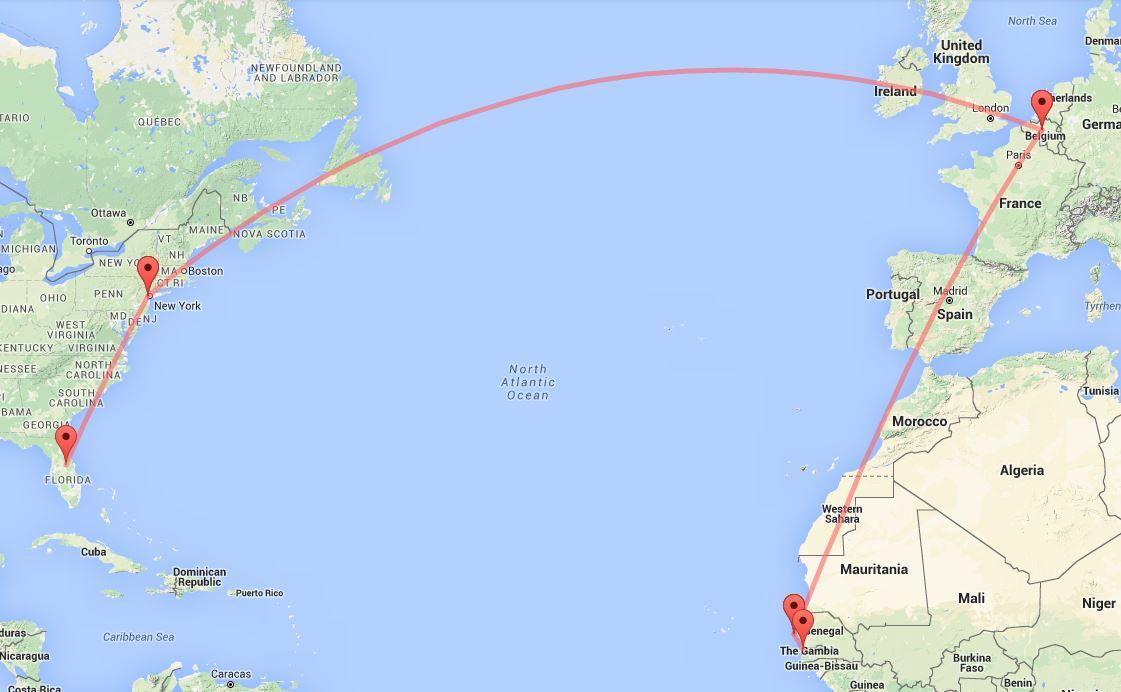 Before the wheels of our first flight had left the ground, at least five people had, separately and individually, encouraged me to "enjoy the adventure." This became my motto throughout the trip, helping me glide through moments where I amazed Porter with my relaxed lack-of-panic. I really did enjoy almost every part of the adventure, all the more so looking backwards and knowing that so many things that could have gone wrong, did not. It was all in all an amazing two weeks, and when people ask if we will return, the reason for replying, "not anytime soon" is not due to negative experiences, but that there are so many other places we want to see.
I will, however, admit that the largest factor in making the trip both awesome and not scary was having a friend on the ground (Kathy, with several years of local experience) and a caring, competent guide/guardian angel (Kathy's student and friend, B). From New Zealand to Japan, Switzerland, France, and now the Gambia, my taste in overseas travel has always favored the local over the standard tourist experience.
Thursday, January 14 - Friday, January 15 Our first day of travel was actually our first two. We left Orlando at a comfortable time, shortly after noon, and arrived in Banjul around six the next evening. Porter had done a lot of research into flights from here to the Gambia, including options that had us going via Tenerife and Casablanca. That would have been interesting, but I'm glad we ended up with a much shorter trip on an airline less renowned for losing luggage.
 First stop: Newark. We've flown through Newark a lot, but United's international gate area was something new indeed, and made for a very pleasant wait. Every airport I've flown out of has some sort of seating at the gate. Good airports have electrical outlets available, but never enough. Many times I've seen pleasant seats going unused at a crowded gate, while weary travellers sat awkwardly on the floor next to the few existing electrical outlets, all of which were positioned to favor the cleaning crews' vacuums over travellers' electronic devices. The better airports have charging stations, or power outlets available in some seats, but again, never enough.
United Airlines in Newark had enough. In addition to power outlets and desk space, each station was equipped with a tablet from which one could use the Internet, play games, shop at various airport stores, and order food. I call that a great idea, though I didn't sit down for long. I left Porter at work at our desk, watching over my charging phone, while I did laps around the gate area, logging my customary 10,000 steps for the day. I would accomplish that goal only three more times before returning home. Contrary to all my expectations, we sat a great deal more than we walked in the Gambia.
 Travelling long distances with small children is challenging at best, and when the airline has lost your stroller and the Customs officials are being particularly nasty it can be a nightmare. Travelling alone means there is no one to watch your belongings when you want to duck into the restroom or pick up a bite to eat along the way. (The fancy new setup at the airport gates can take care of the latter problem, but not the former.) But long flights with several stops can be enjoyable and even restful if you're travelling with a pleasant, adult companion and plenty of entertainment in the form of Kindle books and World of Puzzles magazines. Time changes have also become a lot easier to deal with since I've learned to sleep on the plane when I'm tired and not pay attention to the clock when I'm not. (It also helps to arrive at one's destination in the evening rather than in the morning.) All that to say, as long as the flights are more or less punctual and I have plenty of time to make connections, I enjoy air travel.
 On this trip I added three new countries to my collection in a single day. By the time we landed in Brussels it was Friday. (Technically, I didn't actually enter Belgium until our return trip, as we didn't have to go through Passport Control to catch our next flight.) This cute recycling station is the only photo worth sharing I have from our stay in Belgium.
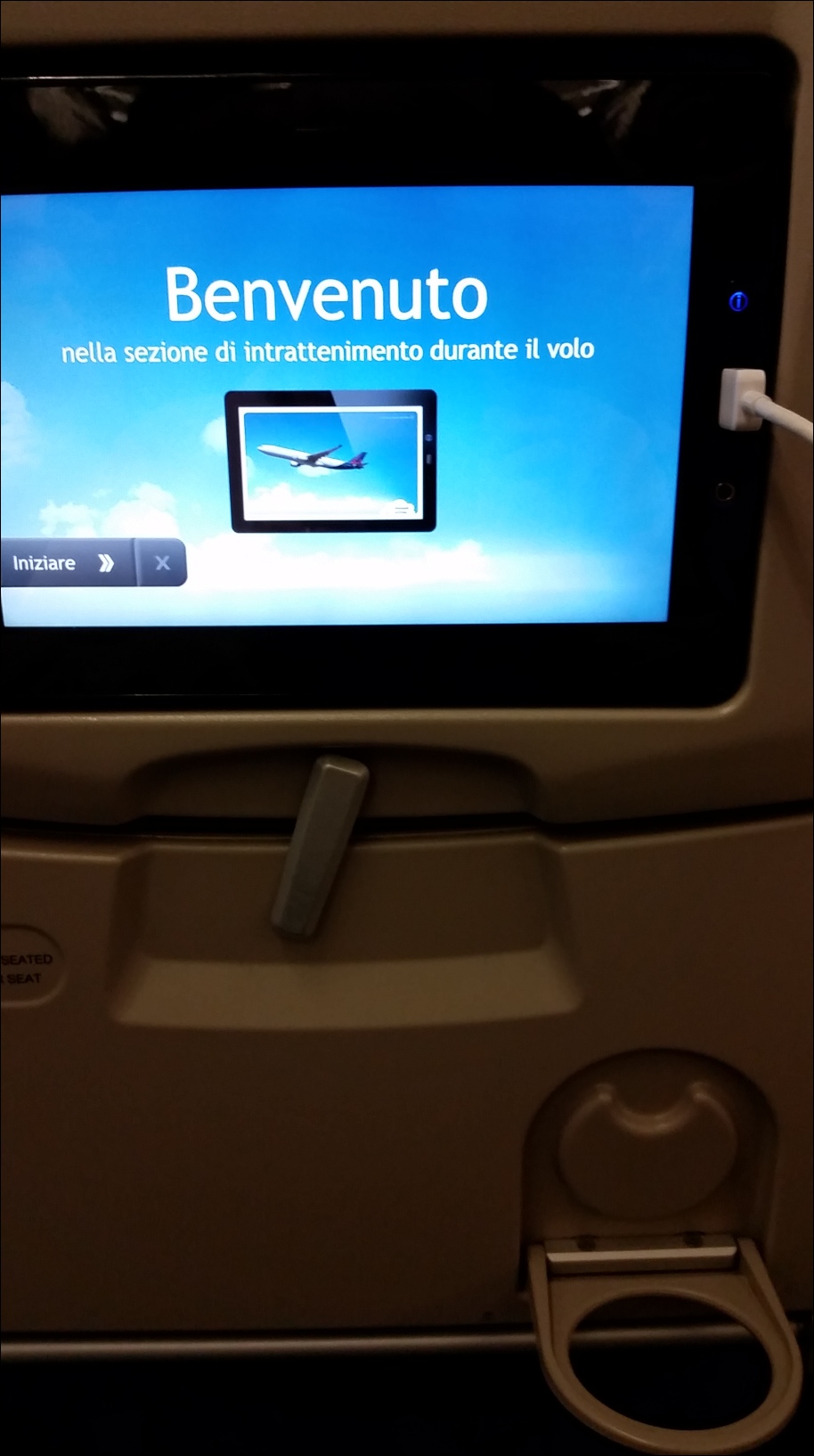
Our Brussels Airlines flight to Senegal, however, provided this example of an intelligent seat console, complete with cup holder and USB charging port. As usual, there wasn't much attractive to me in the entertainment offerings, but I did enjoy watching The Martian for the second time. It was especially enjoyable having read the book since my first viewing of the film. Porter also took the opportunity to watch Bridge of Spies, which he thought was great.
 We didn't officially enter Senegal on this day, either, as we did not change planes. We waited there for over an hour, however, and I was allowed to get to the very edge of the door to snap this photo.
The flight from Dakar to Banjul is short; we probably spent less time in the air than we did getting out of the airport once we landed. Our first impression of the Gambia was not the most pleasant: long waits, and people pushing and shoving and hustling. What must the Swiss think? The Swiss know how to wait a few steps back from the luggage carousel, so that everyone can see, approaching the belt only when it's time to pick up their own bags.
This was also the only time our luggage has been x-rayed on the way out of the airport.
We were glad to be able to tell the hustlers that we had no money; Kathy had dalasis for us, but she was out of reach on the other side of the border controls. At least we certainly hoped so, though she was out of sight as well. We learned later that the hustlers would have been happy to take our dollars, but we weren't inclined to want help with our luggage, anyway.


Finally we made it through, and there was Kathy—and how great it was to see her again! And to meet B., whom we knew only by name and voice: he had recorded the numbers from 1 to 100 in the Mandinka language for our number-and-language loving grandson, Joseph. Apparently B. felt the connection, too, as one of the first things he asked us was to tell him more about Joseph.
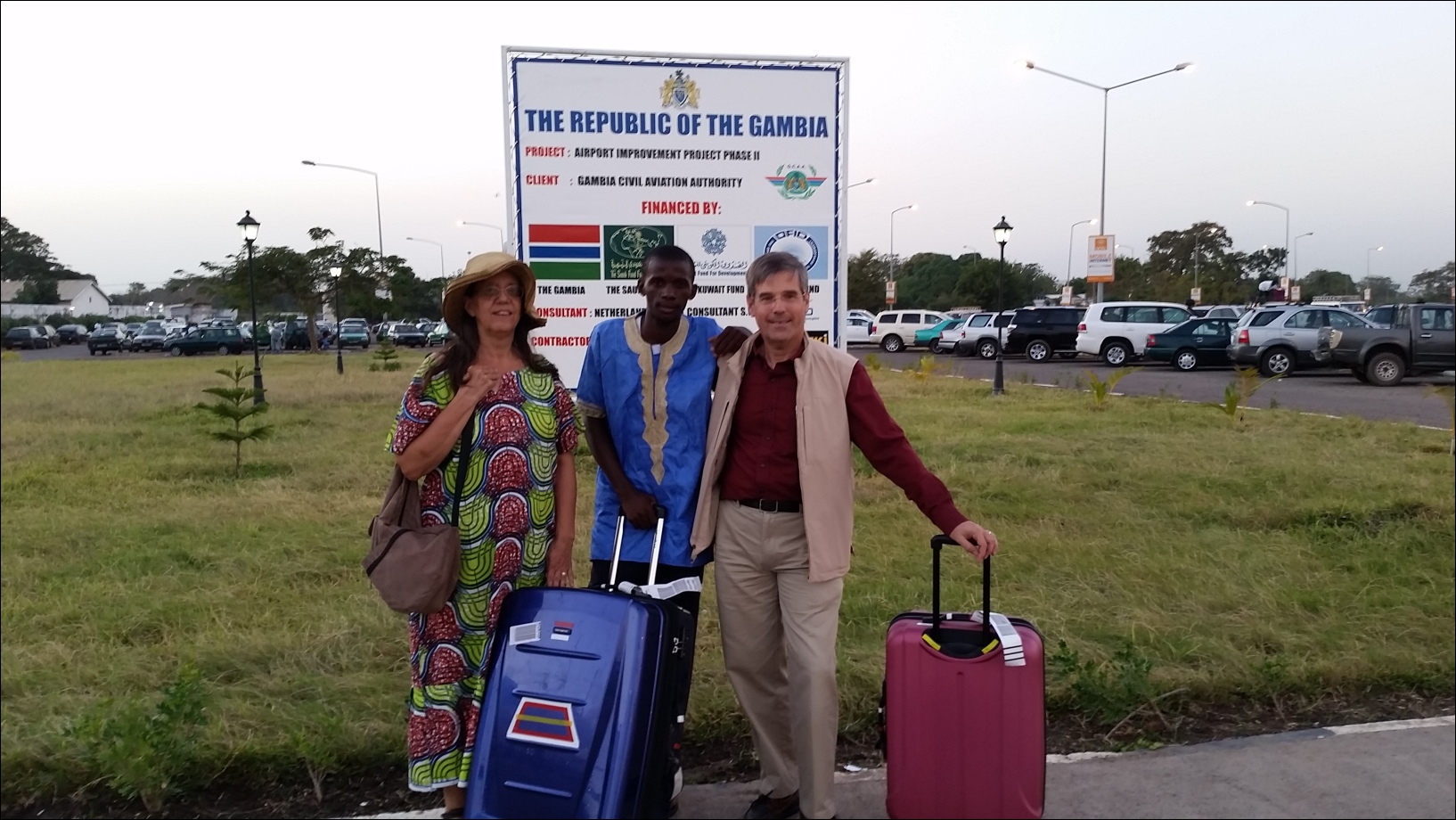
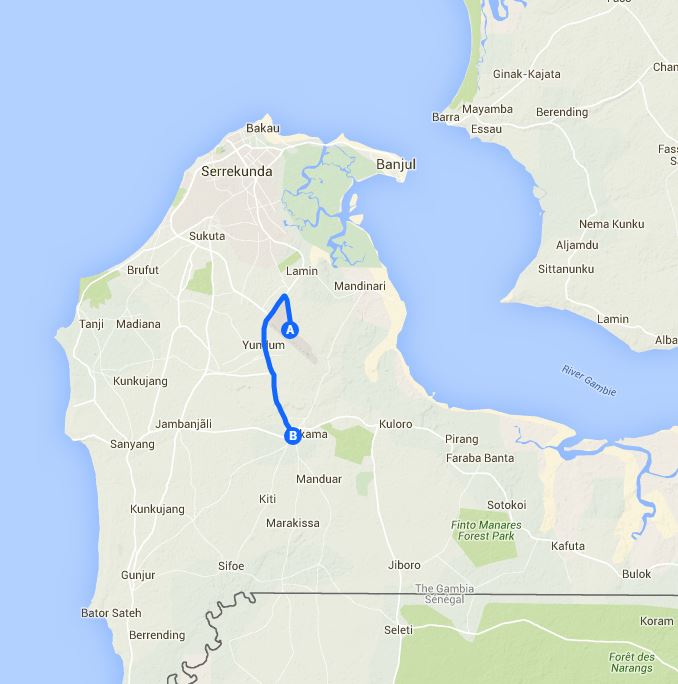
B. had arranged a car to transport us all to Brikama, where Kathy lives. The trip began a bit inauspiciously, as in order to start the engine the driver resorted to a trick I remember seeing as a young child: getting several men—including Porter—to push the car to a certain speed, then popping the car into gear. After a couple of tries, it worked, and we were on our way.
Google says it's a 20-minute ride. There's a lot Google doesn't know.
The car started giving trouble. It stalled. They were able to get it started again, by the same method. It stalled again. The driver decided something serious was wrong, and put into effect the Gambian equivalent of calling AAA: he hitched a ride back to the town we had just passed through and found someone else with a car, who took us to our destination and then returned to help out the first driver.
It was while we were waiting for the second car—in the rapidly-falling darkness of a land near the equator, on an isolated stretch of the highway with no street lights, in a completely foreign third-world country—that Porter wondered why I was so calm. Well, why not? Kathy wasn't upset, B. wasn't upset, and the driver was only upset with the person who had borrowed his car and apparently treated it badly. If the people who knew the country found nothing of special concern in the situation, well then, it was just part of "living the adventure."
Finally, we arrived at Kathy's place. We were more exhausted than hungry, but B.'s mother had send us dinner, and he joined us for the meal. We weren't too tired to enjoy both our first Gambian meal and the conversation.
But thus it came about that practically the first thing we did upon arrival in the Gambia was to break the rules our doctor—and all the travel advice sites, including the CDC's—gave us about what not to eat there: Be sure to avoid everything—except for fruit that you peel with your own hands—that has not been thoroughly cooked.
It was a problem that we would face throughout the trip: how to balance our health and safety concerns with the need to be courteous to our hosts. We felt that in this case the choice was clear, so we dug right in to a dish that included fresh tomatoes and lettuce. It was just another part of the adventure. And although we didn't know for sure until the next day, I'll close by revealing the punch line.
We did just fine.
There was evening, and there was morning: the first day. And it was very good.
 Yesterday was the first day of EPCOT's Flower and Garden Festival for 2016, and we were there to celebrate its opening. As always, the flower displays were wonderful, and the portable butterfly garden was fun.
The only "ride" we bothered with this time was Impressions de France, the wonderful tour of the country accompanied by even more wonderful music by French composers. This film is one of the few parts of EPCOT that remains unchanged, and since we both agree that few of the changes have been for the better, the French pavillion has become an EPCOT "must do" for us, as Dr. Doom's Fearfall is at Universal.
You never know, with YouTube videos, when some official is going to decide one violates something-or-other and take it down, but for now, at least, you can see an excellent production by Martin Smith of his visit there in 2011. I trust Disney World recognizes it for what it is: a longer commercial for EPCOT than they could ever get away with.
Our Disney disappointment came with lunch, which we had intended to enjoy at Norway in World Showcase. Norway used to be one of our favorite stops because of the Maelstrom ride, which sadly is now closed in preparation for being replaced by something based on the movie, Frozen. Oh, how I miss the days when the company abided by Walt Disney's admonition that EPCOT should remain completely separate from the movie characters!
As it turns out, there is now no reason at all to visit the Norway site. The Akershus restaurant, where we had intended to eat, has been turned into a "Princess Storybook Dining" event, exclusively. We were greatly disappointed, as the delicious and authentic Scandinavian fare was something we were looking forward to when we sprang for annual park passes for the first time in many years. But we declined the experience, on the grounds that if we were going to spend over $50 per person for a meal, (1) we did not want a "Disney Princess experience," and (2) we wanted better food than we could expect from a restaurant whose primary audience is now children. Apparently the only other hope for Scandinavian food in Central Florida is IKEA, so you know what a blow this was.
It was hard to stay sad for long, however, since as part of the Flower and Garden Festival they have set up many additional food kiosks, in the manner of the Food and Wine Festival, and we enjoyed some good Moroccan snacks followed by a lemon scone with crème fraîche and blueberries.
I've been overseas every year for the past decade, so it ought to be routine by now. But travelling to the Gambia is not like travelling to Japan or to Switzerland. For starters, we needed visas.
Most visitors to the Gambia don't need visas, but the United States is special. American tourists are required to fill out a bunch of paperwork and fork over $100 (each). Because we have family overseas, we are always a bit nervous when our passports are out of our hands, but the process went smoothly and we had them back, with the necessary visas, in just a few days.
.jpg) Then there was the medical side. Immunizations (yellow fever, typhoid, meningococcal, hepatitis A & B) and medications (malarone to be taken daily as an anti-malarial, Cipro in case of traveller's diarrhea, probiotics in case we had to use the Cipro) cost us some $1200. We were spared the rabies vaccine, although if the doctor had known how many stray dogs we were to encounter, the story might have been different. Our insurance company believes in funding preventive medicine, they say, but clearly their idea of tropical disease prevention is encouraging people to stay home.
Then there was the medical side. Immunizations (yellow fever, typhoid, meningococcal, hepatitis A & B) and medications (malarone to be taken daily as an anti-malarial, Cipro in case of traveller's diarrhea, probiotics in case we had to use the Cipro) cost us some $1200. We were spared the rabies vaccine, although if the doctor had known how many stray dogs we were to encounter, the story might have been different. Our insurance company believes in funding preventive medicine, they say, but clearly their idea of tropical disease prevention is encouraging people to stay home.
And finally, the new wardrobe. As nearly all of you know, I'm not a shopper, I don't care anything about clothes as long as they are comfortable, and the occasions for which I will put on a dress or a skirt are so rare as to be barely perceptible. (Weddings of family members. That's about it.) But then Kathy happened to mention—fortunately, in time for us to do something about the problem—that I'd need to wear a skirt or dress (mid-calf or longer) whenever we went out in public, and even at home if we had visitors.
I suppose most women would have just packed a few dresses and been fine. I needed to go shopping (oh, joy) and climb over a major psychological barrier. Dresses, after all, are the tools and symbols of oppression. Oppression of women by men, of children by parents, of students by teachers. Unless you happen to be the queen, or to live in Scotland, skirts are not associated with power.
While I might not be as sensitive as some in my family to shirt tags and wrinkles in my socks, it's still an issue for me, and I still remember, and not happily, the time when as a very young child I was required to wear a certain dress—beautiful, and hand-made with lots of love, but very scratchy—for an interminable period. Really, it was just long enough to go to the photographer's for a professional picture, but it was torture to me. I'm grateful that most of the time my mother was more merciful when it came to my clothes, but dresses = discomfort was ingrained in me from an early age.
And then there was school. As if school weren't oppressive enough all by itself, in those days all girls were required to wear dresses or skirts and blouses. Even on the playground, even in gym class. Girl Scout uniforms were dresses. Church clothes were dresses. Believe me, if it had been possible for me to get used to wearing skirts, I had plenty of opportunity to do so. It didn't happen.
On top of that, dresses in those days were not loose and flowy, but short and tight. It was the era of the miniskirt; even for the more conservative among us hemlines had to be above the knee, greatly limiting movement and action. A dress was a prison. But the times, they were a-changin.' When I went off to college I left my dresses behind me, and after graduation being a computer programmer allowed me to land a job without much in the way of a dress code. I'm not certain, but I think the next time I wore a skirt was at the rehearsal dinner before our wedding.
Hence my psychological shock at Kathy's statement. Oh, tourists can get away with anything for the sake of their euros, and students sometimes wear jeans and t-shirts, and the rules in that patriarchal society are much looser for men—though Porter still could not wear shorts despite being just 13.5 degrees away from the equator. But mature women do not show their legs in the Gambia. Not if they want to be respected. Kathy quite rightly did not want her American friends to embarrass her Gambian friends. We probably did, anyway, because Gambian women dress beautifully at all times, and even the men have a keen sense of style. But at least we weren't immodest. (Incidentally, Gambians have a much healthier attitude toward public breastfeeding than Americans; it's legs that have to stay covered.)
_WPW_GM_Fajara_Kathy, Linda walking along Kairaba Avenue.jpg) Nothing about the experience was as bad as the anticipation. The shopping was the worst, but Kohl's and Target (both online) came through with three acceptable skirts at reasonable prices. They were even comfortable, as skirts go, because they were soft and loose and long. I ended up only bringing two with me, not wanting to take the time to do necessary hemming on the last one, but why should I need more than two? We wouldn't be going out in public that much, would we? (Well, yes, we would. But two skirts were still sufficient.)
Nothing about the experience was as bad as the anticipation. The shopping was the worst, but Kohl's and Target (both online) came through with three acceptable skirts at reasonable prices. They were even comfortable, as skirts go, because they were soft and loose and long. I ended up only bringing two with me, not wanting to take the time to do necessary hemming on the last one, but why should I need more than two? We wouldn't be going out in public that much, would we? (Well, yes, we would. But two skirts were still sufficient.)
My sister-in-law made an odd but brilliant suggestion, in the form of mid-thigh underwear from the Vermont Country Store. I was skeptical, and indeed they did not suit me as underwear. But as something to wear under my skirt and over my usual underwear, they were perfect for the Gambian weather situation: temperatures in the 90's and no air conditioning. The over-underwear did a wonderful job of absorbing the sweat that otherwise poured uncomfortably down my legs. (As a Floridian, I'm accustomed to hot weather, but deal with it by [1] wearing shorts, and [2] relying on air conditioning.) There's also no overestimating the psychological value: they felt like shorts on my body, which helped undo some of the mental discomfort. I had one other trick up my sleeve as well: When I caught myself feeling overpowered and bowed down because I was wearing a skirt, I imagined being a Scottish chieftain, and that actually worked—even though my skirt could hardly have looked less like a kilt.
We were out in public a lot. As Kathy explained, the Gambia is a hard place to be an introvert. Although I would usually rip my skirt off in favor of shorts as soon as we walked in the door of her house—in order to cool down a little—for most of our two weeks in the Gambia, I lived in a skirt.
And we developed an uneasy friendship, the skirts and I. After returning home, I washed them and put them away in the back of our closet, so glad, as they say, to see the back of them. But one day, after sufficient time has passed, I will pull them out again and wear them for some occasion, perhaps a party. I'm glad to have them in my arsenal of clothing. Being loose, long, and of soft material they are a far cry from the dresses of my childhood. Besides, they are full of wonderful memories!
As for the rest of our trip preparations, I suppose they were mostly normal. We had our tickets, our visas, our "yellow cards" showing yellow fever immunizations, our anti-malarial meds, the proper clothing, and a few gifts. It was time to begin the adventure!
I know people who are fond of saying, as if it were original with them and somehow encouraging to others, that we should never ask for what we deserve, because what we all deserve is Hell. As unhelpful as this aphorism is, there are times when everyday life points to a kernel of truth there. We remember vividly the times when we've done something stupid and paid the price, or done something stupid and managed somehow to escape disaster, but we may not even be aware of how many, many times we've been equally stupid, or more so, and escaped scot free. How often have we taken a foolish chance while driving, or set a can of soda near the computer, or carried a large stack of breakable objects? How many times have we thought, "I knew that was going to happen" when a foolish risk has ended badly? Truly, when we know what we should do and act otherwise, do we deserve to escape the consequences? No—but surprising often, grace abounds anyway.
It's an old, sad story, and out of respect for those who, like me, are not fond of suspense, I'll say up front that this one has a happy ending.
I'm usually a bit compulsive when it comes to doing backups. I have general backups, and specific backups. Whole and incremental backups. Backups divided over several years and different external drives. But I'm not perfect about it, and this was one of those times.
Mostly I find a once-a-week backup sufficient for my needs, but recently I've been working pedal-to-the-metal on processing our photos and videos from the Gambia, so I got into the habit of backing up my work every night. See, I know the right thing to do! But one night the backup system gave me trouble. Instead of spending the next day sorting it out, I carried on feverishly with my work. I was making such good progress! Who could be bothered with a problem that was, I knew, going to be frustrating and time-consuming to sort out? So for a few days—highly productive days—that nightly backup didn't happen.
I'm a big fan of the recycle bin. I love that a deleted file doesn't really disappear right away, so that accidents and mistakes are reversible. However, some files, such as video files, are too big for such treatment. For those I use the shift-delete function, which bypasses the recycle bin and erases the file directly.
One morning I was working with a number of video files, and got a little too careless with my quick response to the "Are you sure you want to permanently delete this file?" question. I was certain I had highlighted the video I was done with, but Windows Explorer had other ideas. You want to delete the entire directory? The entire directory with your final processed photos? The directory that represents 60+ hours' worth of work? Fine, no problem, I can do that for you in under a second.
I stared at the computer. I didn't believe what appeared to have happened. I turned my computer inside out, searched from top to bottom. Finally I let myself admit that the files were gone. Completely. Gone.
I was surprisingly calm. Sometimes big events leave you too overwhelmed to be upset. Besides, I did have some backups, though they were, as I said, a few days old, and the most recent one had been corrupted by the above-mentioned problem. But as I also said, I'm usually compulsive about backups, and if I didn't have my work in final form, I did have it in next-to-final form, and the form before that, and the form before that. What had been done once could be done again, and though the magnitude of effort lost was mind-boggling, I took comfort in a comment reader-friend Eric once made here about work being done better the second time around.
As it turned out, we'll never know how much better I would have done the second time, and that's more than fine with me.
When files are deleted from a drive, even by shift-delete, they're not really erased. They're no longer visible to the user, but the data's there until it's overwritten. I knew that, but had no idea how to take advantage of it. Then a little Internet research led me to a data-recovery program called Recuva.
Had my files been on the C drive, I may have been in trouble, because I did quite a bit of work before finding that program, and the more time that elapses, the more likely the data is to be overwritten. But because of space considerations, my data was on an external drive that I had been careful not to write to since the loss. The operating system, or some other program not under my control, probably did something, but—to shorten the story—with the help of Recuva I was able to recover all but about half a dozen files. The few that had been damaged I easily recreated from the next-to-final layer. I'm very grateful I did not accidentally delete a higher-level directory!
Curious as to what an overwritten file looks like? Here are an original and its corrupted version. You can still see some of the basic structure. (Click to enlarge.)
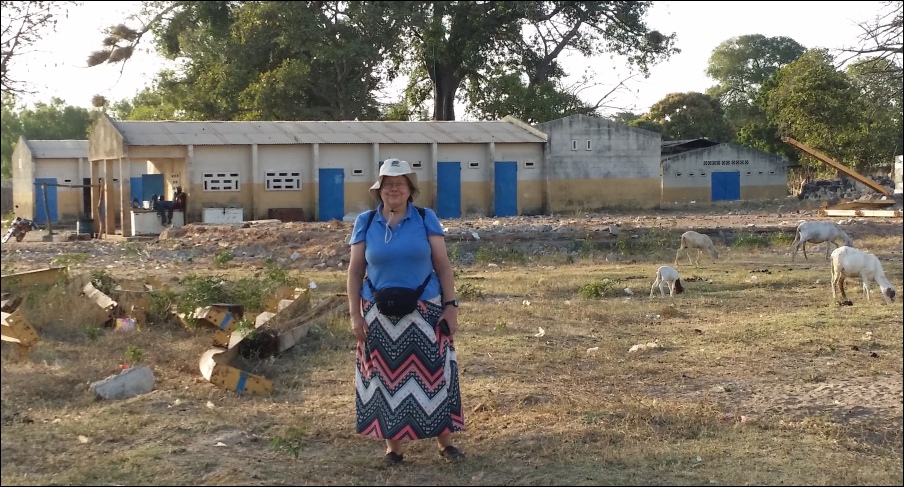

Once I had the program downloaded and unzipped to a flash drive, using Recuva to restore the files was quick and easy. The long and tedious part of the job came in checking the integrity of the recovered files, but that only took five or six hours, and by the next day I was back to where I'd been 24 hours earlier.
With one important exception: I now have Recuva on that flash drive, available should I need it again. It's especially important to have it handy in case I ever need to recover files from the C drive, where overwriting can happen quickly. Which I sincerely hope never happens!
It's amazing how easy it is to accept the loss of a day's work—which normally would have had me tearing my hair—when faced with the realization that the loss could have been many times greater.
Truly, grace abounds.
Permalink | Read 2864 times | Comments (3)
Category Computing: [first] [previous] [next] [newest] Travels: [first] [previous] [next] [newest] Everyday Life: [first] [previous] [next] [newest] The Gambia: [first] [previous] [next] [newest]
Joyce K. is a very good friend of our family, and though she has plenty of grandchildren of her own, she happily played a grandmotherly role to our children. Formerly of Philadelphia's Savoy Company, she is a great lover of Gilbert and Sullivan and introduced our kids to that joy at an early age, through a children's book version of "The Pirates of Penzance." I believe she also provided the taped-from-TV videotape now mouldering away lovingly preserved in our cupboard (the Rodney Greenberg version, starring Peter Allen as the Pirate King).
We nearly wore the tape out. When Janet went to kindergarten, and was interviewed for one of those "all about me" posters, she confounded her teacher by responding to the inane question, "What's your favorite TV show?" by answering, "The Pirates of Penzance." One of my joys of those years was hearing quotes from the show pop up in the girls' conversations.
Fueled by those memories, I let work grind to a halt today while I created an excerpt from that tape as an homage to this special, quadrennial day.
Permalink | Read 2278 times | Comments (0)
Category Just for Fun: [first] [previous] [next] [newest]
 The Fatal Tree by Stephen R. Lawhead (Thomas Nelson, 2014)
This is the final book in Lawhead's Bright Empires series, of which the first four were The Skin Map, The Bone House, The Spirit Well, and The Shadow Lamp. I enjoyed reading The Fatal Tree, which only took me a few hours, but was nonetheless disappointed. As with my experience reading the Harry Potter books, this series got better and better for the first three books, then largely fell apart.
The premise—combining the concept of ley lines with quantum physics and multiverse theory—is brilliant, as are many of the ways the author works the concepts out in the lives of his characters. I wish the last two books had fulfilled the promise of the first three. The confusion of so many characters from many times and places, and the dizzying way the book jumps around, enhance the story in the early books, mimicking the confusion of ley travel and multiple universes, but sadly the last book does not draw all the threads into a coherent whole. Rather, it feels hasty and incomplete.
What's more, Lawhead is a Christian writer, and where his faith is kept in the backgound it adds depth and beauty to the stories. Unfortunately, when it becomes explicit, as in the last two books, it feels forced and awkward.
I still recommend the Bright Empires series, because Lawhead had a wonderful idea and worked it out in some very clever ways. I'd rank it well below The Lord of the Rings but well above Harry Potter. It's just a pity that Lawhead, like J. K. Rowling, stopped at good when he could have reached great.
Do you dream in color or in black and white?
This question, common in my childhood, must seem nonsense to the next generations, as to people throughout most of history.
I clearly remember dreaming in color, but just as clearly I know I frequently dreamt in black and white. The one vividly-colored dream I remember well occurred before we had a television set, and that's significant. What possible reason could there be for black and white dreams except the influence of black and white television?
I thought of that recently as I observed the curious phenomenon that dream time apparently bears no resemblance to real time. I wake up and look at the clock. Fifteen minutes later I awaken again and realize that although only fifteen minutes have passed, the dream I had awakened from had seemingly covered hours of time.
How does the brain do that? Is it natural, or is it, like the black and white dreams, a product of familiarity with the time-compression common to movies and television shows?
Permalink | Read 2019 times | Comments (1)
Category Random Musings: [first] [previous] [next] [newest]

Manjiro: The Man who Discovered America by Hisakazu Kaneko (Riverside Press, 1956)
This book was apparently my paternal grandmother's: her name is scrawled with some other notes on the back of the dust jacket. I suspect it made its way to my bookshelves in one of the eight large boxes I took home when my father—a book lover indeed—moved out of our family home. Inspired by my 95 by 65 goal to read some of those books at last, I chose Manjiro to be my final book of 2015.
The only problem with this project is that I was hoping to declutter at the same time—but I keep finding such interesting books!
Manjiro was the impoverished, uneducated son of a Japanese widow, who by working on fishing boats helped his mother eke out a living. When he was 14, he was shipwrecked by a storm and rescued from a deserted island by an American whaling ship. Proving himself both bright and ambitious, he could have made a good life in Fairhaven, Massachusetts, the home of his rescuer and foster father. But Manjiro had dreams of helping his insular country open its doors to the wider world, and eventually made his way back home, not long before the arrival of Commodore Perry in 1853.
This book is not the only one written about Manjiro's experiences, but I love its style, which retains a feeling not only of 1950's America, but of Japanese culture as well.
There's more to the book than the quotes below, but I especially enjoyed his observations of mid-19th century America.
When he was invited by the Tokugawa Government, soon after Commodore Perry and his fleet appeared in the Bay of Uraga in 1853, he had a vital role to play for the wakening of the Japanese people to world civilization. Upon his arrival in Yedo, the former capital of Japan, he was examined by Magistrate Saemon Kawaji before he was officially taken into government service.
Answering the questions put to him by the investigating official, he revealed his own observations about America to the amazement of his listeners. Never can we overestimate the value of these observations which undoubtedly influenced the policy of the Tokugawa Government in favor of the opening of the country to foreign intercourse when Commodore Perry revisited Japan in February, 1854.
The next quotes are from Manjiro himself:
The country is generally blessed with a mild climate and it is rich in natural resources such as gold, silver, copper, iron, timber and other materials that are necessary for man's living. The land, being fertile, yields abundant crops of wheat, barley, com, beans and all sorts of vegetables, but rice is not grown there simply because they do not eat it.
Both men and women are generally good-looking but as they came from different countries of Europe, their features and the color of their eyes, hair and skin are not the same. They are usually tall in stature. They are by nature sturdy, vigorous, capable and warmhearted people. American women have quaint customs; for instance, some of them make a hole through the lobes of their ears and run a gold or silver ring through this hole as an ornament.
When a young man wants to marry, he looks for a young woman for himself, without asking a go-between to find one for him, as we do in Japan, and, if he succeeds in finding a suitable one, he asks her whether or not she is willing to marry him. If she says, "Yes," he tells her and his parents about it and then the young man and the young woman accompanied by their parents and friends go to church and ask the priest to perform the wedding ceremony. Then the priest asks the bridegroom, "Do you really want to have this young woman as your wife?" To which the young man says, "I do". Then the priest asks a similar question of the bride and when she says, "I do," he declares that they are man and wife. Afterward, cakes and refreshments are served and then the young man takes his bride on a pleasure trip.
Refined Americans generally do not touch liquor. Even if they do so they drink only a little, because they think that liquor makes men either lazy or quarrelsome. Vulgar Americans, however, drink just like Japanese, although drunkards are detested and despised. Even the whalers, who are hard drinkers while they are on a voyage, stop drinking once they are on shore. Moreover, the quality of liquor is inferior to Japanese sake, in spite of the fact that there are many kinds of liquor in America.
Americans invite a guest to a dinner at which fish, fowl and cakes are served, but to the best of my knowledge, a guest, however important he may be, is served with no liquor at all. He is often entertained with music instead when the dinner is over.
When a visitor enters the house he takes off his hat. They never bow to each other as politely as we do. The master of the house simply stretches out his right hand and the visitor also does the same and they shake hands with each other. While they exchange greetings, the master of the house invites the visitor to sit on a chair instead of the floor. As soon as business is over, the visitor takes leave of the house, because they do not want to waste time.
When a mother happens to have very little milk in her breasts to give her child, she gives of all things a cow's milk, as a substitute for a mother's milk. But it is true that no ill effect of this strange habit has been reported from any part of the country.
On every seventh day, people, high and low, stop their work and go to temple and keep their houses quiet, but on the other days they take pleasure by going into mountains and fields to hunt, while lower class Americans take their women to the seaside or hills and drink and bet and have a good time.
The temple is called church. The priest, who is an ordinary-looking man, has a wife and he even eats meat, unlike a Japanese priest. Even on the days of abstinence, he only refrains from eating animal meat and he does not hesitate to eat fowl or fish instead. The church is a big tower-looking building two or three hundred feet high. There is a large clock on the tower which tells the time. There is no image of Buddha inside this temple, where on every seventh day they worship what they call God who, in their faith, is the Creator of the World. There are many benches in the church on which people sit during the service. All the members of the church bring their Books to the service. The priest, on an elevated seat, tells his congregation to open the Book at such and such a place, and when this is done, the priest reads from the Book and he preaches the message of the text he has just read. The service over, they all leave the church. This kind of service is held also on board the ships.
Every year on the Fourth of July, they have a big celebration throughout the land in commemoration of a great victory of their country over England in a war which took place seventy-five years ago. On that day they display the weapons which they used in the war. They put on the uniforms, and armed with swords and guns, they put up sham fights and then parade the streets and make a great rejoicing on that day.
As the gun is regarded as the best weapon in America, they are well trained how to use it. When they go hunting they take small guns, but in war they use large guns since they are said to be more suitable for war. Ports and fortresses are protected by dozens of these large guns so that it would be extremely difficult to attack them successfully. Before Europeans came to America, the natives used bows and arrows, but these old-fashioned weapons proved quite powerless before firearms which were brought by Europeans. Now the bow and arrow has fallen into disuse in America. To the best of my knowledge, they have never used bamboo shields, as we do, although they use sometimes the shields of copper plates for the protection of the hull of a fighting ship. They are not well trained in swordsmanship or spearsmanship, however, so that in my opinion, in close fighting, a samurai could easily take on three Americans.
American men, even officials, do not carry swords as the samurai do. But when they go on a journey, even common men usually carry with them two or three pistols; their pistol is somewhat equivalent to the sword of a samurai. As I said before, their chief weapon is firearms and they are skillful in handling them. Moreover, as they have made a thorough study of the various weapons used by foreign armies, they believe that there are hardly any foreign weapons that can frighten them out of their wits.
More and more both fighting ships and merchant ships driven by the steam engine have been built of late in America. These steamships can be navigated in all directions irrespective of the current and wind and they can cover the distance of two hundred ri a day. The clever device with which these ships are built is something more than I can describe. While in America I had no chance to learn the trade of shipbuilding, so that I would not say that I can build one with confidence. Since I have looked at them carefully, however, I shall be able to direct our shipwrights to build one, if I could get hold of some foreign books on the subject.
While I was in America I did not hear any good or bad remarks in particular about our country but I did hear Americans say that the Japanese people were easily alarmed, even when they see a ship in distress approaching their shores for help, and how they shoot it on sight, when there was no real cause for alarm at all. I also heard them speak very highly of Japanese swords, which they believe that no other swords could possibly rival. I heard too that Yedo of Japan, together with Peking of China and London of England, are the three largest and finest cities of the world.
The book ends with a letter written to Manjiro's eldest son by U. S. President Franklin D. Roosevelt:
My dear Dr. Nakahama:
When Viscount Ishii was here in Washington he told me that you are living in Tokyo and we talked about your distinguished father.
You may not know that I am the grandson of Mr. Warren Delano of Fairhaven, who was part owner of the ship of Captain Whitfield which brought your father to Fairhaven. Your father lived, as I remembered it, at the house of Mr. Trippe, which was directly across the street from my grandfather's house, and when I was a boy, I well remember my grandfather telling me all about the little Japanese boy who went to school in Fairhaven and who went to church from time to time with the Delano family. I myself used to visit Fairhaven, and my mother's family still own the old house.
The name of Nakahama will always be remembered by my family, and I hope that if you or any of your family come to the United States that you will come to see us.
Believe me, my dear Dr. Nakahama,
Very sincerely yours,
FRANKLIN ROOSEVELT
The letter was written on June 8, 1933, just eight and a half years before our two countries would be fiercely at war.
My amusement for this week comes from all the folks who are questioning the right of Pope Francis to suggest that Donald Trump is not the Christian he claims to be. "Who is he to judge?" they wonder. Well, um ...
- What part of POPE don't they understand? He's the supreme head of the Catholic Church, which has been making such judgements for oh, almost two millennia. Remember the Spanish Inquisition? Martin Luther? Henry VIII? Not to mention anyone who wants to join the Church?
- Or any church, any religion. Most Mormons claim to be Christian, while a large number of Christians think otherwise. Protestants and Catholics have traditionally proclaimed each other "not true Christians." My friends who think they remain Jewish after having also become Christian tend to find that their community thinks otherwise. Ask Sunni and Shia Muslims what they think of each other's faith.
- How about any organization with standards and definitions for membership? Or even just traditions? I have a friend who claims I'm not a "real" Democrat—despite the fact that I've been a member of the Democratic Party since the day I first registered to vote, and even worked for a Democratic presidential candidate while I was still in high school—because I share several values with Republicans (and others with Libertarians, etc.).
I agree with those who assert that only God knows a person's heart, but in the meantime we mortals have to make what judgements we can with our imperfect knowledge. Whether or not Donald Trump is a Christian does not make a hill of beans difference to most voters. It matters to me as a human being, and a Christian myself—though Pope Francis may not agree with that label in my case, either, since I'm not Catholic—but as a voter? Meh. In my life the two worst presidents have been the most obviously Christian. (Present administration excepted; I'm holding back official judgement on that until time has given me some hindsight.) Faith means a lot, but what it does not mean is that you have the wisdom, knowledge, and courage to be the president of the United States.
I'm sorting through the photos from our Gambia trip. During our safari in the Fathala Game Reserve in Senegal, I hastily wrote down the names of the animals so that I could properly identify the pictures. That is, I wrote down what I thought I heard our guide say. Her English was excellent but heavily-accented, and I knew that what I heard could not possibly be right. But I wrote it as I heard it, counting on the Internet to help me after we returned home.
It did. For those of you who are curious,
"Rowland antelope" = roan antelope
"yellowbill asparagus" = yellow-billed oxpecker. I knew it couldn't be "asparagus," but that was the closest I could come.
"red vervet monkey" = "patas monkey." I am certain I heard "red vervet monkey," but I couldn't find any red vervet monkeys by name, although many images showed them as a brownish-red color, even though they are apparently often called green monkeys. Google also suggested red velvet cake, which didn't help. Then I found this Wikipedia article, which suggests this of the patas monkey (which looks very much like what we saw):
The patas monkey (Erythrocebus patas) ... is a ground-dwelling monkey distributed over semi-arid areas of West Africa, and into East Africa. It is the only species classified in the genus Erythrocebus. Recent phylogenetic evidence indicates that it is the closest relative of the vervet monkey (Chlorocebus aethiops), suggesting nomenclatural revision.
So I'm sticking with the name our African guides gave it.
Here are a couple from other parts of our stay:
"nests vled vivas yellow female" = some sort of weaver birds' nests, possibly village weaver, possibly Vieillot's weaver. This was a tough one, from our Janjanbureh trip. Fortunately, birding in the Gambia is a popular tourist activity, so that helped. Which particular weaver "vled" is supposed to represent, I can't guess.
"never die plant heal wound kill snake" = moringa plant. This was tougher than it should have been, because where I saw it, the plant had other plants growing with it, and its own leaves had been mostly stripped off. But finally I'm convinced that this is it, despite there being no mention online to confirm our host's contention that it kills, or even repels, snakes.
The rest I actually heard correctly, though I didn't write down as much as I would have liked to. "Write down" meant changing the file name of the camera image to include the label, not the easiest of ways to take notes, but it's what I had.
 The Billion Dollar Spy by David E. Hoffman (Doubleday, 2015)
This is not a book I would necessarily have picked up myself, but Porter thought so highly of it that I couldn't resist.
He was right.
There are many, many reasons why the Berlin Wall finally came down and the Cold War ended, as varied as President Reagan's firm stand, internal weaknesses created by Communism, and the influence of the Catholic Church in Poland. The Billion Dollar Spy reveals yet another: Adolf Tolkachev, a Russian engineer who fought the system he loathed with the best weapon he could: giving critical information on Soviet military technology to the country best able to make use of it: the United States. This knowledge was beyond value.
Not that we didn't bungle again and again his attempts to help us. The incompetence of the CIA at certain times in history and its unfathomable paralysis at others had me cringing as I read. And in the end Tolkachev and his mission were brought down by a disgruntled former CIA employee who betrayed him to the KGB.
In the meantime, his work exceeded the CIA's wildest expectations, and the story as Hoffman tells it makes for great reading.


