
I was a Brownie, then a Girl Scout as a child. Even then I was somewhat disenchanted, as I knew—thanks to my father's experience as a Scoutmaster for the Boy Scouts—how much more interesting the program, the experiences, and the skills learned would have been if only I'd had that Y chromosome.
Nonetheless, we had a good time, thanks to my father, who took us mountain climbing and taught us to build fires and tie knots, just as he had his Boy Scouts, and to a renegade leader who battled the Girl Scout bureaucrats for the right to take our troop on a tour of Europe.
By the time our own girls were of age, however, the Girl Scout program had, in my opinion, degenerated much further, becoming more "relevant," more "modern"—and even less fun. What worked for us was the YMCA Indian Princess/Indian Guide program with its regular campouts and greater freedom to customize the local tribe's activities.
If we had young children now, I don't know what we'd do; the Y program has changed, whether for better or worse I know not. But I do know what we would NOT do: subject our girls to the new Girl Scouts.
Two years shy of their 100th birthday, the Girl Scouts are going through a midlife crisis of sorts, rethinking everything except their cookie recipes.
Struggling to maintain its relevance after years of declining membership, the organization is rolling out a rebranding campaign — for the first time in 30 years — throughout the country this month, trying to shed the quaint image of crafts and campfire songs and reposition itself as an agent of change for girls.
This fall, the Girl Scouts of Southwest Texas ... plans to introduce a new initiative, called Gamma Sigma. ... “Gamma Sigma suggests a club with sororitylike traditions like pinning and candlelight ceremonies that appeal to girls,” said Ann Maria Chavez, the council’s chief executive.
Traditional badges are out. Gamma Sigma will have speakers, workshops and experiences intended to bolster girls’ self-esteem and decision-making, Ms. Chavez said.
Can you say, "B-O-R-I-N-G"?
At least they're not messing with my Thin Mints.
Permalink | Comments
Category Random Musings
Permalink | Comments
Category Travels Everyday Life
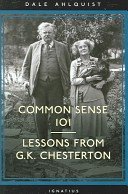 Common Sense 101: Lessons from G. K. Chesterton by Dale Ahlquist (Ignatius Press, San Francisco, 2006)
I tried to take a shortcut. With only three days before leaving the J&S Library behind, I chose this instead of a book by Chesterton himself. Although somewhat unsatisfactory, it was probably the right thing to do: The summary has left me thirsting for the Real Thing.
Many times throughout the book I found myself wanting to say to the author—as I wanted to say to the editor of Chesterton's Eugenics and Other Evils, which I reviewed in January—"Enough of what you think Chesterton is saying; I want to hear more of what he has to say!" But Chesterton can be tough sledding at first, so reading a historical and contextual introduction is not a bad idea. Dale Ahlquist is the president of the American Chesterton Society, which might be another good place to begin.
Although there is much I could quote from Common Sense 101, I'll refrain until I have the direct words from one Ahlquist would freely admit is the better writer. Instead, I'll include a Christmas poem, not by Chesterton, but by his wife, Frances Blogg* Chesterton.
How far is it to Bethlehem?
Not very far.
Shall we find the stable-room
Lit by a star?
Can we see the little Child?
Is He within?
If we lift the wooden latch,
May we go in?
May we stroke the creatures there —
Ox, ass, or sheep?
May we peep like them and see
Jesus asleep?
If we touch His tiny hand,
Will He awake?
Will He know we've come so far
Just for His sake?
Great kings have precious gifts,
And we have naught;
Little smiles and little tears
Are all we brought.
For all weary children
Mary must weep;
Here, on His bed of straw,
Sleep, children, sleep.
God, in His mother's arms,
Babes in the byre,
Sleep, as they sleep who find
Their heart's desire.
One of the fun things about spending foreign money is that it doesn't feel like real spending. It feels like play money, Monopoly money. I don't know at what point I crossed the line, but I'm definitely past that. Swiss francs are now real money, and I look at the green American paper in my wallet and think, "What is this? Do people actually accept this as payment?" No doubt that will not last long, once I am home, but it's a weird feeling.
I've long been in favor of following the lead of the many countries that have replaced their lower-denomination bills with coins. Now that I've worked with such a system for over a month, here are some observations:
- The lowest Swiss bill is the 10-franc note. There are 5-, 2-, 1-, and 1/2-franc coins. Practically speaking, this means I can no longer ignore coins. In America, when I get change back from a purchase, I usually dump the coins in my wallet without checking them, as no error can cost me more than a dollar. Here, where the change might be worth nearly ten dollars, it's worth at least a quick glance. I was quite proud of myself when I noted in one transaction that the cashier had mistakenly given me a 2-franc coin instead of a 5-franc coin.
- I had to train myself to make a point of using coins. Using bills all the time results in a heavy wallet; once I discovered I had over Fr. 40- in change! Once you get used to the idea of not ignoring change, however, it's not a problem to keep the quantity down to something reasonable.
- The lowest denomination coin is the 5-rappen piece. This is a good practice; I see no need for the U. S. to continue to mint cents, other than to feed those fun machines at tourist sites that make elongates. The existence of those machines is to my mind the only compelling reason for keeping the cent.
- I've gotten quite good at paying with change, but still have trouble distinguishing the 1-franc coin from the 20-rappen piece, and the 1/2-franc coin from the 10-rappen piece, when they are jumbled up in my wallet. I have to look at the number on the coin to be certain, and I find that annoying.
- Swiss merchants don't blink when you hand them a 100-franc bill; in the U. S. I don't like carrying $100 bills because clerks suspect them of being counterfeit, and even if convinced a bill is real, will grumble if your purchase is small.
- Paying with cash is much more common in Switzerland than in the U. S. Debit cards are handy, though, when buying train tickets; trying to convince the automatic ticket machine to accept your bills (or coins) can sometimes be a problem.
- A common debit card is the Post-Finance card. Once you get over the shock of thinking of a bank and the post office being the same organization, you begin to wonder if the system works because the former subsidizes the latter. (I have no idea if it does; the thought just occurred to me as a possible explanation for the mysterious combination of banking and postal services. I know that combination is not just in Switzerland, but I haven't researched how it might have come about.)
- Nearly all shopping is done with Swiss francs, but I've noticed that in shops catering specifically to tourists they will sometimes give the price in Euros as well.
Shopping here is as fun as shopping gets because (1) I can walk where I need to go, (2) it's usually not urgent, but part of the process of exploring the city, (3) there's still a challenge in paying with the right change instead of merely handing over a large bill, and (4) there's always the thrill of trying to get by without English. The last is much easier than I had imagined. Knowing a few words of German—notably "please," "thank you," "where is?" and "I'm sorry, but I don't understand German"—goes a long way. It's also a great help that the cash registers display the total price, so I don't have to try to understand rapid-fire cashier language. I'm happy to report that I have managed totally in a combination of German, Swiss German, and gestures—except for one of my trips to the tea shop, where the clerk spoke in English because I had filled out a form with my U.S. address. My proudest moment was asking, "Wo sind die Stilleinlagen?" and making myself understood with no need for repetition or gestures (the latter being a very good thing).
Permalink | Comments
Category Travels Everyday Life
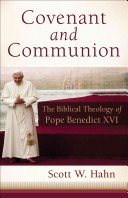 Covenant and Communion: The Biblical Theology of Pope Benedict XVI by Scott W. Hahn (Brazos Press, Grand Rapids, Michigan, 2009)
I read this book quickly, because it's a book to be read slowly. I should have guessed from the names on the dust jacket quotes—names like David L. Jeffrey, Hans Boersma, and Tremper Longman—that Covenant and Communion would be more like a book from a seminary library than the local Christian bookstore. There's a lot of heavy theology here, and I currently have neither the time nor the inclination to do it justice. However, that didn't stop the text from grabbing me occasionally and slowing me down enough to pull a few quotes. Quotation marks set off Pope Benedict's actual words.
The church is the living voice, the viva vox, of the Word of God.... Scripture is at the center of the Church's tradition, but tradition is properly understood as the whole of "the responsive Word of the Church"—a living dialogue in which the Church constantly listens to the Word addressed to her and responds to the claims the Word makes on her through her preaching, teaching, doctrine, and liturgy. More than that, tradition is a participation in the power of God promised to the Church by Christ. It is nothing other than the fulfillment of Christ's promise to be with his Church in the Spirit until the end of the age.... Tradition, then, is nothing less than Christ's living and saving and interpretive presence in the Church.
It is important to keep in mind...that revelation for Benedict is not limited to the written word of Scripture.
"A God who cannot intervene in history and reveal himself is not the God of the Bible."
The Christian faith is not faith in a series of propositions but faith in a historical person.
What is important for us is to recognize that Benedict's theology and exegesis presume as absolutely vital the unity of salvation history—reflected in the unity of the Old and New Testaments—and the principle that Jesus Christ is both the culmination of that history and the interpretive key of God's revelation in the Scriptures.
As the words of Scripture, by their very nature, must admit of more than their literal meaning, the same is true of the historical events recorded in Scripture.... Thus while the events recorded in the Bible are factual, their meanings far transcend "historical facticity" because God in his Spirit is their author. Indeed, because God is acting in the biblical narrative, "...the events carry within themselves a surplus meaning...giving them significance for all time and for all men."
Benedict rejects as unbiblical the sharp dialectic between Law and Gospel introduced by Martin Luther.... Benedict establishes from his close readings of the texts "the inner continuity and coherence of Law and Gospel" and the "deep unity between the good news of Jesus and the message of Sinai." The hinge on which this unity depends is...the figure of Jesus Christ.
"The church is there, not for her own sake, but for mankind."
"We can see in [Acts 2:42] a sketch of the primitive Christian service of worship, which starts with the teaching of the apostles, that is, with the proclamation and hearing of the faith of the Church, of the Word of God that is alive in her and that thus becomes the basis for liturgical and living fellowship: it reaches a climax in the eucharistic encounter with the Lord, who gives himself to us as bread, and resounds in songs of praise. The Church is adoration."
Benedict demonstrates that the New Testament portrait of Jesus is that of a person in constant prayer. The prayer of Jesus is not abstract or monologic. Rather, the prayer of Jesus is an intimate, intense, and sustained dialogue with the God he calls "Father." The Church's earliest confessions and hymns, which profess faith in Jesus as the Son of God, only confirm the witness of the apostles and the testimony of the Scriptures—that Jesus lived in unbroken "primal conversation with the Father."
The Father that Jesus prayed to was "the God of the fathers," the patriarchs of Israel, and Jesus prayed as a child of these patriarchs, as a son of Abraham. He was part of this ancient family, this people of God. This, too, is vital to Benedict's theological understanding. Jesus prayed with his people, in conversation with the Scriptures of Israel, as is vividly depicted in the Transfiguration, where he talks personally with Moses and the prophet Elijah.
We can speak to God bcause God has spoken to us—because he has come to us as a Word and because in his inmost life in the Trinity he is a relationship. The prayer of Jesus reveals that the heart of the Trinity is a familial, filial relationship of love. God in his inner essence is a dialogue of love, and our prayer, both corporately in the liturgy and privately, is a participation in this filial and familial dialogue.
[The Lord's Prayer] illuminates this point. Even when the believer prays the "Our Father" privately, he or she prays as a member of the family of God. It is never my Father. The prayer of Jesus is always personal and simultaneously the prayer of one who knows himself to be part of a family. "Prayer is always praying with someone," in the communion of the Church, in the body of Christ, in the family of God.
As our prayer is never alone, neither is it something we can do of our own initiative. Prayer and worship are our response to the God who has first spoken to us. God's Word to us is a gift, the gift of himself; it is the opportunity to participate in his familial dialogue of love.
"What had always been intended and could never be achieved in the Old Testament sacrifices is incorporated in [Christ]. God does not desire the sacrifice of animals; everything belongs to him. And he does not desire human sacrifice, for he has created man for living. God desires something more: he desires love, which transforms man and through which he becomes capable of relating to God, giving himself up to God. Now, all those thousands of sacrifices that were always presented to God in the Temple at Jerusalem and all the sacrifices performed in the whole course of history, all this vain and eternal striving to bring ourselves up to God, can be seen as unnecessary and yet, at the same time, as being like windows that allow us, so to speak, a glimpse of the real thing, like preliminary attempts at what has now been achieved. What they signified—giving to God, union with God—comes to pass in Jesus Christ, in him who gives God nothing but himself and, thereby, us in him."
The Liturgy of the Word in the Mass presumes the unity of salvation history and in fact tracks and unfolds that history, beginning with readings from the Law and the prophets, a song from the psalms, and then readings from the Gospels and the apostolic writings. Yet it is a mistake to regard the Scriptures used in the liturgy as historical readings or even ethical lessons. They are the Word of God, the voice of revelation that speaks to us in the present with creative and life-changing power.
Divine worship implies that we ourselves have become beings of the Word, that we conform ourselves to the creative Intellect. But once more it is clear that we cannot do this of ourselves, and thus everything seems to end again in futility—until the day when the Word comes, the true, the Son, when he becomes flesh and draws us to himself in the exodus of the cross. This true sacrifice, which transforms us all into sacrifice, that is to say, unites us to God, makes of us beings conformed to God, is indeed fixed and founded on an historical event, but is not situated as a thing in the past behind us—on the contrary, it becomes contemporary and accessible to us in the community of the believing and praying Church, in its sacrament: that is what is meant by the "sacrifice of the Mass."
"Just reading [Scripture[ does not mean necessarily that we have truly understood the Word of God. The danger is that we only see the human words and do not find the true actor within, the Holy Spirit. We do not find the Word in the words.... We stop at the human words, words from the past, history of he past, and we do not discover the present in the past, the Holy Spirit who speaks to us today in the words from the past. In this way we do not enter the interior movement of the Word, which in human words conceals and which opens the divine words. We must always look for the Word within the words."
As one whose religious beliefs and experiences have been either atheistic or Protestant, I found it startling to read arguments about where Luther went wrong. That's not at all the focus of the book, but the few instances caught me by surprise. However, Pope Benedict's focus on Christ, his obvious knowledge of the Bible, and the marriage of his impressive intellect with his strong faith, make Covenant and Communion a book worthy of serious Protestant attention. It's probably not a good place for an atheist to begin, unless he's seeking evidence that intellectual, rational, academic thought is not incompatible with Christian faith.
While Joseph was undergoing a secular baptism of sorts at the American Embassy in Bern, Grandma had no official business other than to receive the diaper bag when it was rejected at the door for possible terrorist connections.*

After a little exploration, the weather—along with the uncertainty of when the party might be over—turned the waiting time over to Li'l Writer Guy, who discovered that a Swiss café is a delightful place to work.

Fr. 4.- may seem high for a cup of tea, but I figure it as: cup of tea with cookie, Fr. 2-; quiet place to work, Fr. 2-; shelter from the pouring rain, Priceless. A great bargain.

Permalink | Comments
Category Travels Everyday Life
Living with other people for several weeks is a good way to experience new foods and new food combinations. If those other people happen to live in another country, the opportunities multiply. And if they also subscribe to a local organic farm's weekly vegetable delivery, well...you get to try Swiss chard. Verdict? Not bad, though I think I'll like it better mixed with other things, such as in an omelet or on a pizza. It's related to beets, but I find the taste more like spinach. As it was with Heather and Jon's Community-Supported Agriculture farm in Pittsburgh, the weekly vegetable lottery is fun to play, and Stephan (like Jon) is particularly good at figuring out how to make good use of fennel, fresh tarragon, and eggplant as well as potatoes, lettuce, and zucchini.
What's a visit to Switzerland without trying a new variety of chocolate? When Stephan brought home a bar of dark Ovomaltine, I was at first skeptical.
I remember the Ovaltine drink (name changed in the English-speaking world thanks to a typo) from my childhood, and not pleasantly. It was touted as a healthy alternative to chocolate milk; perhaps that was the reason we viewed it with suspicion.
This is not your father's Ovaltine. Well, maybe it is, and maybe I would actually have liked it as a child had I not thought of it in the same category as spinach and beets while expecting it to taste like chocolate milk. I don't know. Whatever. This is a delightful form of chocolate, which the Swiss do very, very well: smooth, a little bit crunchy, a little bit malty, a lot yummy.
The good news, for those who support the Nestlé boycott because of the company's aggressive marketing of infant formula in third world countries, is that Ovomaltine, still made here in Switzerland, is Nestlé-free. The bad news is that if you want to try this delicious chocolate, you need to ask me to bring some back for you, as Nestlé owns the rights in the United States. So place your orders now.
There's no adjustment needed when it comes to Swiss bread, the only difficulty being deciding which of the dozens of tempting breads to buy. Butter, on the other hand, is unsalted here. At home I've always found unsalted butter unpalatable, and I'm not sure what to make of the fact that I happily eat it on my good Swiss bread every morning. Either my tastes have changed, or Swiss bread is saltier than I'm used to.
Speaking of unpalatable, that's how I usually find any milk with cream content greater than skim, which I believe is 0.5%. Raw milk is an exception, but I can rarely get that. Here, unless one is willing to drink the ultra high temperature pasteurized milk, the lowest fat content is 2.5%. Needless to say, I haven't been drinking much milk here, except when the temperatures were cold enough to warrant fixing some hot cocoa, which is improved by higher-fat milk. I do find, however, that the 2.5% here tastes better than 1% back home. Sadly, we should be able to get great raw milk straight from the cow here—or at least straight from the dairy farm on the hill, which is close enough to smell when the wind is in the right direction—but we can't. It's legal to sell raw milk in Switzerland; the problem has something to do with the price-support system, under which the farm is not allowed to sell directly to the public. :(
Eggs, on the other hand, are amazing here. Fresh, free-range, organic if that's your desire—with the most lovely, inviting, delicious bright-orange yolks, a sign that the eggs are from chickens that really did range freely enough to eat grass and bugs—which is not true of many eggs that claim that label in the U. S. And here's a surprise: eggs are not refrigerated here. Not in the store, and not at home. They sit out on the shelves or on the counter, even in our recent heat wave with temperatures rivaling Florida's. So far, we're all alive and well.
I love the kefir that is sold in American grocery stores, both the sweetened fruit version and the plain. What I've found here, however, has a slightly different taste, and a texture like a cross between yoghurt and cottage cheese. It will be interesting to see what the product will be like when I make my own from the kefir grains waiting patiently in our freezer.
If Switzerland is known for any food more than chocolate, it is cheese, and cheese shopping is even more complicated than buying bread. I have a lot to learn here, and I haven't been adventuresome. Prices here tend to be high in general, but good cheese is an exception. Gruyère is a staple, rather than the luxury I'm accustomed to. On the other hand, if you can find cheddar at all, the price is outlandish for a rather mediocre product. Asiago, too, is vastly different from at home: it's good, but a rather bland, mild cheese, instead of the sharp, flavorful variety I love.
Grocery shopping is a different experience. European refrigerators (and cupboards, and kitchens) seem to be generally smaller than Amrican ones; Janet and Stephan's refrigerator is not that unusual in being the same size as the dorm fridge I had in college. This promotes a "shop frequently, buy fresh, use it quickly" philosophy that I can learn from. I don't know how onerous this might be if we were not in the city, but as it is, it is easy to pick up a few things at the store on the way home from work, or when doing other errands. Since I like to take a walk every day anyway, I often stop by Migros or Coop then. A grocery trip isn't such a big, scary deal if it's not an hour-long, major provisioning expedition. On the other hand, this practice contributes to inefficiency, greater use of packaging materials, and higher prices, since one routinely buys a liter of milk instead of a gallon, and a kilo of flour instead of five pounds.
I think the grocery cart system in Basel is great: In order to extract your cart from the lineup, you deposit a two-franc piece (about $2); it is returned to you when you return the cart. In the end it costs nothing, but effectively promotes responsible cart use.
Restaurants are a lot more fun here now that smoking is banned. Not perfect, since it is still allowed in bars, and in our favorite place for Rösti, zum alten Stöckli, smoke from the bar rises to the the restaurant, which is upstairs. Nonetheless, it's a great improvement. Another improvement to restaurant meals is knowing how to order something to drink. I can order schwarzer Tee (black tea)—though not iced tea, which would have been lovely when the temperature hit 36 (98). (Iced anything is hard to come by; I still find the sight of a large Coke with no ice odd.) I can order Apfelsaft (apple juice). But the greatest improvement is being able to order my usual American restaurant drink: plain tap water. Order water here, and you'll probably get fizzy mineral water. Order plain water, and it will be the same, only not fizzy. The magic word is Hahnewasser (Swiss German; in high German, Hahnenwasser). I find the regular Swiss tap water—the kind that pours freely from fountains throughout the city—superior to anything I've bought in a bottle. The trick to avoiding dirty looks from the waiter is to spend sufficient money on the rest of the meal.
Permalink | Comments
Category Travels Everyday Life Food
 Ender's Game, by Orson Scott Card (Tor, New York, 1991)
Speaker for the Dead by Orson Scott Card (Tor, New York, 1991)
The short story version of Ender's Game was written back in 1977—more than 30 years ago—and even the novel is 25 years old. That was right when my reading interests veered sharply from science fiction to children and education, so I missed Orson Scott Card entirely until now. Extended visits for the birthing of grandchildren put me in contact with other people's libraries: it was at the birth of another grandchild that I discovered The Hitchhiker's Guide to the Galaxy and finally learned the significance of 42.
Both Ender's Game and Speaker for the Dead are riveting stories. Although the author feels the latter to be more important, and indeed chose to expand the original short story of Ender's Game only because he needed a prelude to Speaker for the Dead, I liked the former much better.
Card claims Isaac Asimov as his inspiration, but I detect more than a few traces of Robert Heinlein. The respect for the abilities of children, the school settings, and the military motifs in Ender's Game remind me of much of what I liked best from Heinlein, notably Space Cadet, Tunnel in the Sky, and especially, Starship Troopers. (I've not seen the movie version of ST, but it doesn't surprise me to hear that you shouldn't judge the book by the film.) The amalgam of humanist and New Age worldviews at the end of Ender's Game and throughout Speaker for the Dead remind me of Heinlein's works that I did not like, such as Stranger in a Strange Land. Like Heinlein, Card is a better storyteller than philosopher.
That Ender's Game must have had a special hold on me will be obvious to those who know how much I dislike both the boarding school genre (the early Harry Potter stories won me over in spite of their setting, not because of it) and reading about battles and military strategies (I haven't yet made it past the beginning of The Iliad). The hook was Card's obvious (personal?) knowledge of the problems of bright children in a world that is more likely to abuse or exploit than to understand, help, or befriend them. Adding boarding school woes—of the sort that made C. S. Lewis write, "If the parents in each generation knew what really goes on at their sons' schools, the history of education would be very different"—exaggerates the problem, but sometimes a situation must be overstated to be noticed.
I like books that inspire me, and Ender's Game does—much more so than Speaker for the Dead, which I'm sure was intended to be the more inspirational. Knowing little about leadership, as a subject, I found Card's treatment of it fascinating, and even the game-playing and battle-winning strategies were educational. Perhaps what affected me most was Ender's skill at turning everything that happened to him into something that made him stronger and better, and the way he patiently endured pain as long as it enabled him to learn.
We interrupt the writing of my review of Ender's Game to alert you to the fact that Janet has now posted Joseph's birth story. I'll add some comments later.
Permalink | Comments
Category Travels Everyday Life
As I've said before, Isaac Asimov has long been one of my favorite authors, from science fiction (of course) to science fact to history to mystery. But his fantasy falls flat, at least if judged by Magic: The Final Fantasy Collection, which I finished reading today.
Asimov is fond of quoting Arthur C. Clarke's assertion that any sufficiently advanced technology is indistinguishable from magic; this may go far to explaining why I find his fantasy unsatisfactory. He is all-rational,* to the extent that even his demons and his dragons seem mundane. There is no magic in his magic. Some of the tales are good stories, but they lack the sparkle, the wonder, the life of a good fantasy.
Interestingly, Asimov had great respect for J.R.R. Tolkien as a writer and read The Lord of the Rings at least five times. Since I consider Tolkien to be a master at the elements that I find lacking in Asimov's fantasy stories, I wonder if those aspects of the LOTR, which in my opinion make it the monumental work that it is, were invisible to him.
Perhaps they were; certainly there is enough depth to the story to attract people on many different levels, as the makers of the movie version proved. Or...perhaps...he did catch a glimpse of the book's magic, which continued to draw him back, though he didn't know why.
The title isn't quite true, but it gets past the censors.
Joseph is the non-spitting-est baby I've ever met. I never think of using a burp cloth, and although when I packed for this trip I took into consideration that my clothes would be subject to much baby spit-up, it simply hasn't happened.
It was a good choice of shirts, however.
Joseph had awakened after a three-hour nap, and was not surprisingly in need of a change. Joseph finds a diaper change to be very inspirational.
Have you heard of the volcanoes that, instead of erupting straight up in the air, blow their lava out a side vent? Bright yellow lava, hitting Grandma straight in the face, and adding a contrasting golden spray to the dark blue Carnegie Mellon t-shirt.
No problem. We're signed up for laundry on Thursday.
Permalink | Comments
Category Children & Family Issues
I like the trash collection system here in Basel: You buy special blue garbage bags, each 35 liters in size (about 9 gallons), which is considerably smaller than an American "large kitchen trash bag." They are, however, much tougher, and can be well-stuffed without ripping. You pack your trash as efficiently as possible into as many bags as you need, and put them out in the street at the appropriate time for collection.
That's it. The cost of trash collection is included in the cost of the bags, and thus you pay proportionately for the amount of trash you produce. There is significant incentive to minimize your waste, yet the capacity to dispose of more is there if you need it. Ideally, you would pay by weight rather than volume, but the system is so easy, it is a worthwhile compromise. I think of a friend's complaint that she can't help feeling annoyed at seeing her neighbor's routine weekly pile of 10 or more large bags as she makes her own family's one-small-bag contribution to the landfill collection; she would welcome such a system in her town. As would I.
Recycling is different here, too, though I haven't decided if it's better or worse. Plastics and metals must be taken to a recycling station instead of being picked up at the curb as I'm accustomed to, but such stations are only an easy walk away. Only one type of plastic is recycled ("PET," known in the U.S. as PETE or #1); our county recycles any type of plastic as long as it has a number code. On the other hand, paper is picked up at the curb, and they recycle all sorts of paper, including office paper, which our county excludes. Not worse, not better, just different—and not any more different than the variability from community to community in the U.S., as we discovered in moving among New York, Pennsylvania, Massachusetts, and Florida.
Permalink | Comments
Category Travels Conservationist Living
 Stained Glass Elegies: Stories by Shusaku Endo translated by Van C. Gessel (Tuttle Publishing, Tokyo, 1986)
When Basel records the highest temperature in Switzerland, and much of Europe has the temperatures of Florida in July without benefit of Florida's air conditioning, and a recent birth precludes visiting the local swimming pool, let alone fleeing to somewhere high in the Alps, then sitting in front of a fan and reading beats most other activities. It especially beats sitting with a hot computer on one's lap, so this will be a short review.
Endo is not an author I would have likely come across on my own, but that's the advantage of having someone else's bookshelves at one's disposal. I chose this book of short stories over the many Endo novels available, on the theory that they would work better in a household punctuated by random baby needs.
Although the themes are decidedly adult, and rather depressing, the stories were good to read and rarely objectionable, even to me. What I found most fascinating was the glimpse of life from a Japanese point of view. Recurring motifs, probably somewhat autobiographical, include tuberculosis; hospitals; internal doubts, fears and struggles; war; and the suffering of Christians, both martyrs and apostates, during the time when Japan attempted to stamp out Christianity—and the effect that era has on Japanese Christians today. "Would I be able to endure torture and death—and the torture and death of my family—without abandoning my faith?" is not a thought most American Christians give serious consideration, but apparently for Endo, a Japanese Catholic in a land where Christians of all sorts make up only 2% of the population, it was a haunting question.
Temperatures in the mid-90's do not surprise me in July: I live in Florida. I'll confess I was hoping for something more reasonable in Switzerland, however. Somehow calling the temperatures "mid-30's" doesn't improve the situation as much as I would hope. I miss air conditioning; I miss ceiling fans. Even when we lived without air conditioning in Boston I could find relief at the grocery store. Not so, here.
But there are compensations. The apartment is wonderfully designed for cross-ventilation, and the lack of screens means we make the most of every breeze. We have two fans, and the temperatures cool off enough at night to make sleeping reasonable. Still, there's not much incentive to be very ambitious, and Janet is really wishing she could take advantage of her membership in the pool that's only a five-minute walk away.
How about you? I gather it's been hot for a lot of folks.
Baby update: Doing fine, eating lots, filling out, doesn't like the heat but still likes to be held. Has perfected the knack of filling a clean diaper within 15 seconds of the change.
Permalink | Comments
Category Travels Everyday Life
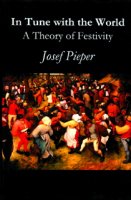 In Tune with the World: A Theory of Festivity by Josef Pieper, translated from the German by Richard and Clara Winston (St. Augustine's Press, South Bend, Indiana, 1999; original copyright 1963, translation copyright 1965)
Sometimes it helps to take a second look.
I wasn't halfway through the first chapter before I was disappointed with In Tune with the World. It was my own fault: Despite the book's subtitle, I had been expecting practical suggestions for recovering festivity in a society where abundance is commonplace. (See New Year's Resolution #2: Rediscover Feasting.) However, when Pieper says "a theory of festivity," that is exactly what he means.
What's more, the first few pages put me off because Pieper seemed to be dividing our lives between work and festivity, with work pretty much defined as what men do to earn a living, and I kept thinking, "But you still expect the women to cook and clean for your festivals; if they separated their work from the feast, it wouldn't be much of one!" He was writing in the early 1960's, so I can't say he's free from that attitude, but there's much more to what he is saying, and my preconceptions definitely distorted that first chapter.
Before I had finished the book, however, I realized that it deserved re-reading for what it is rather than for what I wanted it to be. I'm not generally one to read books of philosophy—largely, I'll admit, because I find them hard going, and true to form, this 88-page book with relatively large print is not something to be read in one sitting, even for a fast reader like me. I had brought it to Switzerland to read and leave with Janet (it was, after all, her suggestion and her birthday present), but as with The Brain that Changes Itself, I soon realized I'd have to bring it home with me. There is only so much of this kind of writing I can take without my eyes glazing over:
Human acts derive their meaning primarily from their content, from their object, not from the manner in which they are performed. Play, however, seems to be chiefly a mere modus of action, a specific way of performing something, at any rate a purely formal determinant.
The text is well worth working through, however—perhaps several times. Here are a few points I was able to glean on the second reading. Because of all the quotations, the rest of the post is very long. I think they merit the time it will take to read them, or I wouldn't have made the effort to type them in, but the ideas are highlighted so you can indulge in "Festivity Lite" if you wish.
Festivity is a joyous affirmation: Everything that is, is good, and it is good to exist.
[S]uch affirmation [is not] shallow optimism, let alone...smug approval, of that which is.... [It] is not won by deliberately shutting one's eyes to the horrors in this world. Rather, it proves its seriousness by its confrontation with historical evil. ... [The Christian martyr]...never utters a word against God's Creation. In spite of everything he finds the things that are "very good"; therefore he remains capable of joy, and even, as far as it concerns him, of festivity. [O]n the other hand, whoever refuses to assent to reality as a whole, no matter how well off he may be, is by that fact incapacitated for either joy or festivity. Festivity is impossible to the naysayer.
To celebrate a festival means: to live out, for some special occasion and in an uncommon manner, the universal assent to the world as a whole.
It is the nature of festivity to be non-utilitarian.
To celebrate a festival means to do something which is in no way tied to other goals, which has been removed from all "so that" and "in order to." True festivity cannot be imagined as residing anywhere but in the realm of activity that is meaningful in itself.
With the death of the concept of human activity that is meaningful in itself...[it] becomes a sheer impossibility to establish and maintain an area of existence which is not preempted by work. For there is only a single justification for not working that will be acceptable even to one's own conscience. That is, dedication of leisure to something meaningful in itself. It is more important not only "socially" but also on a higher human level to work than to kill time; and if we contrast the laboring society and its totalitarian planning for utility with a civilization dedicated mainly to entertainment, the former seems without question overwhelmingly superior.
The antithesis between holiday and workday, or more precisely, the concept of a day of rest, tells us something further about the essence of festivity. The day of rest is not just a neutral interval inserted as a link in the chain of workaday life. It entails a loss of utilitarian profit. In voluntarily keeping the holiday, men renounce the yield of a day's labor....The day of rest, then, meant not only that no work was done, but also that an offering was being made of the yield of labor. It is not merely that the time is not gainfully used; the offering is in the nature of a sacrifice, and therefore the diametric opposite of utility.
Extravagance is appropriate for festive celebrations. Here is a foreign concept that rings true. Surrounded by plenty, yet endowed with a great sense of thrift, it is hard for me in good conscience to be lavish—with money, calories, or enthusiasm—even for a celebration.
A festival is essentially a phenomenon of wealth; not, to be sure, the wealth of money, but of existential richness. Absence of calculation, in fact lavishness, is one of its elements. Of course there is a natural peril and a germ of degeneration inherent in this. The way is open to senseless and excessive waste of the yield of work, to an extravagance that violates all rationality.... But this potential perversion cannot be included within the definition of festivity.... [T]he fact remains that the paramountcy of a calculating, economizing mentality prevents both festive excess and festivity itself. In the workaday world all magnificence and pomp is calculated, and therefore unfestive.
True festivity is inseparable from religious experience. Pieper writes as a Christian, and clearly views Christian festivals as the highest and best of celebrations. Yet the theory of festivity he posits has its roots firmly in pagan, primitive, Jewish, Roman, and other practices as well, and the book is rife with quotations from sources many and varied. He would probably agree with the concept, which I first encountered in C. S. Lewis, that Christianity did not come so much to abolish the old religions as to fulfill them.
[T]o celebrate a festival is equivalent to "becoming contemplative, and, in this state, directly confronting the higher realities on which the whole of existence rests."...Bustle does not make a festival; on the contrary, it can spoil one....[A] special spice, essential to the right celebration of a festival, is a kind of expectant alertness. One must be able to look through, and, as it were, beyond the immediate matter of the festival, including the festal gifts; one must engage in a listening, and therefore necessarily silent, meditation upon the fundament of existence.
A festival without gods is a non-concept, is inconceivable. For example, Carnival remains festive only where Ash Wednesday still exists. To eliminate Ash Wednesday is to eliminate the Carnival itself. [This is nowhere so obvious to me as in Orlando, where the Universal Studios theme park "celebrates" Mardi Gras throughout Lent. It is an excuse for partying, or more accurately for profit-making, and nothing else.]
Secular as well as religious festivals have their roots in the rituals of worship. Otherwise, what arises is not a profane festival, but something quite artificial, which is either an embarrassment or...a new and more strenuous kind of work.
[F]estivals are doomed unless they are preceded by the pattern of ritual religious praise. That is the fire that kindles them. But it is that very thing—praise of God—which constitutes almost the entire content of Christian ritual....[A]ffirmation is the fundamental form of Christian liturgy. Christian liturgy is in fact "an unbounded Yea-and-Amen saying."...St. Augustine has defined worship in the same terms: "Worship takes place," he says, "by the offering of praise and thanksgiving." Indeed, the Church itself uses the name "thanksgiving" for the sacramental offering which is the source and center of all other acts of worship. The Mass is called and is eucharistia. Whatever the specific content of this thanksgiving may be, the "occasion" for which it is performed and which it comports with is nothing other than the salvation of the world and of life as a whole....Of course, everything depends on whether or not we think the historical world and human life are "made whole" or at any rate "capable of being made whole" by Christ. This is the all-important question....Christian worship sees itself as an act of affirmation that expresses itself in praise, glorification, thanksgiving for the whole of reality and existence.
The purpose and fruit of a festive celebration is an other-worldly phenomenon, which cannot be attained by effort, but only received as a gift.
Language harbors a variety of names for this phenomenon: renewal, transformation, restoration, rejuvenation, rebirth. But they all mean the same thing, even though it does not lend itself to clear definition and description. There are many ways in which the gift is experienced. It is recreation; it is, as Goethe put it, release from the pressure of daily obligation. Passing time stands still....Men are swept away from the here and now to utterly tranquil contemplation of the ground of existence; to happiness, as in absorption in beloved eyes. Everyday things unexpectedly take on the freshness of Eden; the world, again in Goethe's words, is "glorious, as on the first of days."
[T]he fruit of the festival, for which alone it is really celebrated, is pure gift; it is the element of festivity that can never be "organized," arranged, and induced. The will is bent on action; however easy it may seem, we have far less talent for relaxation, slackening effort, letting ourselves go, than for the hard task of work. To be sure, relaxation can be learned and practiced to a certain degree. But no amount of effort, no matter how desperate, can force festivity to yield up its essence. All we can do is prepare ourselves to receive the hoped-for gift; and perhaps the idea of "ritual purity"...should be rethought and recaptured. All these considerations, however, do not in any way nullify the nature of the gift, which is in no way pledged, predictable, or meritable, and descends only of its own accord. "In order for a festival to emerge out of human efforts, something divine must be added, which alone makes possible the otherwise impossible." This is an ethnologist's conclusion, but it applies not only to primitive peoples. It suddenly makes us realize the very real sense of the statement in both the Psalms and the Platonic Dialogue that the festival is the day God has made.
Thus, when a festival goes as it should, men receive something that it is not in human power to give. This is the by now almost forgotten reason for the age-old custom of men wishing one another well on great festival days. What are we usually wishing our fellow men when we send them "best wishes for Christmas"? Health, enjoyment of each other's company, thriving children, success—all these things, too, of course. We may even—why not?—be wishing them a good appetite for the holiday meal. But the real thing we are wishing is the "success" of the festival celebration itself, not just its outer forms and enrichments, not the trimmings, but the gift that is meant to be the true fruit of the festival: renewal, transformation, rebirth. Nowadays, to be sure, all this can barely be sensed behind the trite formula, "Happy holidays."
The fine arts are necessary, though not sufficient, for festive celebration.
[A] festival without singing, music, dancing, without visible forms of celebration, without any kind of works of art, cannot be imagined.
[T]he artistic act is like festivity itself, something out of the ordinary, something unusual, which is not covered by the rules governing the workaday world. This is true not only of the artist's creative act, which gives rise to the work of art, but also of the secondary act of the person who (for example) reads a poem poetically.
[T]he invisible aspect of festivity, the praise of the world which lies at a festival's innermost core, can attain a physical form, can be made perceptible to the senses, only through the medium of the arts.
[T]he fine arts keep alive the memory of the true ritualistic, religious origins of festivals when these begin to wither or be forgotten. And this memory may at some moment succeed in blasting open again the buried entrance.
On the other hand, the very overestimation of the arts can also obscure this knowledge.... [The arts] are not themselves the festivals. Rather, the arts, like pleasure itself, are derivative and secondary; they are a contribution, the adornment and medium of the festival, but not its substance. As soon as festiveness itself becomes unachievable, the arts are inevitably left without a home; their necessity and even their credibility fade away.... It is not too surprising that under conditions of tyranny the arts fall into the service of the political power and are subjected to utilitarian ends—quite often with the acquiescence of the artists themselves.... [H]omeless art looks for a new home.
Gloomy diagnosticians told us long ago that in an existence founded on negation, festivity becomes a caricature of itself.... If assent to the world can no longer be celebrated festively at all, then every one of the fine arts becomes homeless, useless, idle, unbelievable, and at bottom impossible. To be sure, such refusal can exist side by side with the greatest technical skill. That is precisely what complicates the matter. For wherever truth in form is achieved, no matter how "formalistic" it may be, there exists...in some sense harmony, concord with a pre-established image of order—and thus inevitably a grain of affirmation. Complete negation is necessarily formless; it presupposes the shattering of form; whereas negation proclaimed in perfect form is only a half-negation, inherently a contradiction of itself.
Unfestive, sham, made-up festivals will proliferate when true festivals are absent.
Worse than clear negation...is mendacious affirmation. Worse than the silencing and stifling of festivity and the arts is sham practicing of them.... [P]seudo-art is related in a variety of ways to pseudo-festivity. The sham is inherent in the fact that the affirmation and assent compatible only with true reality is falsified into a smug yea-saying, whose basic element is a desire to fend off reality, so as not to be disturbed, at any prices. A deceptive escape from the narrowness of the workaday utilitarian world is found in the form of entertainment and "forgetting one's worries." And the same mendacious message also reaches men through the medium of the pseudo-arts, whether trivial or pretentious, flattering or entertaining, or intoxicating like a drug. Man craves by nature to enter the "other" world, but he can attain it only if true festivity truly comes to pass. For it appears—but it is appearance only—that this other dimension of reality can be produced with ease and at will; it appears to stand at the disposal of the harried or bored man who needs "entertainment" and a "change."...But the man who by such devices is the more imprisoned within a workaday world now made amusing no longer misses real festivity; he does not notice the emptiness. And thus he even stops grieving over his loss—and the loss thereby is finally sealed.
[T]he place in life which should naturally be occupied by real festivity cannot remain empty. And when real festivals are no longer celebrated, for whatever reasons, the susceptibility to artificial festivals grows.
[T]hings have not reached their sorriest pass as long as men are concerned over the disappearance of the festive principle from life....[T]he grumblings of cultural critics and the plaints of pets are the very opposite of hopelessness. But when, unnoticed and almost unnoticeable, sham festivals foist themselves on men in place of true festivity...then the situation is really bad....
Naturally enough, in the past as well as in the present, the festivals most prone to such corruption have been those whose public character is unassailable. Even secularized society cannot—not yet—ignore Christmas. However, as everyone has observed , the real festival is almost disappearing behind the commercialized folderol that has come to the fore. The true content sometimes becomes distorted to a degree that is really grotesque. In Japan the opinion has been voiced in all seriousness that commercial advertising is not misusing the symbols of the Christmas festival, but rather that the Christian holiday has borrowed the various motifs so successful in the department store displays, in order to exert a more powerful influence on the public.
Compared with the falsification...of festivals already existing as institutions, the creation of completely new festivals...is a relatively unambiguous problem, although those closely involved may find it difficult to see through the illusion. Granted, all festivals are in some sense "made" by men...from the fixing of a particular calendar day to the specific forms.... While man can make the celebration, he cannot make what is to be celebrated, cannot make the festive occasion and the cause for celebrating. The happiness of being created, the existential goodness of all things, the participation in the life of God, the overcoming of death—all these occasions of the great traditional festivals are pure gift. But because no one can confer a gift on himself, something that is entirely a human institution cannot be a real festival.
This habit of inventing festivals took a serious turn only when, in the course of the French Revolution, entirely new festivals were initiated by the state. These were intended to displace and replace the traditional religious holidays....
The entire section on the French Revolution is worth reading; you'll never look at the Opening Ceremonies of the Olympic Games in the same way again.
The fundamental vapidness of these artificial festivals is clearly exposed when we try to find out what they are actually celebrating. What is the object, the reason, the occasion? A phrase that recurs so constantly...as to be virtually a classic formula maintains that the people themselves are not only the "ornament" of the festival and its organizers, but also its object....[The phrase] goes back to Rousseau. The object of the festivals celebrated by "happy peoples," he says, is, "if you willl, nothing at all"; strictly speaking, however the people themseves are the festive spectacle....[W]hat is really being celebrated is human "happiness"....
There can be no festivity when man, imagining himself self-sufficient, refuses to recognize that Goodness of things which goes far beyond any conceivable utility; it is the Goodness of reality taken as a whole which validates all other particular goods and which man himself can never produce....He truly receives it only when he accepts it as pure gift.
Festivity IS.
[T]here remains the indestructible...gift innate in all men which impels them now and again to escape from the restricted sphere where they labor for their necessities and provide for their security—to escape not by mere forgetting, but by undeceived recollection of the greater, more real reality. Now, as always, the workaday world can be transcended in poetry and the other arts. In the shattering emotion of love, beyond the delusions of sensuality, men continue to find entrace to the still point of the turning world. Now, as always, the experience of death as man's destiny, if accepted with an open and unarmored heart, acquaints us with a dimension of existence which fosters a detachment from the immediate aims of practical life....Consequently, for the sake of what prospects there are for true festivity in our time, it is essential to resist the sophistical corruption of the arts, the cheapening of eroticism, [and] the degradation of death.
The core and source of festivity itself remains inviolably present in the midst of society....[T]he festive occasion pure and simple, the divine guarantee of the world and of human salvation, exists and remains true continuously....
The Christian...is convinced that no destructive action...can ever corrode the substance of Creation. "Miraculously founded and more miraculously restored," it cannot be corrupted by the "will to nothingness." Thus there always remains the "festive occasion" which alone inspires and justifies celebration. It remains in force, forever undiminished.
Warning: You can read In Tune with the World in under an hour, but the ideas you encounter therein may never leave you.
(This is not the resolution I thought I'd be adding this month, but as authors often say about the characters in their novels, my resolutions tend to take on a life and will of their own.)
Not everything—even on the Internet—requires the expression of my opinion.
Anyone who knows me from recent years—where "recent" probably means the last 15 years or so—may find it hard to believe that my habit of jabbering away on any subject that interests me is not my natural state of being. I like silence, do not like to talk about myself, and have always preferred to have other people carry the burden of conversation.
But silence is not generally considered "friendly" in the presence of other people. I am blessed with a husband who will happily be silent with me for long stretches of time and not feel slighted, but for most social interactions, silence is not golden, but rather interpreted as indifference or even hostility.
Thus I made it a matter of effort and prayer to open up and share in conversation with others. Perhaps a bit too much. :) If I don't like to talk about myself, I've discovered that I do like to talk about my thoughts and opinions. This can be helpful in some contexts, such as discussion groups and classes, but in general conversation tends to bore some and overwhelm others. Worse, I get carried away, and that does not leave room—physically or psychologically—for what I want to hear, which is the other person's thoughts, opinions, and experiences.
So this month's new resolution involves:
- Listening for signals that I'm with other people who don't find silence unfriendly.
- Working on conversational strategies to encourage others to speak.
- Remembering that it is not necessary to express my opinion on any- and everything.*
- When asked for my thoughts, trying to give them in digestible portions rather than the all-you-can-eat buffet.
Progress Report
#1 Read More Books June's progress was half of May's, and it can't get any less and still be a postive whole number. I'm living amidst a veritable feast of books that I want to read and thus far have read one of them. But I'm not worried. There are seasons in life, and babies don't keep. And yes, I've so far chosen writing over reading in my spare time.
#2 Rediscover Feasting No Fasting Wednesdays while overseas—I suppose that's a kind of feasting. :)
#3 Learn to Relax No progress in actually relaxing, but some in data gathering, I think. I attended two of Janet's Alexander Technique classes, and even had a private lesson with her teacher while we were waiting for labor to progress. I'm also halfway through a book her teacher recommended. Although I'm still quite incompetent at it, I'm learning to ask, "Do I really need to tense this particular muscle to do the task at hand?" We all waste much effort and energy on useless actions—who doesn't know the phenomenon of sticking out one's tongue when concentrating? Often we feel it's actually wrong not to put forth as much effort as possible, even useless effort. For example, she assured me that tensing my own muscles when Janet was not even in the room was not going to assist the progress of her labor in the least, but at some gut level that was hard to acknowledge.
#4 Like More Things Living in another household is always a good time to try new food combinations, and when that household is in another country the opportunities are multiplied. When that country is Switzerland, some of them involve chocolate. Gooseberries, too.
#5 Pay Attention Hmm. I haven't been paying much attention to this resolution. But I have been paying more attention to locations and directions this month, as I've been taking many solo walks through the city of Basel, and need to be able to find my way home.
#6 Cast Away Fear This month has provided a few opportunities: In addition to my city-wanderings—which trust me was at least at the beginning an exercise in conquering fear—there was also my first solo overseas trip, and participating in the long and difficult (though in the end joyful and radically successful) home birth of a new grandchild.
Permalink | Comments
Category Everyday Life
My original impression of Basel as a quiet place has been irrevocably shattered now that I'm here in the summer instead of the winter. In this season construction projects are in full swing, and the noise of machinery is nearly incessant during the work day—including some sort of saw that reminds me of a high-volume dentist's drill and sets my teeth on edge worse than the World Cup horns.
That unavoidable annoyance notwithstanding, I realized this morning that in some ways Janet and Stephan's city apartment is closer to nature than our own suburban house. (And our back yard, for its size, is an especially wildlife-friendly area.) Light and air stream through the many windows, and when I look up from my computer I rest my eyes on a view of the blue sky, the trees of a nearby park, and a window box garden of herbs and wildflowers.
When I look up from my computer at home, I see a wall. Well, I also see pictures of our grandkids, which is a delightful view itself, but here there is something restful to the eyes in focussing on the distant trees, and soothing to the spirit in watching the birds soar and the wildflowers move in the breeze.
Who'd have thought one could feel so close to nature in the middle of the city? The peace it brings almost cancels out the noise.
Permalink | Comments
Category Travels Everyday Life
Grandma: "It's afternoon where you are, but it's nearly bedtime here in Switzerland."
Noah: "What are you doing?"
Grandma: "I'm writing a blog post."
Noah: "If it's bedtime, why are you writing a blog post?
Good night, all!
Permalink | Comments
Category Everyday Life
I left the new family to their own devices on Saturday morning, when Stephan's mom whisked me away for an adventure. There is a small farm in nearby Riehen which, as I understand it, specializes in biodiversity/heritage breed conservation of berry plants. On this day, they opened their farm to the public for tasting! We could take nothing away, not even by purchase, but were welcome to taste and enjoy all we wanted.
(Somewhere therein is a metaphor for life, I'm certain.)
There were tiny strawberries with the sweet, strong flavor I remember from my childhood, from the wild plants that once grew profusely in the field near our house in New York. My mother would make the most delightful strawberry jam imaginable from what berries escaped immediate consumption.

The raspberries had clearly been the most popular among those who had come before us, but there were still plenty left for tasting, including a white variety.


Even more to my delight, though less popular in general, were the tiny black raspberries, again from my childhood; we called them "black caps."

And one more childhood memory; this one will be shared by my younger siblings, whose memories are more solid of our time in Pennsylvania.


Some fruits were new to me. A former neighbor had black and red currant bushes, but she moved soon after we became acquainted, and the bushes were cut down. This was probably my first taste of fresh currants in over 30 years. The black were my least favorite of all the tastes there, but the red and the white were exquisite.


Finally, there were the gooseberries (green) and the jostaberries (purple). Having cut my teeth on (and learned spelling from) English novels, I'd heard of gooseberries, but had never, to my knowledge, tasted one. They are delicious. The jostaberries—a somewhat complex mixture of gooseberry and black currant—tasted strange at first, but that impression soon evolved into a nice, tart flavor.


(As usual, you can click on the images to see the full version.)
Not everything was ready for tasting.

As might be expected from a farm specializing in diversity, there was no such flavor as, say, "raspberry," any more than "orange" can cover the vast spectrum of Citrus sinensis. Half the fun was moving from one bush to another apparently the same, and being surprised by the change in taste.
Over half a century I have watched our choices for food (and much else) expand astronomically, and yet at the same time contract. We can eat food from all over the world at nearly any time of the year, and appreciate ethnic recipes of which our ancestors knew nothing. Yet at the same time our choices within a particular food are narrowing, perhaps dangerously. Milk is milk, orange juice is orange juice, tomatoes are tomatoes (or red tomato-like substances in the grocery stores), hamburger is hamburger, and we know nothing of the rich variability within a single food.
My gratitude is great to the Creator who wove such diversity into his work, to the gardeners who lovingly, carefully work to nurture and extend that diversity, and the heritage breed preservationists whose efforts may allow us once again to recover the flavors that delighted our ancestors.
Permalink | Comments
Category Travels Everyday Life Food Conservationist Living
Janet and Stephan are the proud parents of Joseph Andreas Stücklin, born at home in Basel, Switzerland on June 28, 2010, at 5:28 a.m. after 25 hours of labor. Joseph arrived a week early, proving his independence at an early age: Stephan, Janet, Heather, and all of Heather's children were late. Thus we were taken a bit by surprise, and if Janet had known when he was coming, she would not have scheduled two days of major exams (Thursday and Friday), a wedding for which she was not only a guest by also a participant (Saturday), and a mere four hours of sleep before going into labor on Sunday. But she was a trooper and her stamina showed that she had been taking good care of herself all along—barring the last few days. (Click photo to enlarge.)

The vital stats: 3590 g (7 lbs 15 oz), 51 cm (20 in) long.
There were several similarities between Janet's labor with Joseph and my own with Heather, which brought back memories both pleasant and not so pleasant. There were surprising similarities, also, between Joseph's birth and that of his birthday buddy, his cousin Noah, four years earlier.
I expect that some day Janet will write her own post, but at the moment she's finding more important things to do. You can check out Stephan's blog for more. Eventually I'll have a few more comments, too.
I wouldn't call it a picture-book birth, more an Old Master's painting birth: the laboring mother surrounded by her attendants, which numbered five at one time or another, each with a different role to play. It was a joy and a privilege to be one of them.
Permalink | Comments
Category Everyday Life
On Sunday, Firefox suddenly stopped working on my computer. It would open all right, but no matter what URL I used it would only display a blank page. Existing HTML files on the computer worked fine, but nothing online. The problem was not with my connection, as Internet Explorer worked, as did other network connections.
I have no brilliant solution to the problem—though mine is now "fixed"—but am writing it up because I appreciate reading other people's experiences online when I run into a problem. My Invisible Firefox post is also one of the most read on this blog.
I did find other folks out there with the same blank-page-only issue, but no clear solution. Suggestions included doing a system restore, creating a new Firefox profile, reinstalling Firefox, and/or making various changes to Firefox, firewall, and registry settings. In my limited research, I found no obvious reason for the changed behavior of Firefox, and no definitive evidence that the suggested approaches would work. Moreover, there wasn't a one of them that I trusted myself to implement, given that all this was taking place under the exciting and sleep-deprived circumstances of the home birth of my latest grandson. Thus I was reduced to depending on IE, which I dislike, though I must admit times like this make me glad it's there as a backup.
By Wednesday I figured I was in sufficient command of both my faculties and a few moments of time to tackle the problem. But before I could make any changes at all, Firefox suddenly started working agan. To all appearances it is back to normal.
As my father always said, I'm suspicious of inanimate objects that appear to heal themselves. I don't understand the fixing any more than I understand the breaking. But there it is.
Permalink | Comments
Category Computing Everyday Life

