
It's been a long time since I've posted an update on Grace, which is of course very encouraging! But here's something Jon posted recently that demonstrate that "no news is good news" hides a life that is far from normal, even though you'd never guess it from a casual encounter. There's a lot they don't tell you when you begin a complex medical journey—or maybe they do, but it's just too overwhelming to be taken in. One cannot pour highly toxic substances into a growing body (or any body) and expect them to do no harm. And sometimes it's the (relatively) little things that have a surprisingly strong emotional impact; hearing that Grace is apparently condemned to flu and COVID shots for the rest of her life hit me very hard, though if pressed I will admit that if I could eliminate just one of the actual and potential side effects, that would be far down on my list.
Lest you think nothing has been going on, here was Grace's medical schedule since we last posted.
- 8 visits to primary care for vaccinations - she had to restart over as a baby, and get all of them over again - just one left, plus flu and COVID, which oncology told us yesterday they highly recommend for Grace since one of the chemos she received can cause long-term lung problems and she is more likely to have a harder time with respiratory illnesess.
- 3 visits to dermatology - this has gone really well, and it would have been good to meet with a dermatologist earlier, as the doctor changed out the skin meds she was on, and (perhaps in combination with figuring out thyroid dosages and lowering the Koselugo), her skin is 100% better, though as we enter into the drier winter season she'll need to use her lotions more often than she needed to over the summer.
- 1 visit to our dentist - nothing to report. Though oncology told us yesterday that one of the chemos she had causes long term teeth problems, and before pulling any teeth or major dental work, they need to check to make sure that the adult tooth exists and is in the right place, and is shaped properly, etc.
- 3 visits to endocrinology - mostly just to lay eyes on her; the doctor has been working on getting the dosage to get her thyroid levels within normal limits, and that has been a success. Oncology just said to keep an eye on it as she gains weight, as the dosages will need to change.
- 1 visit to opthamology - everything looking pretty good, though they have some concerns about "thickening" around one of her retinas, but is is good for now.
- 1 visit to neurology - we like to do combination visits with neurology and oncology to make sure we are covering the bases with NF1 and JMML.
- 2 visits to oncology - this is Dr. Santacruz at Dartmouth, who we love and who we basically consider her primary care provider, though after the conversation yesterday with Boston, we need to have some conversations with all of her providers, as it is depending a little too much on each individual to be thinking about the whole picture, and I'm not sure specialists are that good at thinking that way, and while I'm comfortable managing much of her care, it is easy for us to not connect the dots across everything.
- 1 visit to audiology - hearing is still good (even with the lower dose of the anti-tumor med, so that is good news!). There is always a question about one of the tests (air pressure/response), and from my view point, the test is greatly skewed by how the sensor is physically held into her ear, so I'm not entirely sure we are getting consistent tests to compare to each time, but the regular actual hearing tests are good, and the frequency responses are mostly normal.
- 1 visit to cardiology - this was just yesterday, so I haven't talked to anyone yet, but Heather said the report looked good. And the valves look good to my inexperienced eyes. I am going to ask someone to double check they aren't anything, as I don't remember those being there before. Gemini tells me bright spots can appear due to reflections of the ultrasound waves, so perhaps it isn't anything.
- 1 visit to pulmonology - also yesterday, and because she is considered too young for a spiromometer test, they just do a walking test while monitoring SpO2 levels, and she did fine on that. Prior to the appointment, I was wondering if they were going to have her do the spiromometer, so we practiced some in the car, and the oncologist was interested to try, partly just to get her to understand the test (everyone fails the first time they take it - I failed and the tech had to show me how to do it), but said typically they don't use that test until they are 6 or 7 years old.
- 2 visits to radiology: 1 "regular" MRI on her head/ears/eyes. Another one scheduled for November. She also got a bone density scan yesterday for the first time - the whole skeletal picture is pretty cool, so hopefully we'll get to see it in more detail than just me watching over the tech's shoulder. People with NF1 are susceptible to weak bones, etc. When Grace fractured her leg last year, they were concerned about whether it was due to NF1, but due to how it broke, decided it was due to being on steroids too long, so were less concerned about anything going forward, but she'll get a scan every year or two.
- Countless blood draws, which fortunately she doesn't mind at all.
Whew!
Most doctors are starting to talk about longer time spans between the visits, so that will be nice to have those slow down a little. We did meet the "long term survivorship" medical team yesterday; when Grace heard about this, she said, "Oh good, more doctors!"
Nathaniel and Grace made brownies which we delivered to Boston Children's Hospital 6th West, where she stayed during the bone marrow treatment, and they were all happy to see her, both the nurses that we knew, who were especially happy, but even some other nurses thanked us for coming, that everyone likes to see success stories.
Boston oncology does want her to get a bone marrow aspirate, not entirely for chimerism, which they did via a blood test yesterday, but there are also some other things that are important to check that I didn't really understand.
And as I referenced above, there were a number of times yesterday that the oncology team said things like, "well, her <insert other specialist> will be keeping an eye on that, so we will defer to them..." Because of Grace's NF1, she gets seen more than the average JMML patient, and so the onocology team isn't as used to having so many other reports and so many other specialists watching over her. So, I just need to check to make sure that the other specialists are, in fact, actually thinking about the total picture and keeping an eye for something that might be pointing to a larger issue. Case in point, I hadn't realized that GVHD was still a concern at this point, and I think acute GVHD isn't likely, but chronic GVHD is more of a possibility, thought we've not seen anything so far that is particularly concerning. Her Boston oncology team was surprised to hear about her lack of hair growth and hair color changes, but now that she is through it, it appears it wasn't GVHD related, but I'm not sure anyone was actually thinking about that previously.
We also got some conflicting information yesterday compared to what we were told previously about the purpose of removing and freezing one of her ovaries, so we need to check into that. The nurse practitioner yesterday said that her ovary would definitely not be used for hormone therapy during puberty, but only for potential fertility later. I now know more about NF1 than I did, mostly due to being on Facebook groups with other patients and parents and watching them go through NF1 as an adult, or learning that they have NF1 after passing it onto their children, though I've attended some medical provider trainings on NF1 as well. My counsel to Grace would currently be to not have children, where previously I was thinking that would be okay, and we wanted her to be able to make that decision. The annual costs of freezing are going up, and we're now wondering if it is worth paying all that money each year if she won't eventually even use it. Apparently, hormone therapy/replacement for teenagers is reasonably well understood, so they have synthetic meds or whatever that can control and compensate for imbalances, so they are confident they wouldn't need/want her ovary for that. We need to ask some other providers about that, since if you recall, this journey started with bad information from a nurse practitioner who insisted she knew what was going on...
I know many of my readers still pray regularly and faithfully for Grace. Our gratitude is necessary but not sufficient. (If that last line is confusing to some of you, it's just me reverting to my math major roots. What I mean is, "Thank you so much!")
Permalink | Read 220 times | Comments (1)
Category Health: [first] [previous] Children & Family Issues: [first] [previous] Pray for Grace: [first] [previous]
In winter I get up at night
And dress by yellow candlelight.
In summer, quite the other way,
I have to go to bed by day.
I cannot wait for the return of Standard Time!
The above lines by Robert Louis Stevenson return to me every morning these days. In point of fact, I have been "dressing by yellow candlelight" all summer, too. In Orlando, the earliest sunrise is about 6:30 EDT, which occurs in early June, and the latest sunset about 8:30 EDT, in late June. According to reality (sun time as opposed to clock time), these numbers are 5:30 for the earliest sunrise, and 7:30 for the latest sunset, which my own body clock finds much more reasonable.
Recently I came upon the advice that the first thing we should do when we awaken in the morning—specifically, within the first 10 minutes—is to expose our eyes to sunlight.
I'm a big fan of sunshine—I live in the Sunshine State after all—but my immediate reaction was the impossibility of following that advice for anyone who, like me, is up well before the sun peeks over the horizon. And what about Alaskans and Scandinavians?
I decided to ask Claude for the extremes of sunrise and sunset for Central Florida, and that led into the following conversation:
My prompt: These thoughts were inspired by reading someone's theory that it's important for our metabolic health that our eyes take in actual sunlight during the first 10 minutes or so after waking up. My reaction was that that sounds good, but it's not going to happen with any consistency, not only because of modern artificial light, but because the times of sunlight vary so much geographically. Have you ever heard of that theory? If so, what do you know about it?
Claude's response:
Yes — that's a real and pretty widely discussed idea, most associated these days with Andrew Huberman (Stanford neuroscientist with a popular podcast), though the underlying science predates him by decades in circadian biology research.
The core mechanism, briefly: Your eyes have specialized retinal cells (ipRGCs — intrinsically photosensitive retinal ganglion cells) that don't contribute to vision but feed directly into your suprachiasmatic nucleus, the brain's master circadian clock. Bright light exposure early in the day — especially the low-angle light around sunrise, which is rich in certain wavelengths — helps set that clock, which cascades into timing for cortisol release, melatonin onset later that night, and various metabolic processes (insulin sensitivity, body temperature rhythm, etc.).
What's solid: The general principle that morning light exposure helps anchor circadian rhythms is well-established in sleep and chronobiology research, going back to work in the 1980s-90s. Poor circadian alignment is genuinely linked to worse metabolic outcomes — shift workers, for instance, show elevated rates of metabolic syndrome. Light intensity matters a lot: outdoor light even on an overcast day is far brighter than typical indoor lighting (think 1,000-10,000+ lux outside vs. 100-300 lux in a typical room).
Where it gets oversold: The specific claims — that it has to be within the first 10 minutes, that it has to be actual sunrise, that you need a precise duration — go well beyond what the research actually nails down. Most of the underlying studies show benefits from "bright light exposure earlier in the day" generally, not a narrow 10-minute window. That kind of precision makes for a compelling podcast soundbite but isn't something the science actually demands.
Your instinct is right, too: the practical version of this advice — "get outside in the morning when you can" — is useful and low-cost. The rigid, must-be-within-minutes-of-waking version runs into exactly the problems you flagged: it's not achievable consistently for people with early alarms in winter, night-shift workers, or anyone at high latitudes where sunrise might be 9 AM in December. A "rule" that only works for early risers near the equator in summer isn't a robust health principle — it's a lifestyle-compatible one, dressed up as more universal than it is.
My next prompt: Thanks—although I would push back on the idea that it "works for early risers," since I am routinely up before the sun in Orlando (no alarm clock, just the way my body works), and natural light isn't available until much later. It's good to know that it's still helpful to get out in the sun once it shows up to the party.
Claude's response:
Fair pushback, and you're right — I stated that carelessly. "Early riser" doesn't line up with "sunlight available at wake time" at all; those are two different things that just happen to overlap for people whose wake time is late enough (or whose local sunrise is early enough) to coincide. You're up before the sun regardless of the clock, so the "within 10 minutes of waking" version of the rule was never going to apply to you no matter how you set your schedule.
The more accurate framing is probably: get bright light exposure reasonably early in your day, whenever the sun actually shows up relative to your own wake time — not tied to the moment you open your eyes. The circadian benefit comes from getting that light signal before too much of the day has passed, not from some magic window immediately post-wake. So for you, sun exposure shortly after sunrise (even if that's an hour or two after you're already up) should still be doing useful work — you're just not getting it in the first few minutes, and that's fine.
That is not only comforting but makes real sense. We humans could not have been designed (or evolved, if you prefer; for this point it makes no difference) to have our well-being depend on a very narrow window of time that has been unavailable for most of the population since long before the invention of electric lights.
It's also good to know that the anti-natural clock machinations of the government can't take away the benefits of early morning sunshine.
But I still can't wait for the return of Standard Time.
I love almond paste. It was a late-in-life acquired taste, introduced to me by my mother-in-law, who fed us marzipan in several forms at Thanksgiving and Christmas. Marzipan is great, and almond paste, which is not as sweet, is even better.
While making almond paste spirals (a type of pastry) this afternoon, I decided to query about the nutritional value of almond paste. This is the answer I received—I assume from Leo, as I was using the Brave browser.
Almond paste offers significant nutritional value, particularly as a dense source of healthy fats, protein, and essential micronutrients.
Macronutrients and Energy: Almond paste is calorie-dense, providing approximately 458 calories per 100 grams (or about 130 calories per 1 oz serving). It is composed primarily of healthy fats (around 28–59g per 100g depending on the source), which are beneficial for heart health, and provides a notable amount of protein (9–19g per 100g). It also contains carbohydrates (48–47g per 100g), including dietary fiber (4.8–11g) and natural sugars (36–82g).
Vitamins and Minerals: It is exceptionally rich in Vitamin E, providing up to 90–205% of the Daily Value per 100g, which supports immune function and skin health. It is also a good source of Magnesium (32–70% DV), Calcium (13–30% DV), Iron (9–20% DV), and Potassium (7–15% DV). Additionally, it contains minerals like Selenium, Zinc, and Copper, contributing to overall metabolic and cellular health.
Health Considerations: While nutrient-dense, almond paste is high in sugar and calories, so it should be consumed in moderation. It contains zero cholesterol and is naturally low in sodium, making it a heart-friendly option when portion-controlled.
"Portion-controlled." Aye, there's the rub.
When we moved to Florida more than 40 years ago, the heavenly smell from an orange juice factory frequenly wafted over our new house. As we drove around we frequently encountered citrus groves, and just outside of our neighborhood a farm stand sold Page oranges. Technically a Page orange is not an orange, but a cross between a clementine and a tangelo, thus 3/4 tangerine and 1/4 grapefruit. But these small, round orange-colored glories are by far my favorite citrus fruit, now nearly impossible to obtain. In the image below, the juice on the right is the best unpasteurized, non-adulterated, not-from-concentrate orange juice I could buy from the grocery store, and the juice on the left was squeezed from Page oranges.
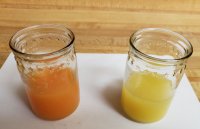
Sadly, a series of devastating freezes in the mid-1980's drove the citrus industry out of Central Florida, as the owners of our local orchards were faced with the expense of replanting their entire crops—or selling out to developers who were eager to obtain the land on which their dead trees were sitting.
One of our first projects at our new house was to plant a Marsh white grapefruit tree. We nursed it through the freezing time, and for years it provided some of the best grapefruit I've ever eaten. After our local source of Page oranges disappeared, we doubled our "citrus grove" by adding a Page orange tree, and we enjoyed its fruit for many years.
The unusually cold weather of the 1980's moderated, sparing our trees, but the troubles of Florida's citrus industry were far from over. Production peaked in the 90's but the turn of the century brought one deadly attack after another: the Mediterranean fruit fly (Medfly), citrus canker, and several hurricanes that destroyed trees and spread disease and pests all over the state. The pressures of growth and development swallowed many struggling groves. And then in 2005 came citrus greening, a vicious bacterial infection spread by the invasive Asian citrus psyllid, which came to us from China through Mexico. That absolutely devastated Florida's groves, taking our own two trees with them.
The bridges don't fall down immediately. — Bret Weinstein
It's been 20 years since citrus greening came to our state, and the full effects accumulated slowly. Other than the deaths of our own trees, I didn't realize the extent of the damage until about a year ago when I picked up a carton of orange juice from the grocery store. Our favorite brand had long been Florida's Natural, which was reliably not from concentrate, guaranteed squeezed from Florida oranges. But that day I stood there in the middle of Publix, staring at a container of orange liquid that was neither natural nor from Florida: it was made from concentrate, and from Brazilian oranges. Keeping the Florida's Natural name took a lot of chutzpah.
For more of the story, including some out-of-the-box efforts being made to keep the industry alive while searching for a permanent solution, you can read the informative article from which I have pulled a few quotes (emphasis mine).
Florida harvested a record 244 million boxes of oranges during the 1997–1998 season. This year, the Department of Agriculture estimates that Florida will produce only 12.2 million boxes, a stunning 95 percent drop in a little less than 30 years.
Occasional freezes, catastrophic hurricanes, and an on-and-off, decades-long battle with the citrus canker disease proved to be frustrating setbacks for many orange growers, but the destruction of Florida’s citrus industry kicked into high gear in 2005.
The Asian citrus psyllid feeds on citrus tree leaves, causing the plant to contract a bacterial infection known as huanglongbing, commonly called citrus greening. The disease causes rapid root loss, slowly draining the life from healthy trees as they try to absorb and retain nutrients. There is no known cure.
Citrus greening has slashed total U.S. orange production by 80 percent and grapefruit production by 88 percent since 2000, according to a report from the American Farm Bureau Federation. California has now overtaken Florida to become the United States’ largest citrus producer, and nations such as Egypt and South Africa now export more oranges worldwide.
But Florida citrus farmers are not giving up.
Permalink | Read 361 times | Comments (0)
Category Hurricanes and Such: [first] [previous] [newest] Health: [first] [previous] [next] [newest] Everyday Life: [first] [previous] [next] [newest] Food: [first] [previous] [next] [newest]

I'm not unsympathetic to those who are genuinely suffering in the heat. I spent the first 30+ years of my life in the Northeast, where air conditioning was almost unheard of, even in critical care hospitals. The laboratory where I worked in the 1970's only had air conditioning in the computer rooms, and that only because—like art—the machines would not work under conditions that people were expected to endure with patience. Even in Florida, my grandparents' house, like most buildings before the late 20th century, had no air conditioning. (It was, however, intelligently built: two blocks from the ocean, and constructed for maximum cross-ventilation, to take advantage of every breeze.) I know unrelenting heat.
So how did we manage?
- Buildings, like my grandparents' house, were built to take the heat into account, with cross-ventilating windows, breezy porches, and shady trees arching over the roofs. Central Florida as it is built now could not exist without the HVAC industry.
- House windows were habitually opened as soon as the outside air cooled off at night, which it did most weeks of the year in the Northeast, and closed when the day began to heat up. This practice has a power that I didn't fully appreciate until we moved to Florida, where the nighttime cooling is ofttimes non-existent.
- Swimming: in ponds, lakes, pools, and/or the ocean. Plastic kiddie pools and running through the sprinkler helped a lot, too. When we first moved to Florida, we kept the A/C set in the 80's, and spent a lot of time in the pool. That kept us cool, but took a terrible toll on our energy. Once we gave in and brought the inside temperature down to the high 70's, we used the pool less—but got a lot more accomplished.
- Another advantage the more northern climes have is that the really unbearable temperatures are only for a short time. When we lived in Rochester, there were usually only two or three weeks in the summer when I was reduced to nursing my baby while immersed in a cool-water bath, and planning excursions based on whether or not the destination was air conditioned. In Florida, sans A/C, that would be the majority of the year.
- A few very lucky people had jobs in air conditioned buildings. As for the rest of us: we suffered; we endured; we dialed down our activities to keep our bodies cooler and our minds saner. And we looked forward to the first hints of autumn.
But that was then, and this is now, and now what makes it possible to have a comfortable, productive society is air conditioning. It's no secret that the closest thing the American South has to a secular saint is Willis Carrier. Air conditioning is as critical in the Sun Belt as heating is in the Snow Belt. Having heard people seriously suggest that the cause of France's heat wave is American air conditioning, I can only say, "Come back and talk to me about giving up my A/C after you've lived a winter in your country without heating." Better yet, discover air conditioning for yourself. Even if you only need it for a few weeks out of the year, you'll feel better, and can be pleased with how low your A/C bills are compared with ours, just as we Southerners feel better about our heating bills in winter when we look at yours.
You might also consider investing in public places of respite, as I've seen in various cities here, where people can come in to get warm, or to get cool, depending on the season. As I said in my last post, one can stand a much greater intensity and duration of heat or cold if one can occasionally retreat to a more comfortable situation.
And gelaterias. We all need more gelaterias.
Permalink | Read 421 times | Comments (2)
Category Health: [first] [previous] [next] [newest] Politics: [first] [previous] [next] [newest] Everyday Life: [first] [previous] [next] [newest] Conservationist Living: [first] [previous] [next] [newest]
Now that we're back from three weeks in the Mediterranean region, people are wondering how we survived Europe's heat wave. The answer is simple: the same way we survive Florida's summers. Nowhere that we went did the temperatures exceed Florida's numbers: high 80's to low 90's were the worst we experienced. That's actual temperature. Having lived more than seven decades with that as my measure of ambient temperature, my brain rebels against the modern "feels like" idea, which always makes me feel more miserable than I am. For what it's worth, the UV Index at its highest in a day was generally 8—like a normal Connecticut summer. In Florida at this time of year that number is routinely 12. I was barely aware of the UV Index until I acquired the dminder app for my phone to help me keep track of the vitamin D my body is making. If I'm wearing shorts and a t-shirt, a 15-minute walk in the midday sun at UVI 12 easily gets me 1500 IUs (and a warning that it's time to go inside). On the UV Index scale, 1-2 is considered Low, 3-5 Moderate, 6-7 High, 8-10 Very High, and 11+ Extreme.
Our first four days were in Florence, and were undeniably hot, because we wanted to make the most of our short time there. Our hotel was convenient to everything we wanted to see, so we walked everywhere and were on the go most of the time the sun was up. (Sane Floridians avoid the midday hours outside if possible. "Mad dogs and Englishmen," you know.) The Mediterranean sun was intense, the humidity was high, the cobbled sidewalks a challenge to walk on, and Florence's many staircases a trial for legs accustomed to flat surfaces. What made this only a minor inconvenience?
- This was early in our trip, when we were fresh and eager.
- Hats and sunglasses. Generally I hate wearing a hat, but keeping the sun off my face was a necessity.
- A Floridian's practiced eye for finding shade. Walk on the shady side of the street. Rest in a shady spot. It makes a significant difference, even when the humidity is high.
- Air-conditioned respites. This is huge. As with cold in the winter, one can stand a much greater intensity and duration of heat if one can occasionally retreat to a more comfortable situation. In our case, we spent much of our time walking from one museum to another, and generally recognize that great art survives better in a hospitable climate. So do people, but art refuses to be bullied. The museums were comfortably air conditioned—not the frigid situation one finds in Florida restaurants, for example, which is why I keep a sweatshirt in the car at all times and occasionally pull it out even during the hottest summer days.
- We didn't hesitate to adjust our schedule to accommodate our physical needs.
- Frequent gelato stops. Never underestimate the importance of this Italian staple.
For the remainder of our trip, we were on a Princess cruise, visiting Italy, Greece, Turkey, and Montenegro. The ship itself was over-airconditioned, but an occasional trip to the blistering sun of the top decks took care of that nicely. And the otherwise-excessive A/C was admittedly glorious upon returning from a long, midday excursion of hiking, under a cloudless sky, through ancient ruins.
Overall, to those who asked us how we managed in Europe's "terrible heat wave," my first thought was always, "What heat wave?"
But I do understand unrelenting heat, as I'll explain in my next post.
It was a small gesture, but it felt so good.
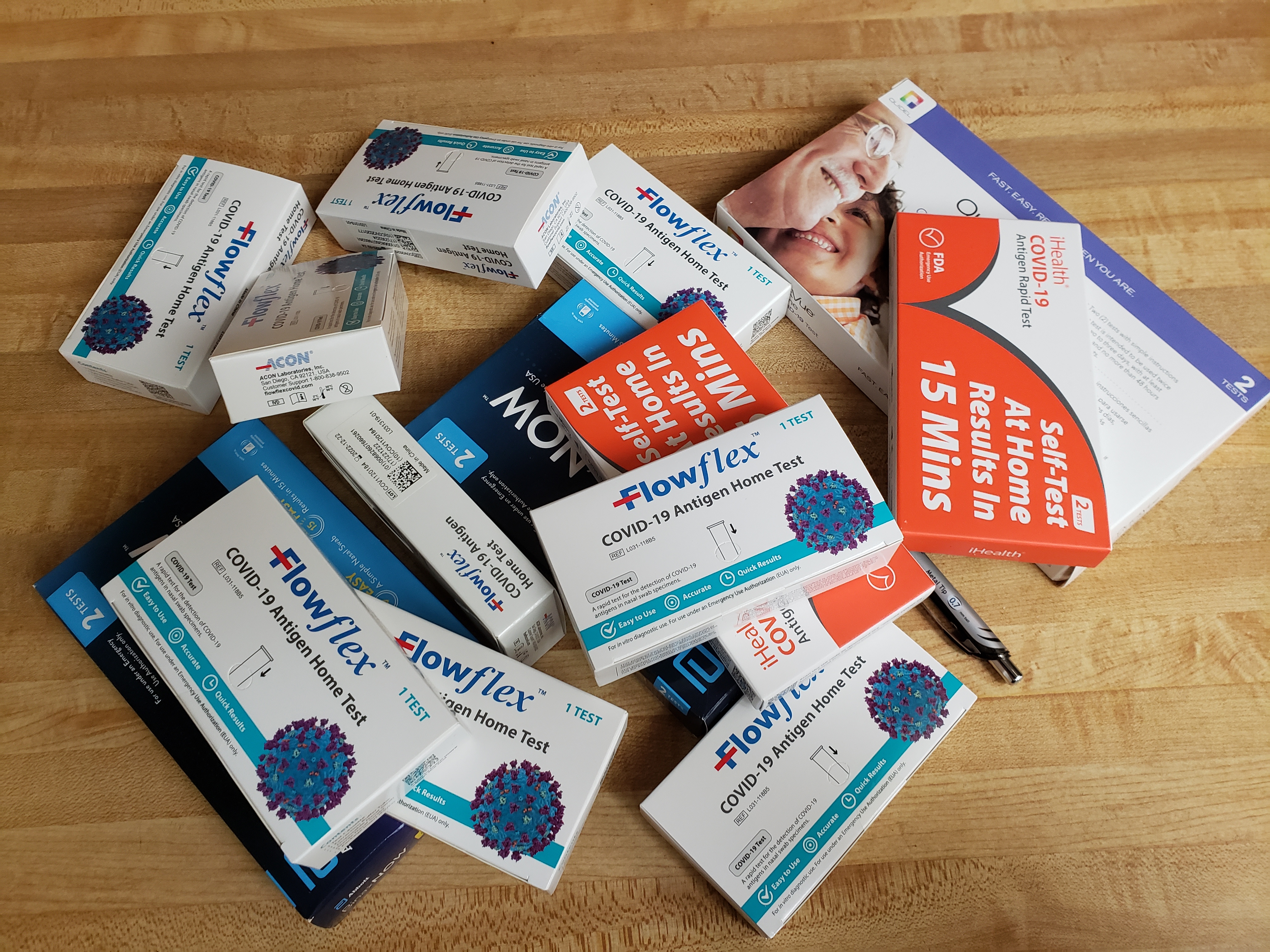
The government gave us these for free, and they've been stashed in our closet ever since. The last time I used one was ages ago, in order to be able to assure members of our choir that my symptoms were seasonal allergies, not covid. They are now three years past their putative expiration dates, and I needed the space in the closet—and in my mind.
Tossing these boxes into the trash did nothing to undo the harm that was done during the covid era, nor to erase the shame I carry for my own behavior in that time of mass delusion and conformity.
But it still felt really good.
One characteristic I share with of both my parents is a deep-seated suspicion of psychology and psychiatry, especially in their popular manifestations. Granted, I've known people who have been helped by counsellors, but I've also known those who have been badly hurt by the process. History is littered with examples of "best medical practices" that were more likely to kill patients than to cure them, and practices that mess with people's minds are no exception.
I totallly agree with my father's reaction to a lecture he heard in 1993, while visiting Uruguay.
The lecturer started talking about an article from "Psychology Today" on "The Secrets of Happiness," and I began to have problems. The problems were mainly with semantics and my interpretation of the meaning of words and while this was not a subject for discussion, I spent a fair amount of time thinking about it.
The article listed four important traits of happy people:
1. Self Esteem: Happy people like themselves.
2. Optimism: Happy people are hope-filled.
3. Extroversion: Happy People are outgoing.
4. Personal Control: Happy People believe they choose their destinies.
Of course I got into trouble early by asking what is meant by self esteem. I think she figured it was obvious, but she gave a rather long explanation that I didn't understand either. I suppose the answer is: Of course I like myself—I'm the only self I have.
But what we did not discuss is my dislike of the word "happy." To my mind, "happy" is a rather shallow word that describes a short-term condition. You were happy about Heather's recital; Porter's birthday was a happy event. But over the long run, your life is not happy except at times. You are contented, your life has been very satisfying, but it has always had the ups and downs that make "happy" inappropriate. Anyway, I think there are better words, no matter what others think. Perhaps my problem is that I don't have all the important traits for being happy.
I have still more to say about that letter, and that lecture, but that will be for another time.
There's been a lot of talk about autism, and the autism spectrum, in recent years: what it is, what causes it, why the condition seems to have skyrocketed, what can or should be done to help those dealing with it. I'm not getting into the politics of it all; whether you blame heredity, vaccines, Tylenol, environmental pollution, ultraprocessed foods, random chance, or all of the above doesn't matter for this post. Personally, my own favored "cause" is the explanation I once heard of the high number of children considered "on the spectrum" in places like Silicon Valley and Seattle: Engineers are marrying engineers. I'm only half joking.
From my perspective, 1988 seems recent, but in the 38 years since then much has changed, including autism awareness. In that year, my father attended an Elderhostel program near Pikes Peak, Colorado. This comment from his journal of the occasion stood out:
Mrs. Drummond felt compelled to keep up a conversation as we traveled to her home. They have two children, a girl about 7 and a boy about 5 years old. The boy is Autistic and is in the public school for the first time this year. The disease is rare enough, at least in that area, that she has had to spend a good deal of time instructing the teacher on how to handle the problem.
Today, no one would call autism a disease, nor would they consider it rare. On the other hand, I'm certain there are many parents of autistic children who would say that they are still having to spend a good deal of time educating teachers (also family, friends, and random strangers).
As I've mentioned before, I've been enjoying going through (and digitizing, where possible) my father's old journals and letters. I particularly like coming upon examples of his sense of humor, which often relied on either exaggeration or understatement, or both. The following, from a mid-1988 letter, made me smile this morning.
Last Monday while I was carrying an ancient and defunct television set out to the trash, my back gave way. It was not a heavy load--certainly not more than 20 pounds--but even though I had no trouble getting it up the basement stairs and through the house, the problem came without warning as I was descending the front porch steps.
Over the next several days, interspersed with other news, Dad reported feeling fine enough to spade the garden, then feeling considerably worse, finally consulting a doctor and getting x-rays which revealed a compression fracture. He next visited an orthopedic specialist, who was not concerned about the x-ray results, since they showed only something minor that might have happened many years ago. Based on Dad's description, the doctor concluded that the problem was muscular, and prescribed "time and a heating pad." When Dad then asked what kind of activities he could could indulge in, the doctor replied, "Anything you want." For anyone reading this who knew my father, the alarm bells are now going off....
Dad did limit his activities to the extent that he did not go bungee jumping, nor bowling, the latter having landed him back in the hospital on a previous occasion when his surgeon had told him that he could "do anything you feel like doing." He did decide that that heavy gardening was still on the table, and paid for that the next day, but the orthopedic doctor was apparently right, and the references in his letters to his back petered out. In the end, he was left with the following conclusion:
I guess this confirms my feeling that television is bad for you. But on the other hand, if you have one, keep it.
There are Lies, Damned Lies, and Statistics.
Here's a very interesting, 14-minute video that sheds light on one reason Americans are so unhealthy: It's not that they've gotten sicker; it's that we're discovering things wrong with them that would never have hurt them in the past. Perhaps Americans in general really are less healthy than we once were, but the misuse of medical statistics is no way to prove that, nor to treat it.
It's worth your 14 minutes, despite a few bizarre misreadings of the script, and one word that somehow slipped through the profanity filter.
Pay special attention to the problem of overaggressive treatment that is encouraged by early detection of problems that would have been better left alone. I speak here from personal experience: My mother-in-law was saved from the trauma, expense, and harmful side effects of aggressive treatment of a cancerous mass only because she had something more urgently wrong that needed to be dealt with first. By the time she was ready for the cancer treatment, the mass had disappeared completely on its own.
What do you picture when you hear autism called a "spectrum"?
I think of a linear scale, the kind you see in so many surveys, such as this:
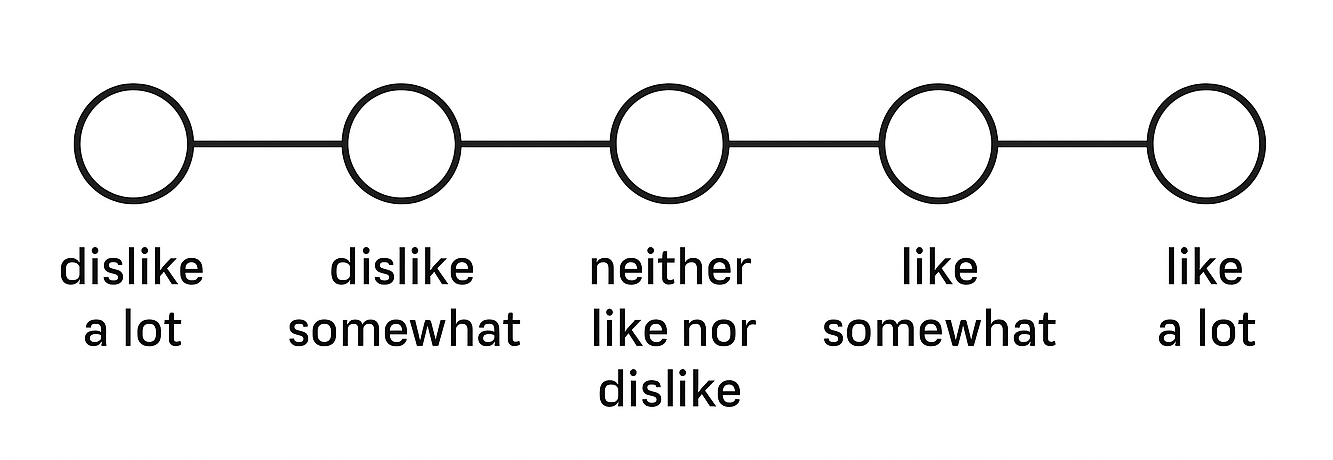
That's the image that comes to my mind, but I don't believe it's accurate.
Recently, I saw a short video of a man who dusted a thin metal plate with sand, and then drew a violin bow along one side, the vibrations creating a pattern with the sand. By placing his fingers on different combinations of points on the edge, he could create beautiful, complex patterns. These are called Chladni figures, and you can find out more in this demonstration, which is under 10 minutes long.
This strikes me as a much more reasonable way of describing the set of people that we have decided to label "autistic."
What of other people? What of other dimensions?
Maybe the true value of diversity lies not in magnifying our differences but in celebrating our beautiful patterns?
"Let the Worms Decide" is an Epoch Times article that caught my eye first because of the author, Joel Salatin, and secondly because I knew what kind of worms he was talking about. We've been vermicomposting since 2009, and I know a little bit about what our worms will and will not eat.
Salatin begins with a story from a middle school program he visited in California, where students worked on a small farm half a day each week.
They had a worm box about 8 feet by 3 feet by 3 feet. Imagine an oversized coffin. If you want to see children get excited, show them a worm box. It’s mesmerizing with all the slithering, slimy worm activity....
One week, the farmers assigned homework: “Bring food on Monday.” The students dutifully brought some food: Twizzlers, Gummy Bears, Froot Loops—you get the idea. They placed their “food” in one end of the worm box. The farm ladies put different items in the other end: an apple, a pork chop, and a glob of yogurt, among other things. The following week, the students, eager to see what had transpired, ran to the box and opened it.
They pulled out their Gummy Bears, Twizzlers, and Froot Loops—untouched. When they tried to find the food items that the farmers had placed at the other end, all that food was gone. The day’s lesson was obvious: “Why would you want to eat something worms won’t even eat?” I'll bet a lot of young people made some different eating decisions that day.
Tongue not totally in cheek, Salatin proposes turning our expensive—and too-easily corrupted—food safety testing over to composting worms.
I’ve known and worked with many worm farmers over the years who explain how sensitive their “livestock” is to unacceptable items placed in their boxes. If they like the substance, they devour it readily. If they don’t, they move away and give it a wide berth.
If worms are that decisive and timely to determine healthy versus unhealthy things in their environment, why not ask them to share their preferences with all of us?
Worms don’t vote, don’t listen to lobbyists, don’t invest in Wall Street, or watch ads. They are about as objective a researcher as you could ever want. Goodness, they aren’t even swayed by money.
Here’s my idea: why not get a small plot of land—perhaps 5 acres—and set up 100 worm boxes? Everything Americans apply to the soil or put in our mouths would undergo the worm test for a week. What the worms ate would get a green light. What the worms didn’t eat would get a red light.
We could hire a couple of college students to run the program. If glyphosate is really innocuous, let’s see if the worms like it. If Coca-Cola is really nutritious, let’s see if the worms like it. Pour it in and see if they want to come to that area, or if they avoid it like the plague. If Red Dye 29 is a wonderful food additive, or monosodium glutamate (MSG), put them in the worm bed and let the worms vote.
Based on my experience, I see a few problems with this scenario, as I'm sure Salatin himself does. Worms will eat (and detoxify) some really nasty things, given enough time for their cohabiting microorganisms to break them down. The farmers who sold us our system have huge vermiculture setups in which they say the worms will devour battery acid in small quantities. Just because you can convince a worm to eat something, that doesn't mean I want it in my food. But the one-week test would probably take care of that problem. Maybe the worms will eventually eat something, if they get hungry enough, but they definitely have their favorites and, like a small child at the dinner table, will go for the good stuff first.
That same small child may reject his beets despite their certified goodness, and my worms will reject things I find great. Like homegrown, organic lemon balm. Or citrus peels. (Granted, I never tried them on the chocolate-covered variety.) Some worms don't like broccoli; fortunately, ours eat it right up. So it's not a foolproof system.
That said, Salatin makes an important point: If something we're doing causes natural systems to thrive, that could be a clue that we may be going in the right direction. On the other hand, a failing system is a red warning light that should give us pause.
Stay tuned for the results of my own experiment. We have leftover Hallowe'en candy, including the above-mentioned Twizzlers. I plan to make an offering to the worms and see what they have to say.
Permalink | Read 773 times | Comments (1)
Category Education: [first] [previous] [next] [newest] Health: [first] [previous] [next] [newest] Politics: [first] [previous] [next] [newest] Food: [first] [previous] [next] [newest] Conservationist Living: [first] [previous] [next] [newest]
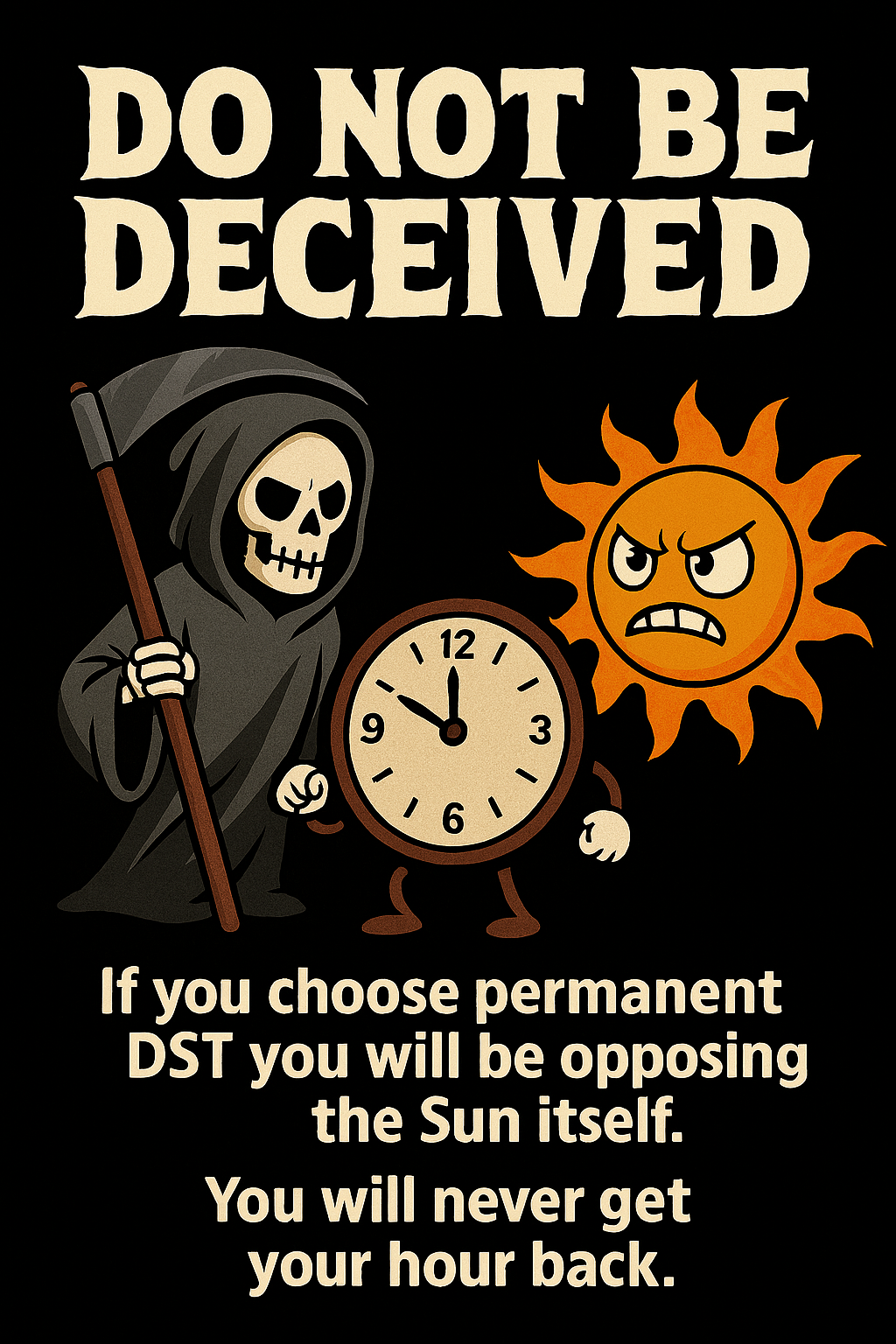
Ahhhhh. My mind and body are once again aligned with Nature.
Permalink | Read 465 times | Comments (0)
Category Health: [first] [previous] [next] [newest] Politics: [first] [previous] [next] [newest] Everyday Life: [first] [previous] [next] [newest] AI Adventures: [first] [previous] [next] [newest]

